 Away
Away Et maintenant, je suis tout seul en France.
I love how quiet Paris can be. The French don’t take it to quite the same extreme as the Germans but they both share a respect for personal aural space. To the traveling introvert, the quiet is inviting; it beckons one toward reflection, rumination, retrospection. And after one has spent a week banging around France with noisy college students (they’re so loud!), the quiet is almost stunning. It’s like asking for rain and getting dumped into the ocean—it’s too much, real fast.
Because the quiet reminds me that I am now completely alone in a foreign land. The students have gone, my wife has flown home, my bags are packed, my hotel key is due to be returned. I sit on the bed next to my giant suitcase and look at my shoes. They belong on my feet, doubtless, but if I put them on then I have to step out into this next phase of the journey, which is shrouded in unknowns. I’m in France, I’m alone, and I don’t even know when I’m going home again. Whatever this journey has in store for me, it’s clearer than ever that I face it alone. Those shoes belong on my feet, but lacing them up will start the plot; once shoes are on feet, there’s nothing to do but put feet in motion.
For the first time in 35 years, tying shoes takes some concentration. I’ve been sent to France to spend an uncertain amount of time at a foreign university to establish research relations and partnerships. No, I don’t know what that looks like, either. Neither do they. And while it will ultimately all be a tremendous success, this moment of lacing up sneakers is much more poignant than I was prepared for.
But what else is there to do but lace them up and step quietly out into the unknown?
It won’t be long before I’m glad I’ve done so, though. My mission for today is to reach and install myself in Tours, a Raleigh-sized city in central France that’s home to the University I’ll be working with. Not one to misarrange my priorities, however, I’ve scheduled a stop by a football stadium before I leave Paris.
Parc des Princes
Le Parc des Princes is the home of football powerhouse Paris Saint-Germain. They have outgrown this ground and are unequivocally leaving it, that’s official. Where they will go, when it will happen is not known. Turns out PSG has quite a lot of unknowns on their journey, too. But it is their home for today, and the fact that it is too intimate for the size of the club makes it all the more charming. The players that have graced this pitch loom larger than the game itself, and even American sports atheists will know many of the names that have appeared on the back of a PSG kit. Even when empty of player or spectator on a chilly Saturday morning, the collective memory and energy of le Parc resonates.
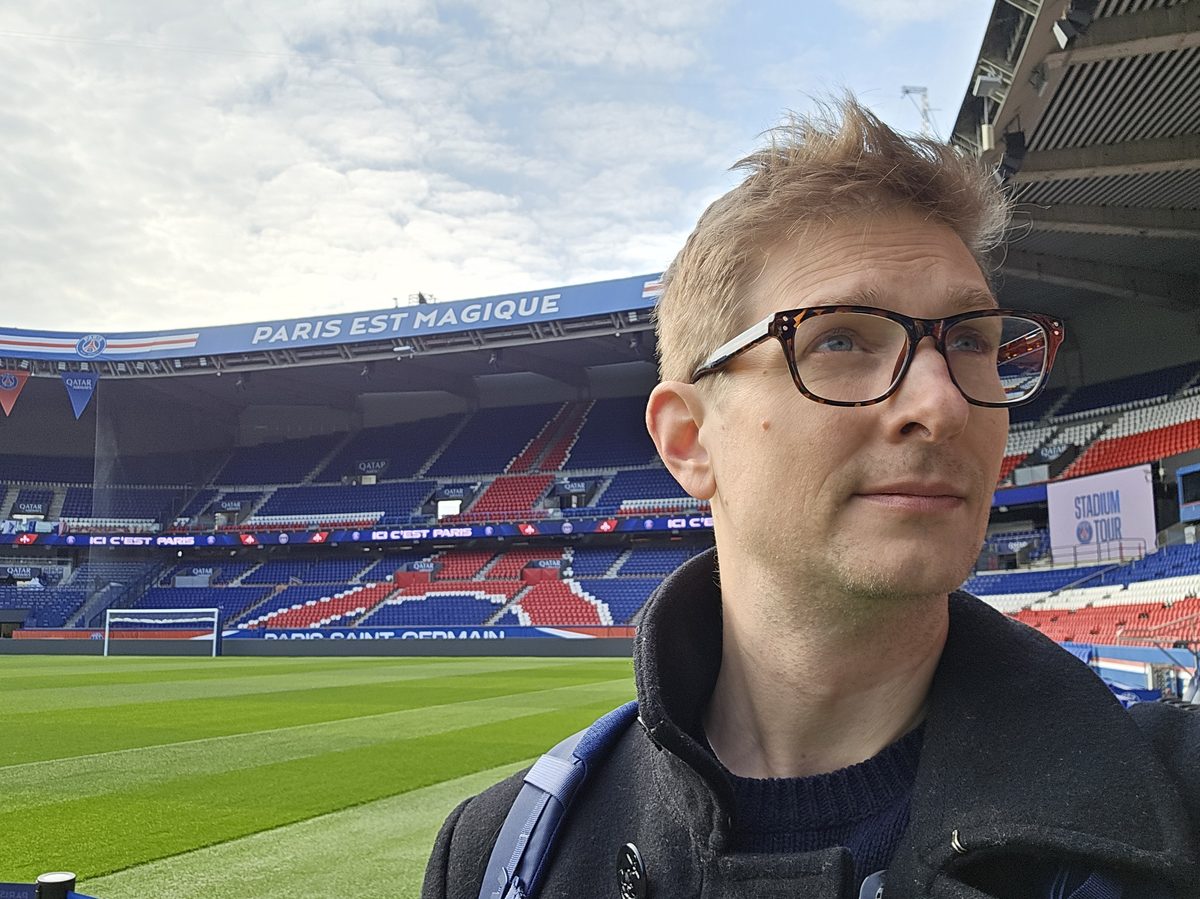
Parc des Princes. Paris est magique.
Equally intimate are football dressing rooms. Unlike American sports locker rooms, small dressing rooms are preferred in football. Teams are limited to 25 players and the ability for that small group to be able to speak together, in one room—to look around the space and see each other clearly—is valued over the lush comfort one tends to find under the stands of American stadiums. About 25 people are in the dressing room today; tourists, like myself, touching things, taking pictures, speaking foreign languages, trying to act like grown-ups and not children, but to be in this space triggers a childlike giddiness and it’s not far under the surface.
I sit in Nuno Mendes’s spot, the remarkable Portuguese left back, and place my backpack strategically in front of my legs. A couple staff members monitor the space to make sure no one tries to steal a jersey or put a tack in the coach’s chair. In a turn of play, I sit and watch them for a minute, and when I see that they are both distracted, I reach down and take off one of my shoes. Then I put it back on and lace it up again. The whole affair is quick and happens behind my strategically-placed backpack, but I have removed and restored an item of clothing, no argument can be made otherwise. That’s a wardrobe change, y’all, and now the list of names that have dressed in this room has grown by one.

The scene of the crime.
People who have dressed in this room:
- Kylian Mbappé
- David Beckham
- Zlatan Ibrahimović
- Neymar
- Lionel Messi
- Erik C. Taylor
L’Appartement
Why do European hosts insist on meeting you? Why can’t they just blindly give strangers the passcode to their homes or leave the key under a mat like we do back home? But no, she wants me to call her when I reach the train station, she’ll meet me at the address. All communication so far through email and chat, but when I step off the train platform and call her number, it takes about no seconds for each of us to realize that we both suck at speaking the other person’s language. She texts me the address. I walk a half mile in the cold Saturday rain down slick cobblestone walkways and when I reach the building, a sympathetic soul lets me in to the lobby. I linger, thinking that a woman will surely burst forth with a set of keys at any moment. Any moment now. Annnnnny moment.
I call again. “I am here,” I say. Where are you, she says. I recalibrate: “I am arrived.” Non. I am ’ere. You are not ’ere. This is going great.
Eventually it comes together. She was waiting outside, smoking, I was waiting inside, worrying. It is an awkward start, and it doesn’t get less awkward as she shows me around l’appartement. Like le Parc des Princes, this feels more intimate than it needs to be. Would I have found the bedroom on my own, the bathroom? We’ll never know; she shows me all of it, just to be sure. Eventually we would strike up something of a friendly acquaintance, we even shared a brief, friendly communication after I left because she lost a key and was checking to make sure it wasn’t with me. It’s a nice little character arc, but today it’s the awkwardness. Her English is as bad as my French. We’re both good enough to ask the standard questions in the other’s language, and bad enough to not understand the answers.
I would come to love l’appartement. It’s too big for one person and the landlord automatically assumes that (a) I have a wife and (b) she will be joining me, despite me trying to explain otherwise. It covers the top two floors of a building on the main drag of the city. It’s a recently updated apartment in a very old building; fancy new European appliances, same old drafty windows.
They are drafty, but I love the windows. I would end up spending every morning perched at my favorite window watching life move up and down the cardo maximus and drinking too much espresso. For its clinical foundations, the routines that unfold every day carry a particularly romantic charm here. Every morning, the florist across the street unfurls the awnings, wheels out the tables, and lines the sidewalk with fresh flowers. A woman with a handsome German shepherd lives across the street; every morning I watch their routine, the shepherd’s tail wagging, nose exploring, leash tugging, woman being pulled sleepily along. The pairing of the dog’s excitement and the woman’s evident slowness is displayed every morning, and when they return thirty minutes later they have always averaged each other out.
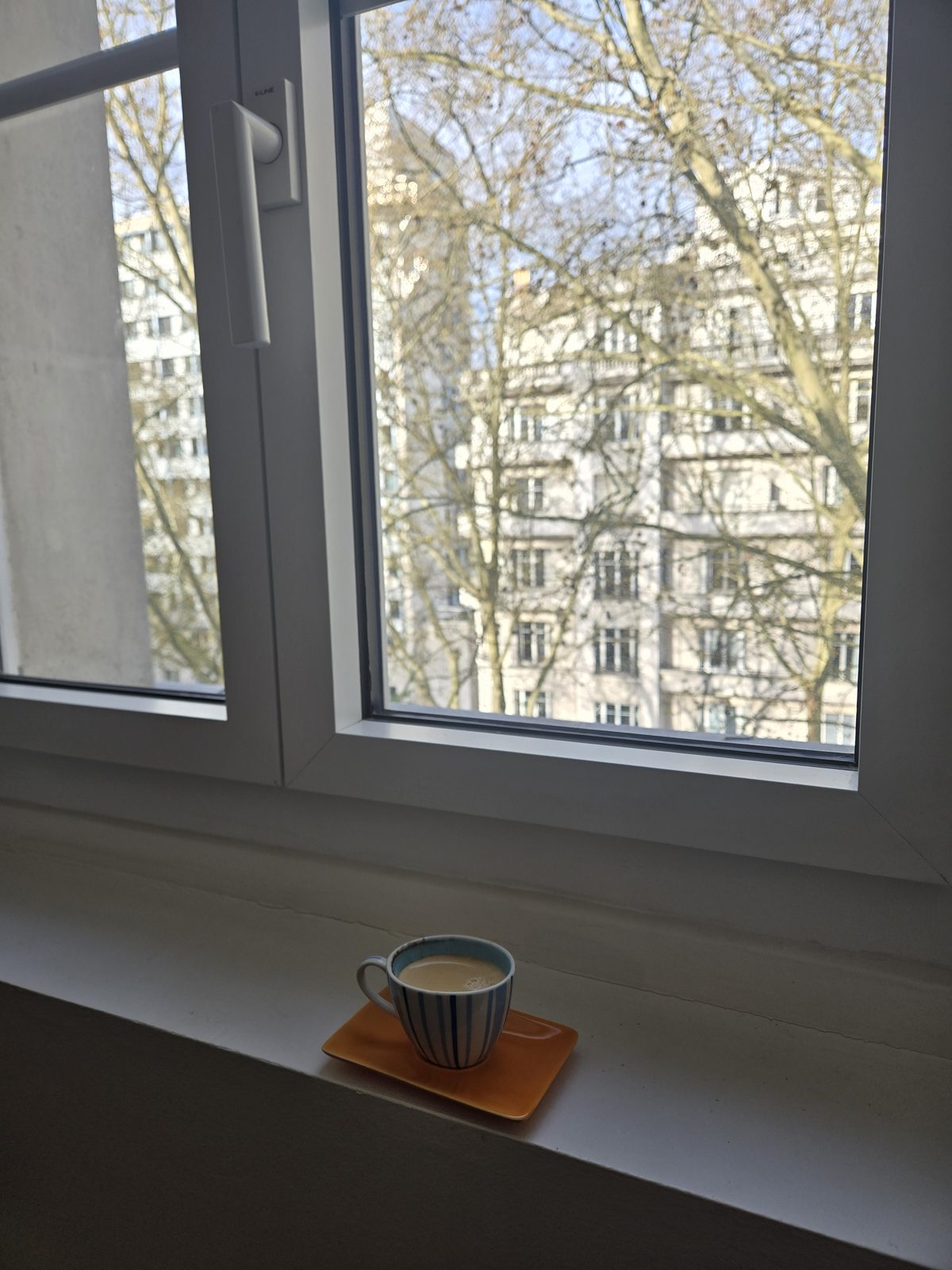
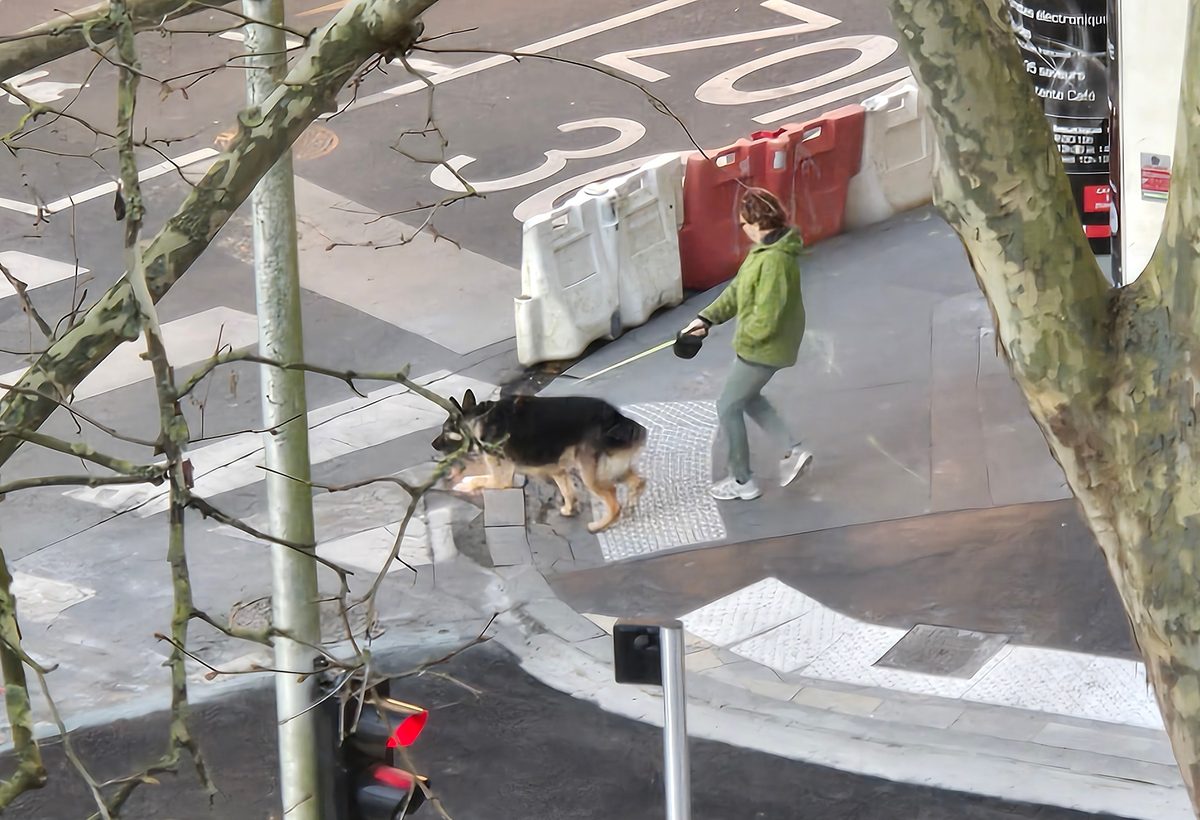
Left: The morning perch—espresso, window, and the cardo maximus. Right: An eager shepherd walks a sleepy owner.
There’s a hotel above the florist, so I see new people, new routines every week. There’s another window percher at the hotel for a while and I assume we play the same game of pretending we’re not observing each other. It’s a tasty tableau, and every morning I’m content to warm myself with espresso and watch the scenes unfold. In a season of uncertainty, the window + espresso routine is grounding, it feels safe and familiar. I send a picture of the view to my wife every morning, life slowly unfolding under a series of gray skies.
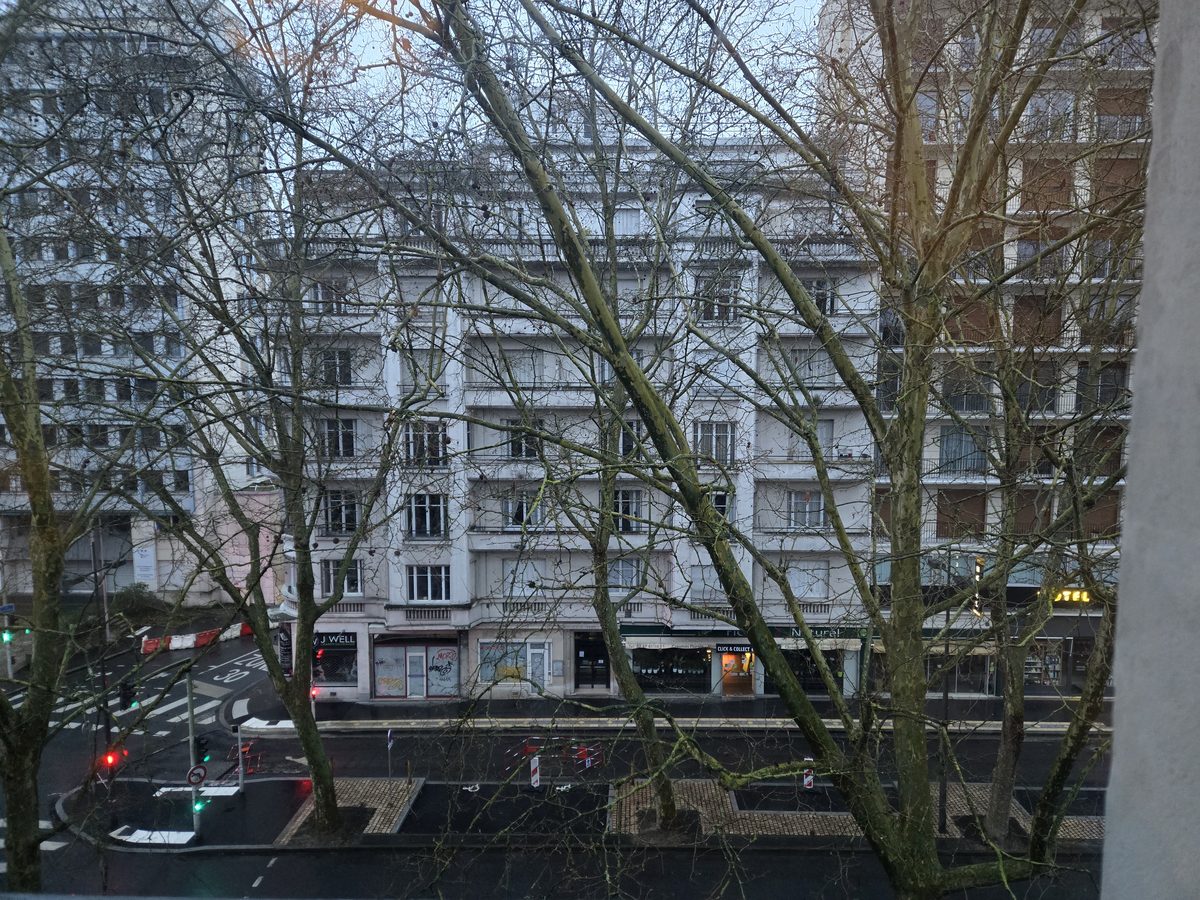
The view from the apartment window on a regular, gray morning in Tours.
Été / Hiver
I like both the big and small differences of travel. I’ve traveled with students enough to know that a lot of people never get past the big differences, but those really aren’t the interesting ones. The little things are the juicy things. Sometimes a foreign land is strikingly familiar—the French are equally as bad as Americans at taking up the whole sidewalk or blocking the grocery aisle. Other things are oddly contrasting: on the ground floor of my apartment building is a Maison Thiriet, an all-frozen grocery store. A whole store of freezers. I do a shopping run through Thiriet and bring home some genuinely gourmet frozen fare; it’s interesting to note how precise the preparation directions are. They are as tricky as my oven itself—ChatGPT has to coach me through using both oven and range, the digital control panel baffles me—but the end product proves the effort worthy.
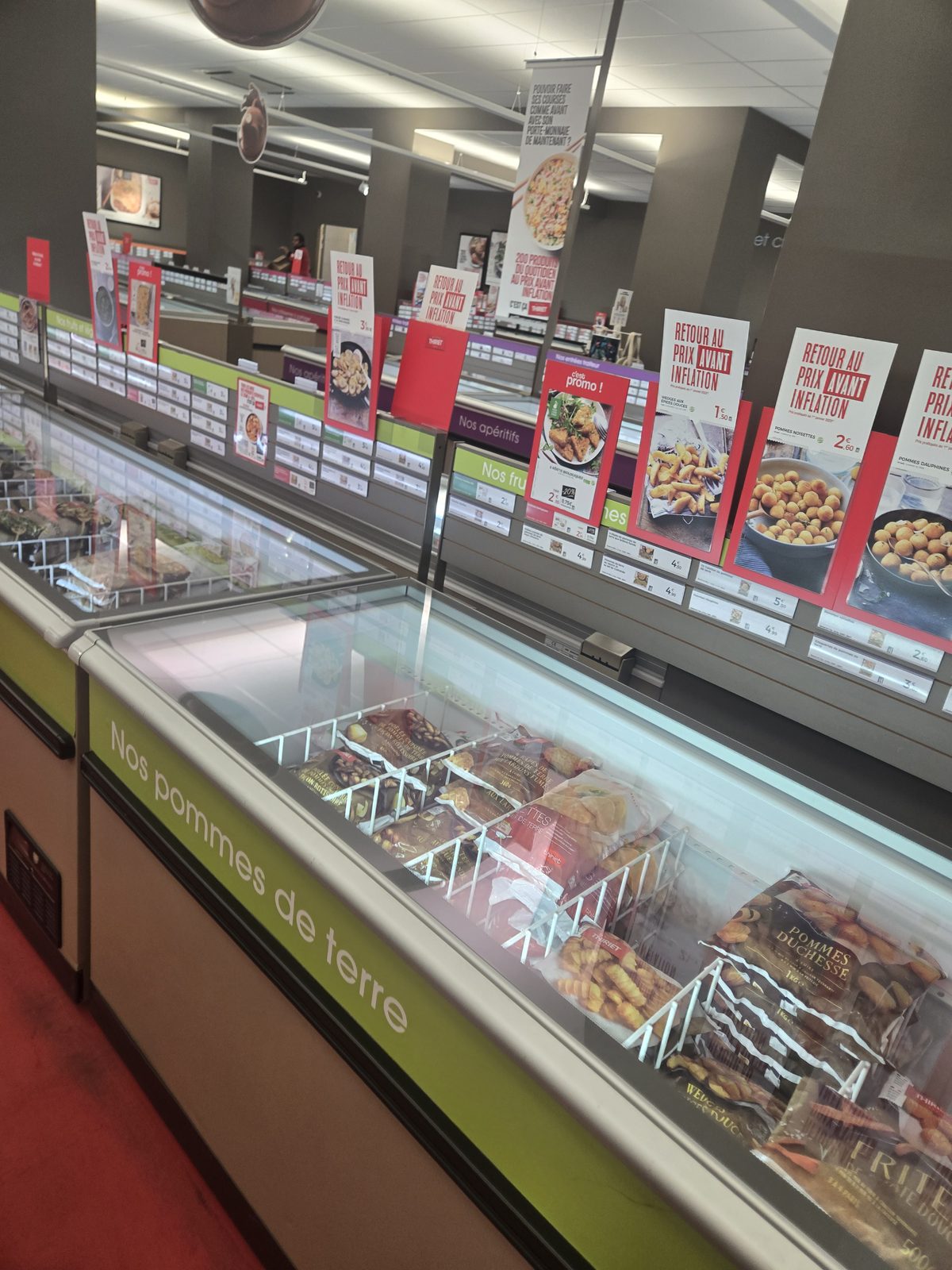
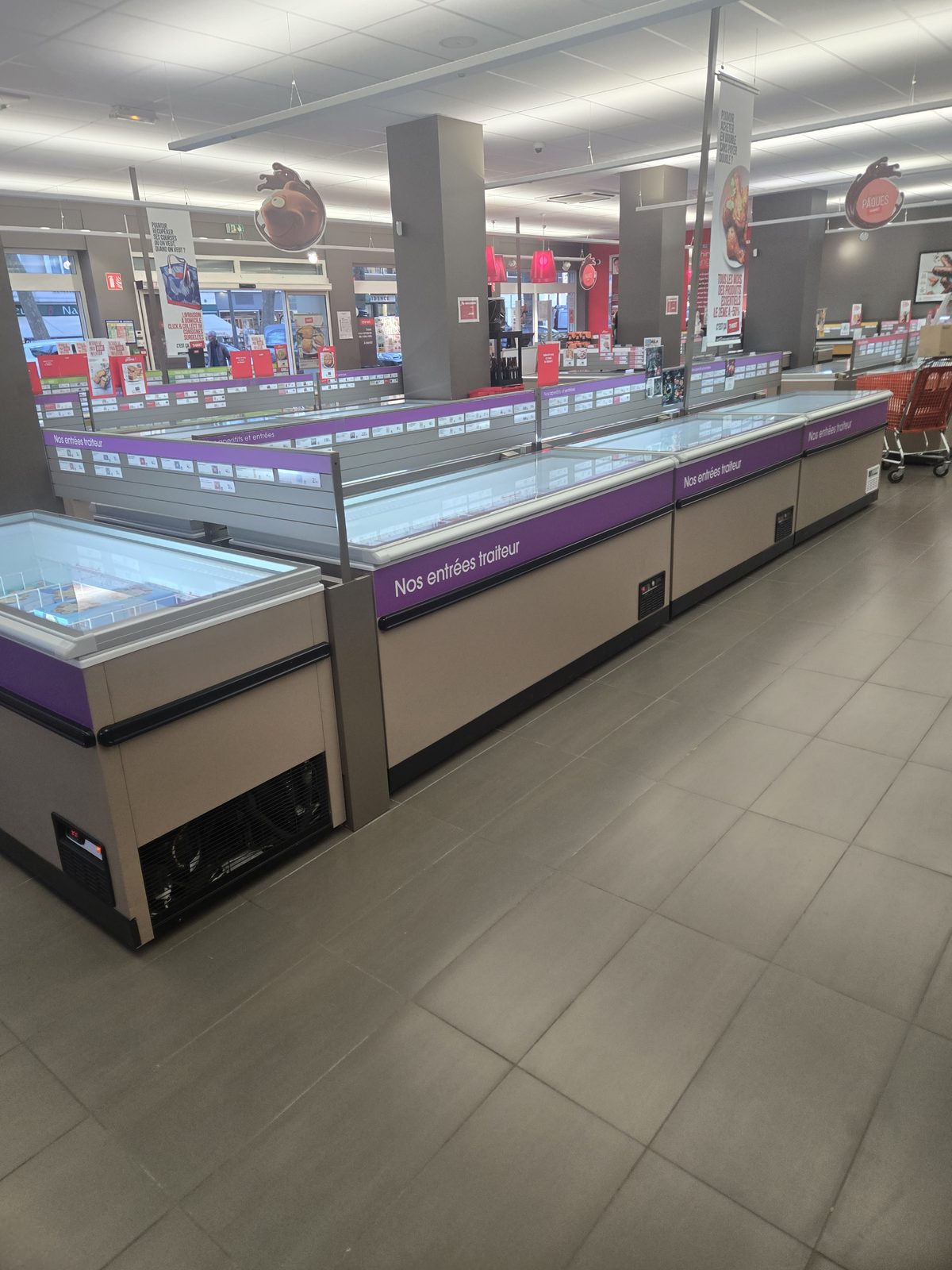
An entire grocery store of freezers. France is full of surprises.
And there’s a switch in l’appartement that I definitely don’t have at home.
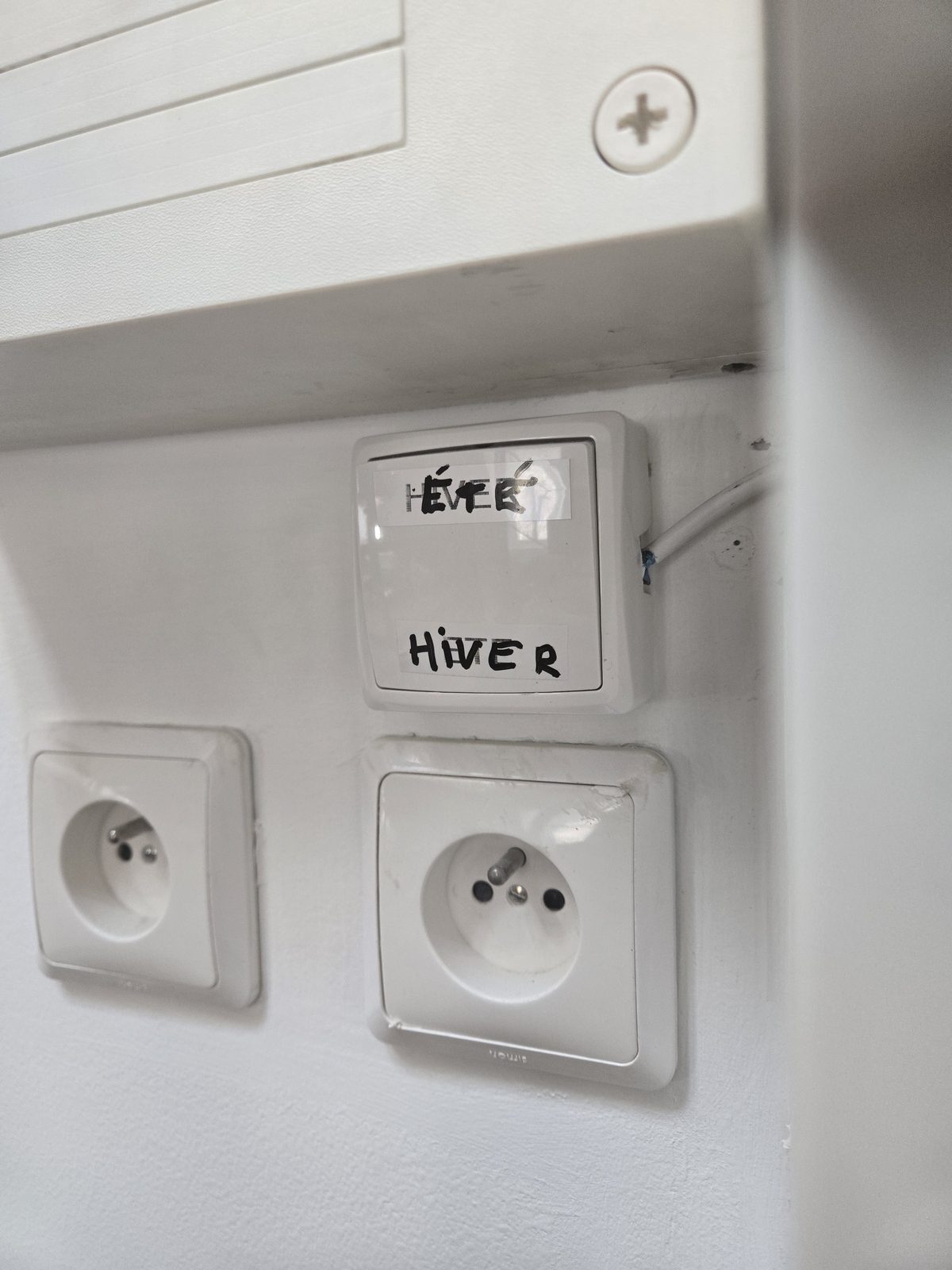
The été/hiver switch. Season control at the flick of a finger.
Été/Hiver. Summer/Winter. It’s March and that’s when Spring begins in North Carolina, but here in Tours, winter is still ascendant. In this drafty apartment amidst a season of uncertainty, this American southerner struggles with the lingering winter. What the hell does this button do if not change the season that’s unfolding out my window? There’s no air conditioning so it wouldn’t change the HVAC system. And it’s been relabeled—what was once été is hiver now, and hiver has been switched to été. Is this why it’s so cold and gray here? Is it my responsibility to change the seasons? The temptation is strong but the responsibility is too great; I never push the button. Eventually the struggle between hiver and été resolves into a slowly-developing Spring, and for the first time in my life Spring is actually a season rather than an awkward rest stop between chilly and hot.
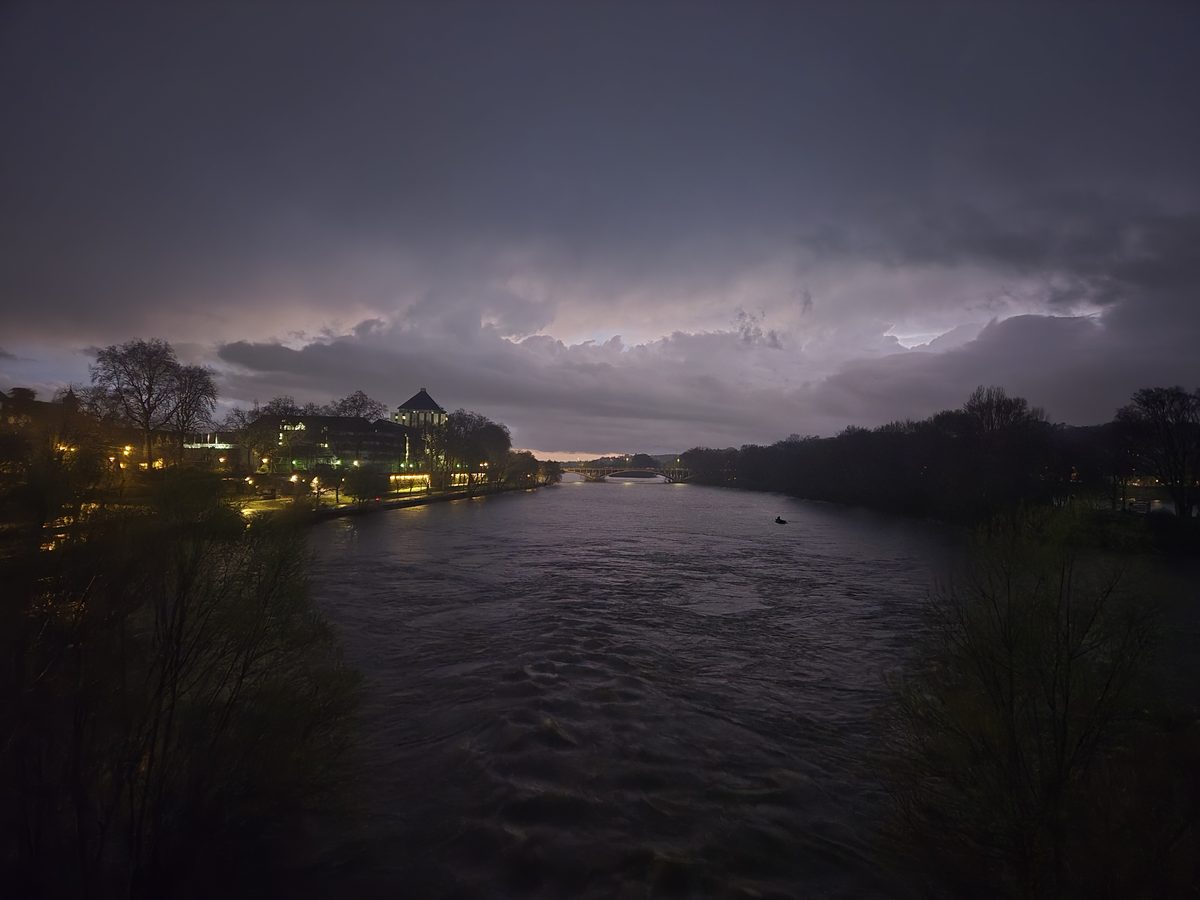
The Loire at dusk. Even the river takes its time here.
A 1,000-Year-Old Hole in a 2,000-Year-Old Wall
I enjoy the subtle differences between places and cultures, but sometimes the big differences are irresistible. I say Tours was founded in the year 10 “to the people of my culture” because mine is a direct descendant of that Roman culture. Romans gave us the 7-day planetary cycle (aka, the week) and the 12-month calendar (the month of my birth and this old Roman city share a namesake). We write our laws in Latin and build government buildings in the Roman style. The mere notion of citizenship is itself a Roman invention—a way of deciding who has what rights on what side of a line on a map.
But there was a culture here before the Romans, and the fingerprints of that culture have not worn away. Had there not been a prior culture, there would have been nothing for Rome to “civilize” here. To Romanize here. That the Romans were here is a direct reflection of that prior culture.
I’ll never know enough about the Gauls because too much is lost to history. When the sun set on Rome, the remaining elements of Gallic culture were again absorbed, this time into the culture of the Germanic tribe that dominated, politically. But Gallic culture is the substrate from which the rest of it catalyzed, and finding that base layer is, I adjudge, a worthy pursuit.
In Tours, in the heart of the city in a totally ordinary park in a totally ordinary neighborhood, a section of the original protective city wall remains. There’s a bus stop a half-kilometer away and nearby is a sign that directs the traveler to Enceinte gallo-romaine, but that’s it for advertising. Many of my colleagues in Tours learn of its existence from me and are surprised to learn it exists. Even the park in which it resides is named for yet another conquering group, Jardin des Vikings.
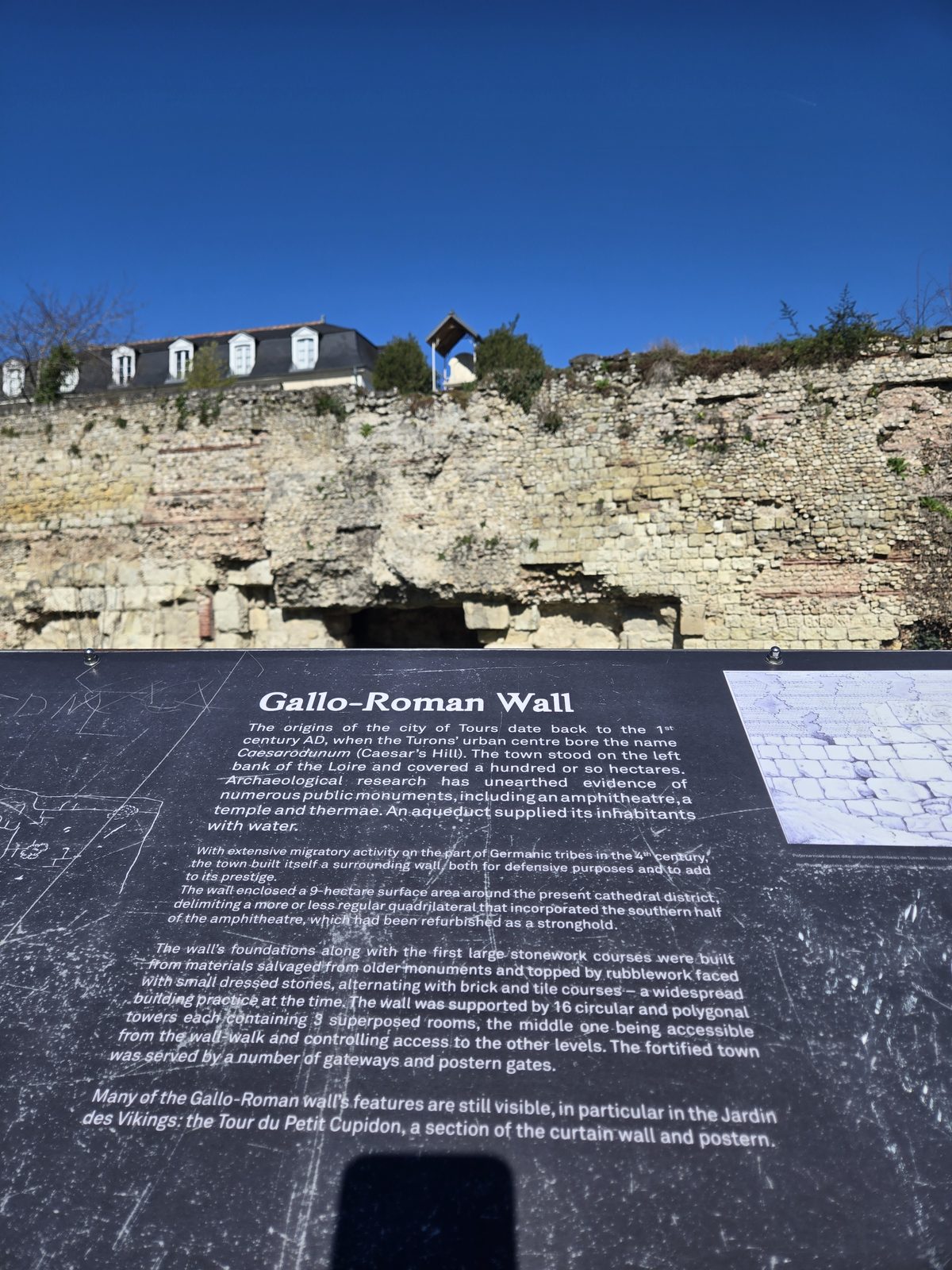
The Gallo-Roman wall. Built by Gauls, reinforced by Romans. Still here.
It’s spectacular. I visit frequently. Its most significant construction occurred in the early 300s but it’s eclectic; dating an ancient structure that is itself compiled of even older material is like asking where a circle starts.
Any historian will confirm that walls all share a singular fate: failure. Whether they are built to keep out or to keep in, they don’t. The mere presence of a wall almost signals this inherent failure because a wall can only arise out of fear. We tend to dress fear in layers of costume to mask that fear, but the fear of losing something is the only reason a wall ever grows. That we have uncertainty about our ability to hold on to something, whatever it may be, is why walls arise. And that which is rooted in fear is destined to fail in the end, always.
But like most things in life, a wall will enjoy successes and failures, even if failure wins in the end.
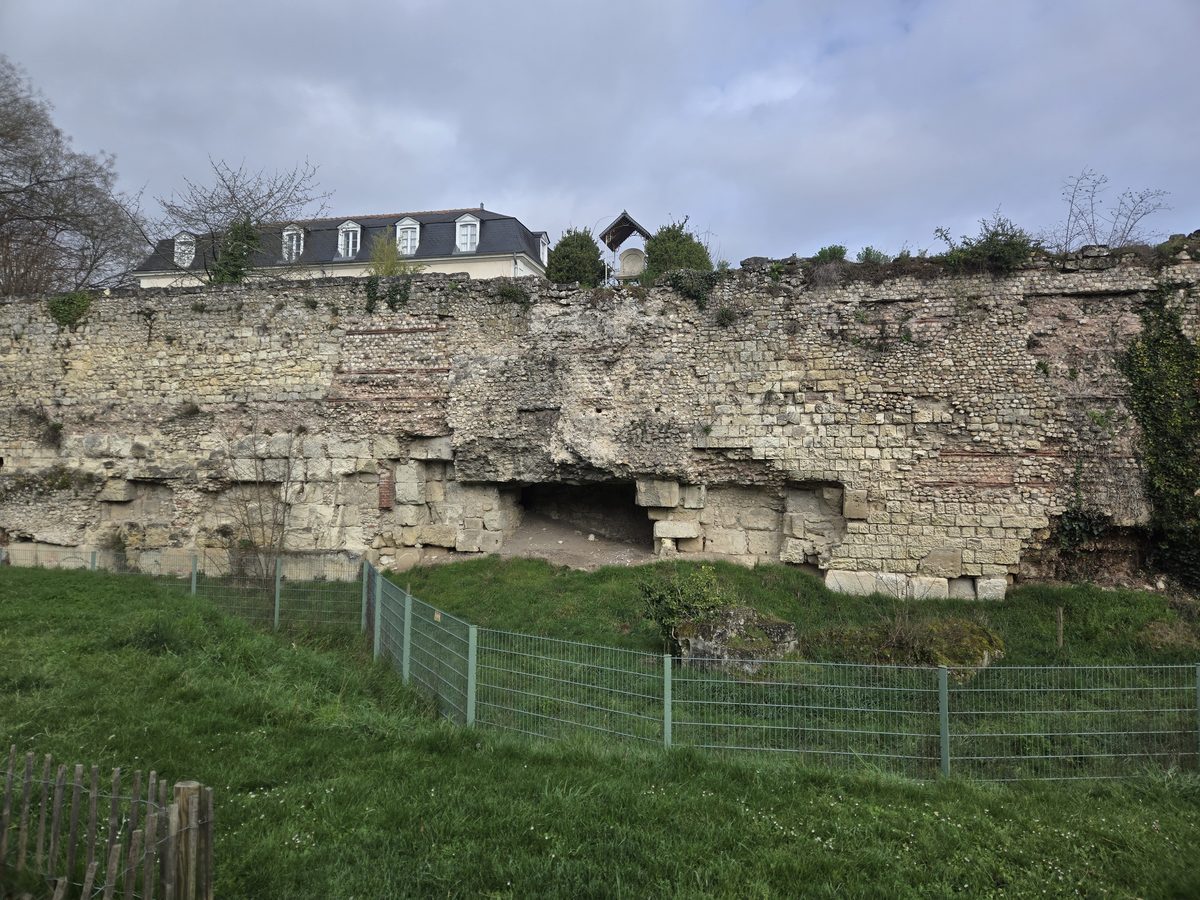
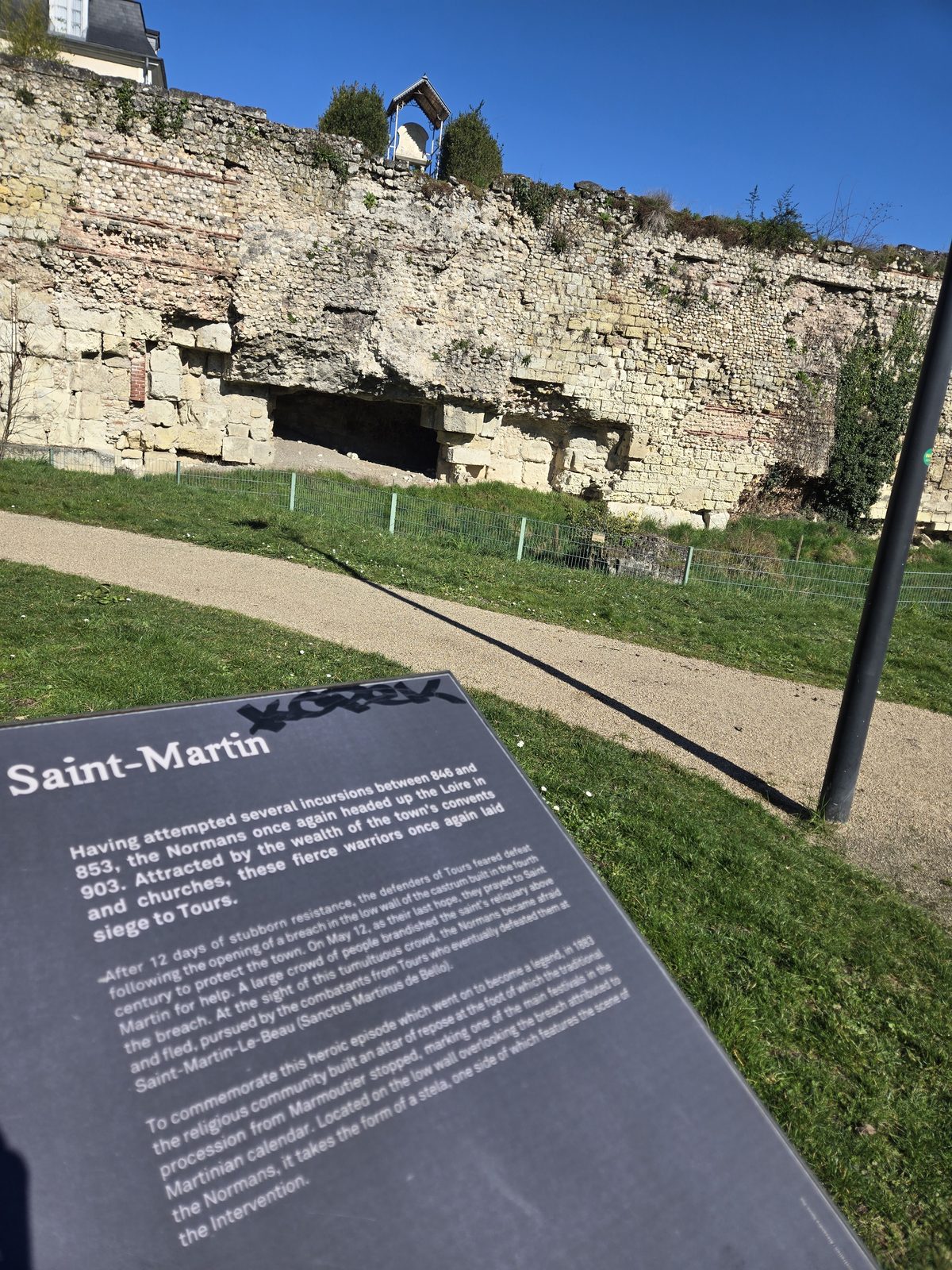
The ancient Gallo-Roman wall. Can a wall be called a friend?
Normans invaded Tours around the year 900 and managed to tunnel through the wall, but the Tourangeau, the citizens of Tours, were able to repel the invasion. How they did so is a mystery to me. Your history book may tell you that the citizens had placed the casket of Saint Martin atop a rampart, and when the Normans breached the wall and encountered the casket, they were spooked and driven away.
The rational side of my brain says that’s a ridiculous story. The Normans were voracious; so much so, in fact, that a third of my native tongue is derived from the Norman tongue because they successfully conquered my ancestors in England a century after the Saint-spooking at Tours. That I can communicate with the modern Tourangeau is partly a reflection of this—we have so much French in our English that it’s one of the easiest languages for us to learn.
Maybe I’m biased, but I don’t see the Normans tunneling through a wall only to be spooked by a saintly relic. There’s a tension for me between knowing what actually happened that day and the fact that we’ll never actually know. My mind longs for certainty, for facts, but my heart appreciates the mystery. That we’re uncertain about what repelled the Normans rings true for me today, it feels right. That the story we’ve received down the annals of time itself is mysterious suggests that the ancient Tourangeau also were uncertain about how they succeeded. Uncertainties layered upon uncertainties, history layered upon history.
It’s just a hole in a wall, but it’s a 1,000-year-old hole in a 2,000-year-old wall. There’s a historical marker but it doesn’t contain much history. How could it? Mystery and uncertainty dominate here. We know that there was a wall, we know the Normans were repelled, and we know that the culture the wall was meant to protect was permeated and altered all throughout the wall’s millennia-spanning life. The wall has failed but the wall remains, and the people of this region remain, too, even if that culture has changed and shifted. The wall suggests certainty, a hard line between within and without. But it’s merely a physical manifestation of human uncertainty—our uncertain ability to hold on to that which we value, to hold on to our collective identity, to hold on to our safety. The manifestation of that uncertainty, the wall itself, has outlasted all of it. Now it stands only as a reminder of that struggle. I understand why it’s not a draw, why even the people that live here are unaware of it and, in at least some cases, not particularly interested in it. Where I come from, that type of ancient history is hard to come by. Here, everything has grown on top of ancient history. Ho hum, life goes on.
The hole in the wall carries tremendous meaning for me, though. It’s as sacred to me as the cathedral that still houses Saint Martin’s casket, it’s as sacred as le Parc des Princes. All three are repositories of knowledge and history and culture, and all three contain the essential elements of the human tension between uncertainty and certainty, our striving to make the uncertain certain, and our ultimate failure to do so. At a time when I struggle with so much uncertainty, I find as much solace at the wall as the parishioner finds at church.
A Different Season
It’s a week before they have an office for me on campus, and another week beyond that before I start making headway in establishing meaningful research and relationships. Ultimately I am successful in my mission, but for two weeks I live in a state of uncertainty and limbo. I work from l’appartement every day for that first week, and I spend a lot of time perched at my window with another espresso. Amidst all the uncertainty I lean into the grounding experiences: the window, the wall, the evening walk around the city.
Living in North Carolina and Louisiana is not a recipe for understanding Spring. In North Carolina spring is a stutter-start affair; it’s more like winter and summer dissolving into each other in barcode pattern. I vaguely remember “Spring” from growing up in the mountains in Virginia, but in Tours I experience a real Spring for the first time in my adult life. It’s slow, patient, methodical. Buds appear on the trees of the outskirts of town and slowly make their way to my downtown abode. The weather warms slowly and the rain is frequent and cold. I sniffle and sneeze in my drafty apartment and complain to the people back home about the weather. In truth, I’m just being whiny. The uncertainty of my situation grates on me. I like the adventure, I like the challenge, but my heart is two wolves about it. The bad weather is just an excuse.
One day the rain is particularly relentless. I work from home all day but then there’s nothing for me to do after work except perch at my window. This time, though, it doesn’t have the same appeal; I’m restless.
I don’t have any better ideas, so I throw on some extra layers, lace up my sneakers, and grab my raincoat.
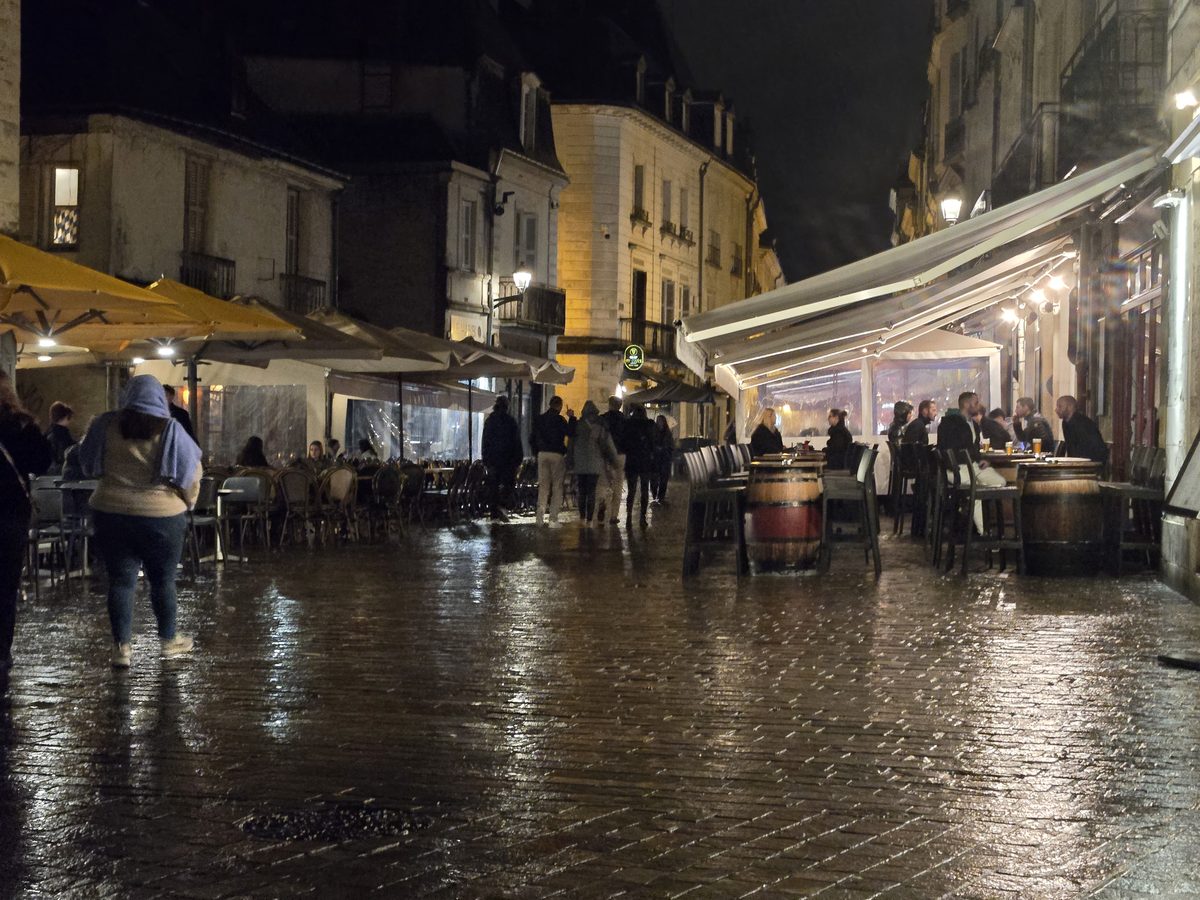
Tours after dark. The rain turned every surface into a mirror.
Tours in the nighttime rain is a different experience. The cobblestones turn to mirrors and suddenly stepping down every avenue is like stepping into an album cover, or on to a film set. Much life happens in the third spaces of Europe and a cold rain is not a strong enough force to stop that. The cafes are busier than normal, the sidewalks less so. It’s both busier and quieter in the evening rain. Old buildings seem taller, the light striking from different angles, their features glistening.
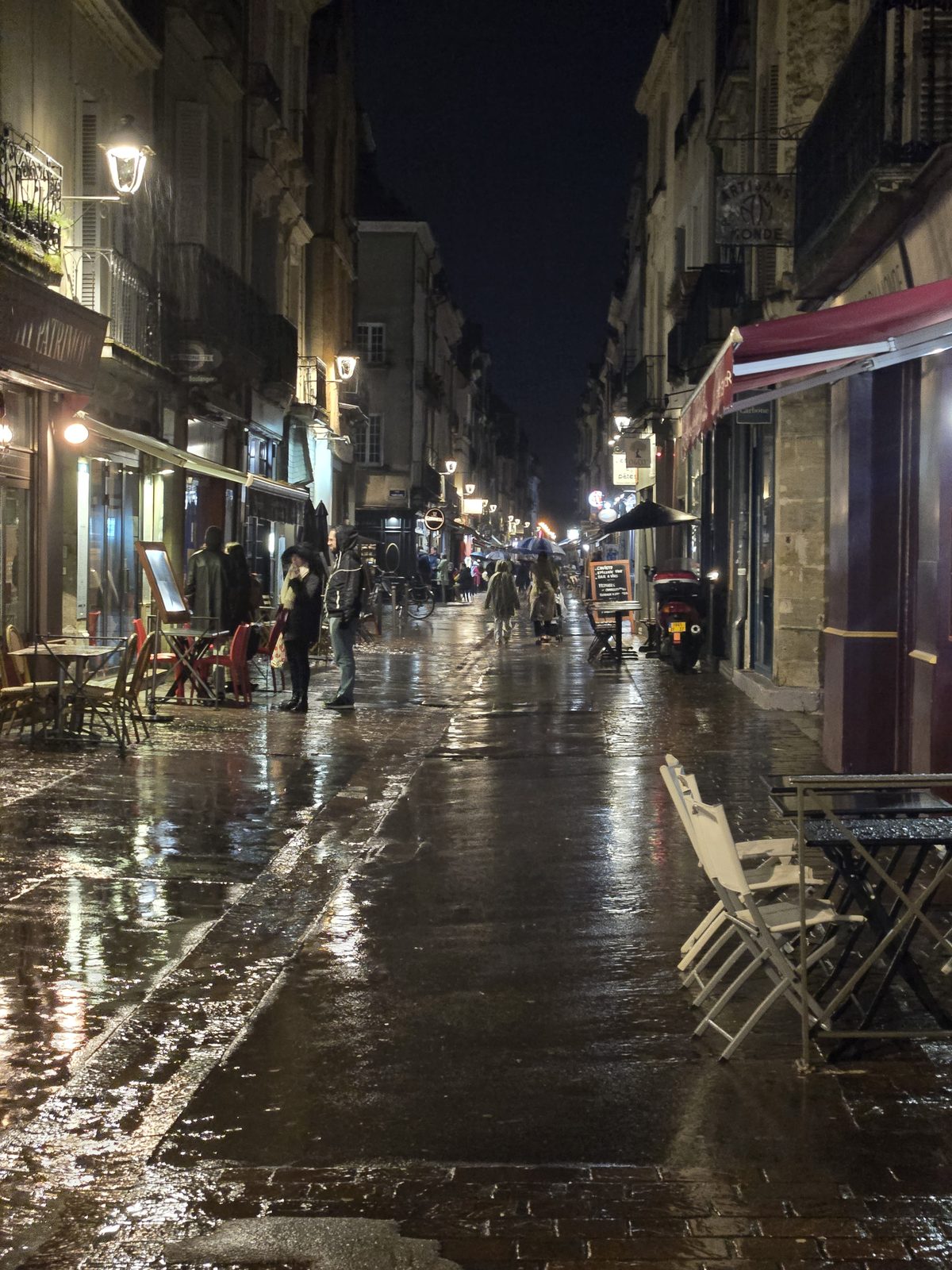
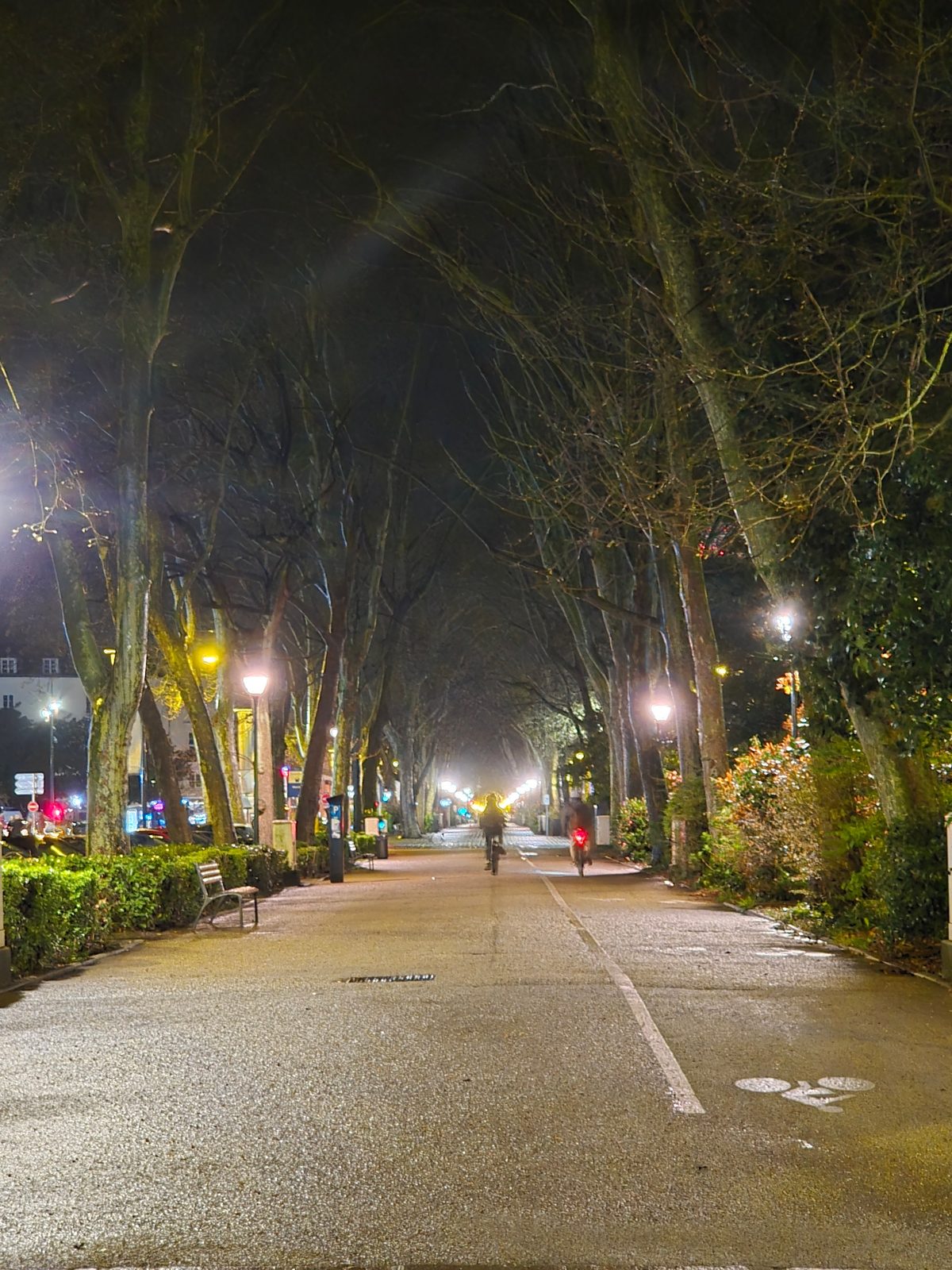
Left: Every alley, an album cover. Right: Normally busy boulevards are nearly empty and silent.
You know, it’s not so bad.
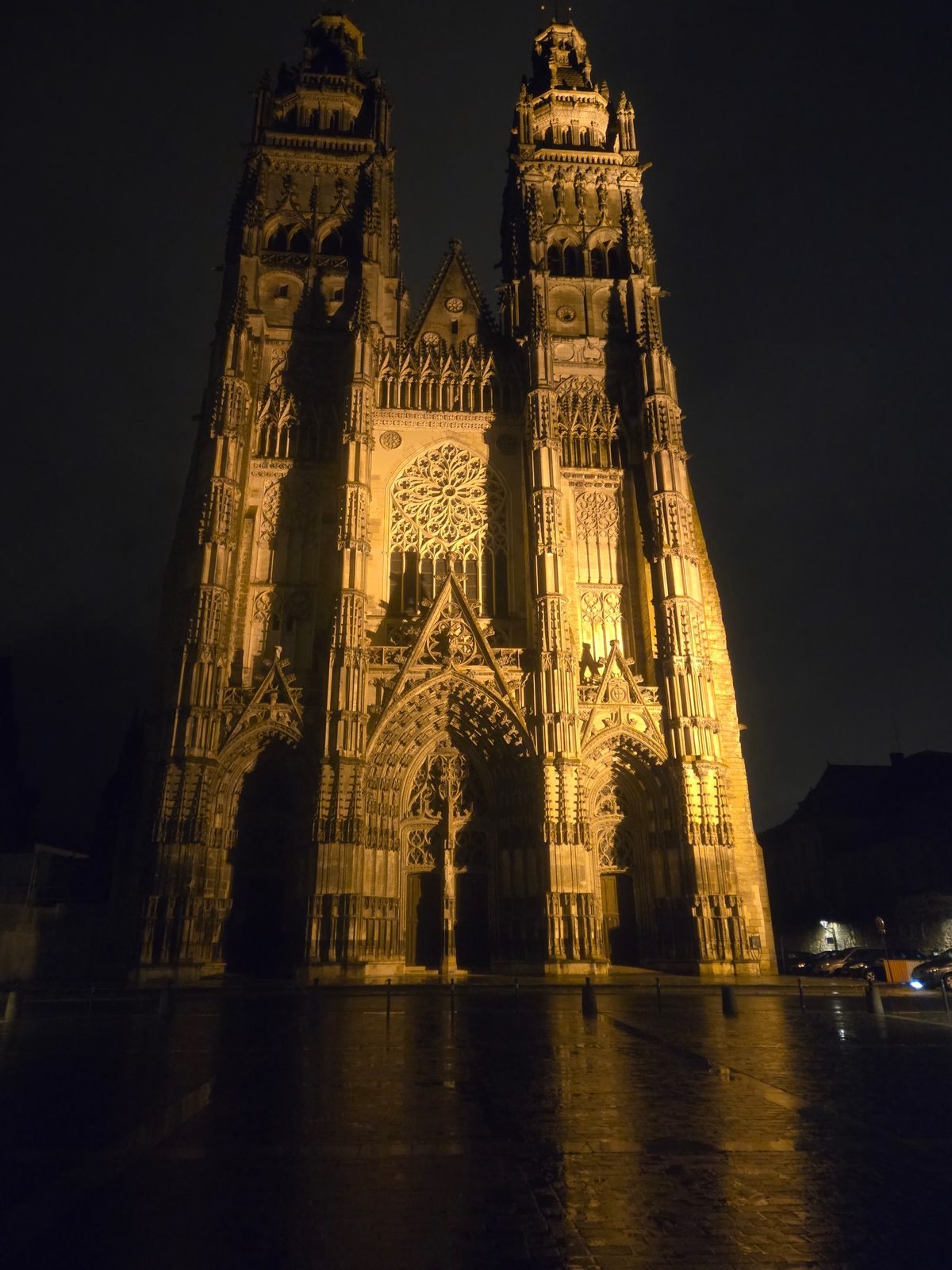
Cathédrale Saint-Gatien. By day, handsome. By night, in the rain, transcendent.
The tension between certainty and uncertainty is not one that I can resolve at this time, on this night, and walking around a 2,000-year-old city in the cold rain doesn’t change that. But it changes something. A city that has evolved in place over two millennia suggests, by its very nature, that it all ends up being okay in the end. The buildings have seen centuries of people struggle with their own seasons of uncertainty; the buildings are still standing, and so are the people, even if they have changed over time and over years. Tonight I’m just another one of those lives passing under the stony, glistening watch of these old buildings. I walk the same stones as those that have come before me, and I’m not the first to feel the cold rain.
So I walk the city, watching the rain, watching the trees glisten. This is Spring, a season of regeneration; the rain is fitting. And fitting, too, is actually experiencing Spring develop and reveal itself in its own time, not as though someone flipped the été/hiver switch. It’s a season of uncertainty, too, but that’s part of the struggle. Like Spring itself, uncertainty is a fertile time, a time for growth. For letting things develop in their own time.
It’s a different season, but at least for this night, under the rain and the streetlamps, I’m at peace with it.
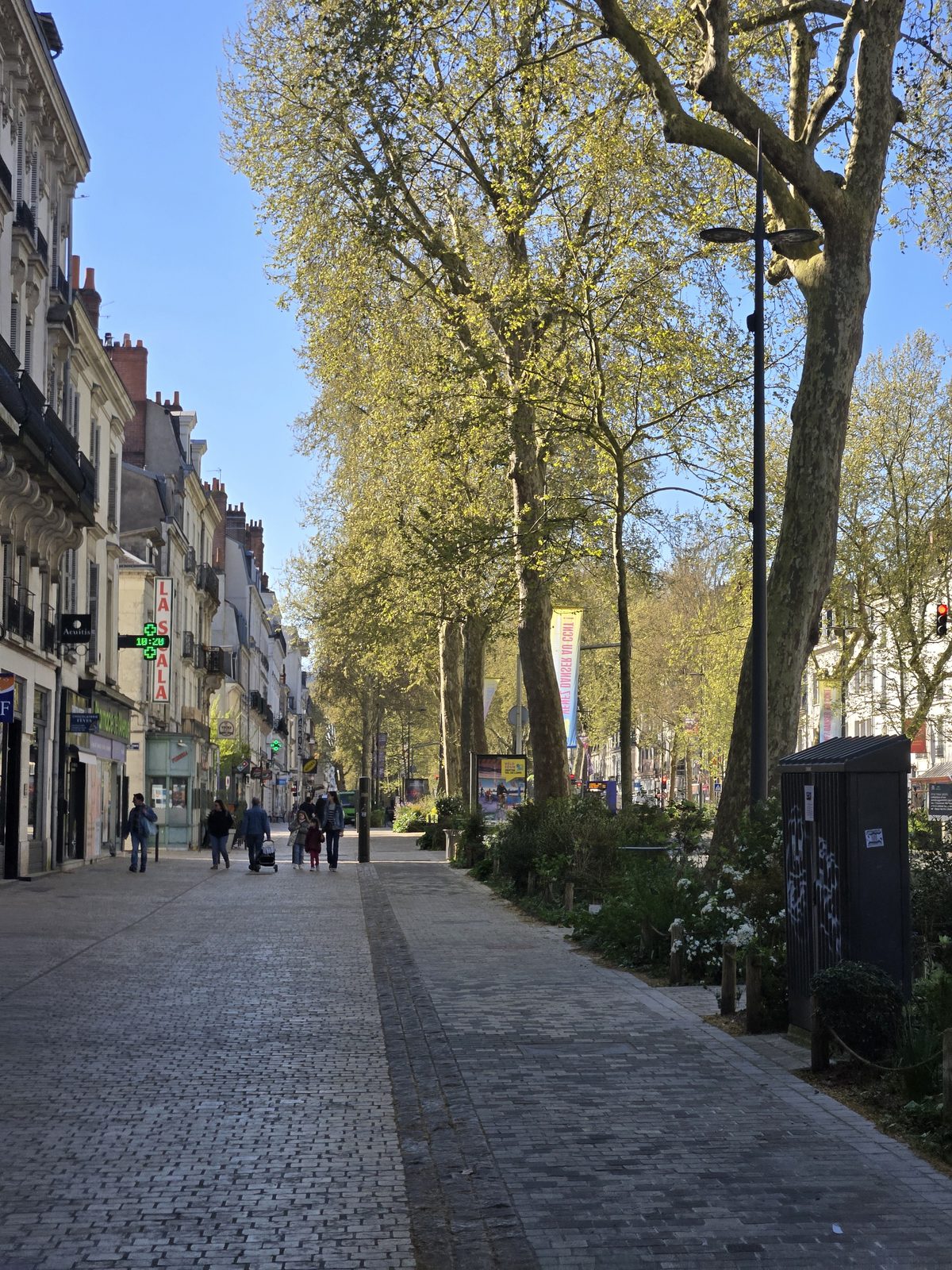
The same city, a few weeks later. Spring arrived on its own schedule.