 Away
Away Prague again. I return leading another group of students on what is technically a business trip. A rerun of the previous itinerary in many ways, only now I know the answers to the tour guide's questions in advance. Reruns are both a classically human phenomenon, and simultaneously one of the great cosmic answers to the question of “what's next?” Here in Prague, the students have changed, the calendar has changed, but the city is just as I left it. Almost defiantly does Prague resist the new. Every step one takes in the city is following a path worn over centuries, its bones are ancient. The city reflects one's own nature as a rerun back at the individual. The city has seen thousands, millions like you come and go, and Prague will remain largely unchanged once you've come and gone. And yet, with each rerun, a deeper layer is revealed. The city just waits, unchanging, for you to return and peel back another layer.
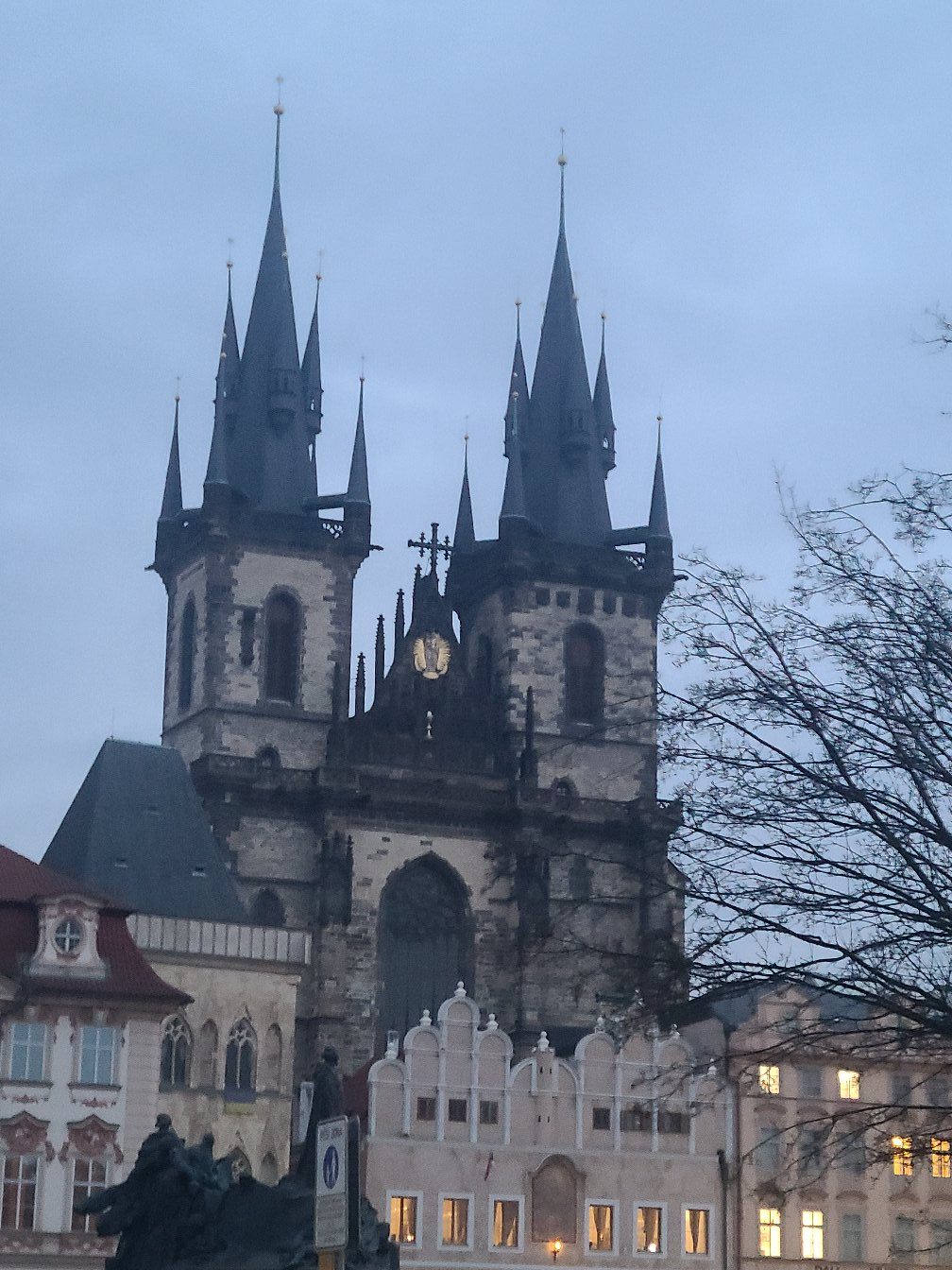
The Church of Our Lady before Týn, watching over Old Town Square. Just as before.
Cathedrals and Bones
As before, the churches and cathedrals of Prague invite my attention, rerun or otherwise. I spent an afternoon in St. Vitus Cathedral, the cathedral inside the palace complex. The largest and most significant holy building in all of Czechia, it does the job in communicating the Gothic message. Already perched atop a hill overlooking the town, the cathedral strives for even loftier heights. Multiple levels of flying buttresses support platoons of spires, hipped roofs point unequivocally toward the firmament, and merely looking at the cathedral draws one's eyes away from the Earth. The building stands a hundred meters tall but the experience of it reaches toward heaven. Inside, towering stained glass windows under peaked archways and vaulted ceilings bring the mysteries of heaven right to the eye of the beholder, and gold-frescoed arcades tell the story of God's acts on Earth. Physically, it's a space that does exactly what it's meant to do—make you feel religious for at least twenty minutes.
Construction of this Gothic masterpiece began in 1344, the period in Prague's life Bryan Adams would use were he to write a song about the city (“those were the best days of its life”). As it stands today, it reflects that 1344 vision—a coronation grounds, a crypt for kings and emperors, and, unintentionally, an unfinished product. The vision laid out in 1344 was not finished when a war in the early 1400s stopped construction for a full century. And then it sustained serious fire damage in 1541. So they regrouped and started finishing it again. And again and again. Visit today and one will still find scaffolding and workmen. That we keep “finishing” the job, though, that we keep playing that rerun is more the point than the job itself. A city like Prague shows you that the rerun is the way. We just keep doing it, whether it's growing food, raising kids, fighting wars, or building cathedrals—not finishing it was never an option, even if it's never actually finished.
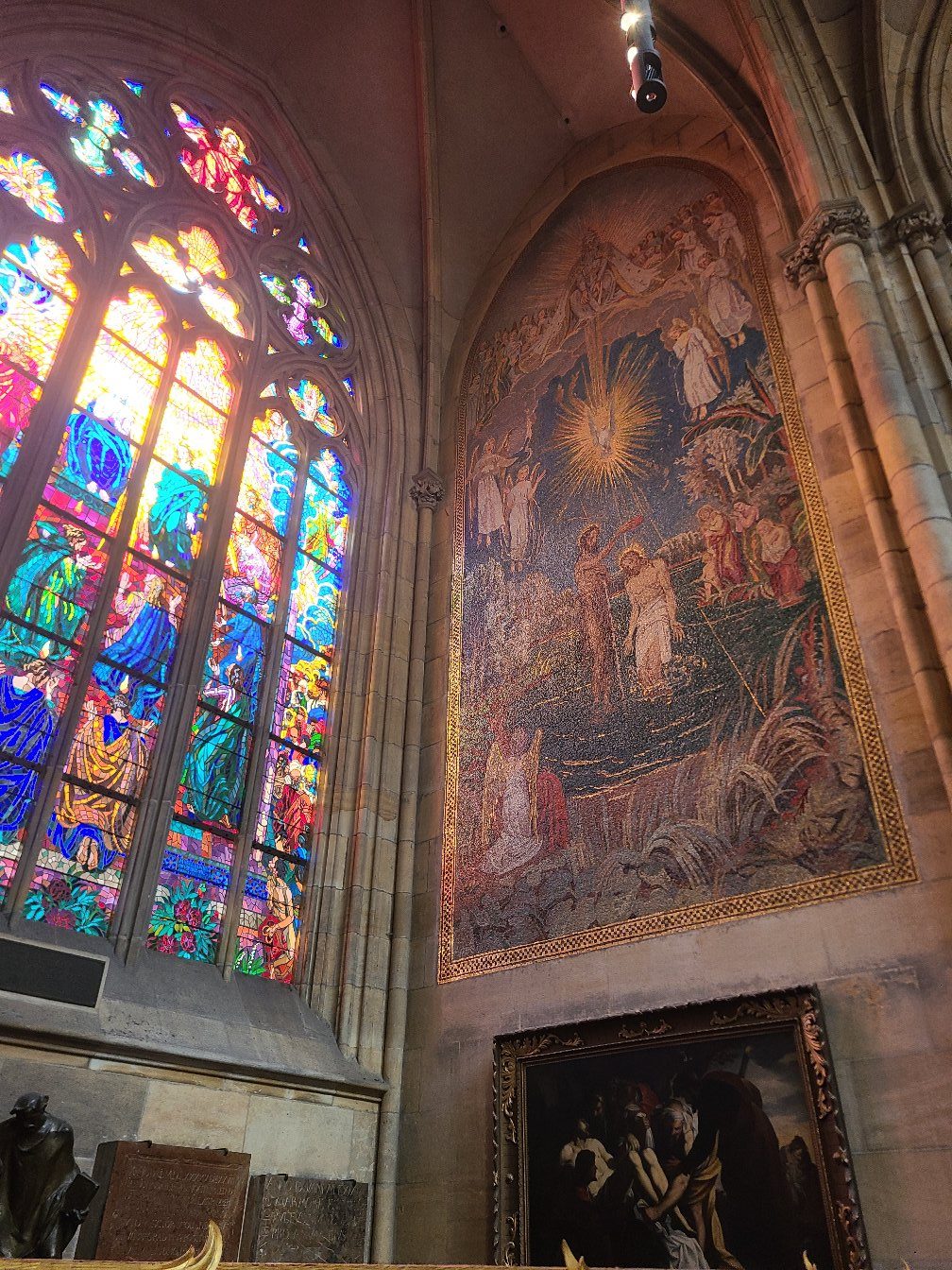
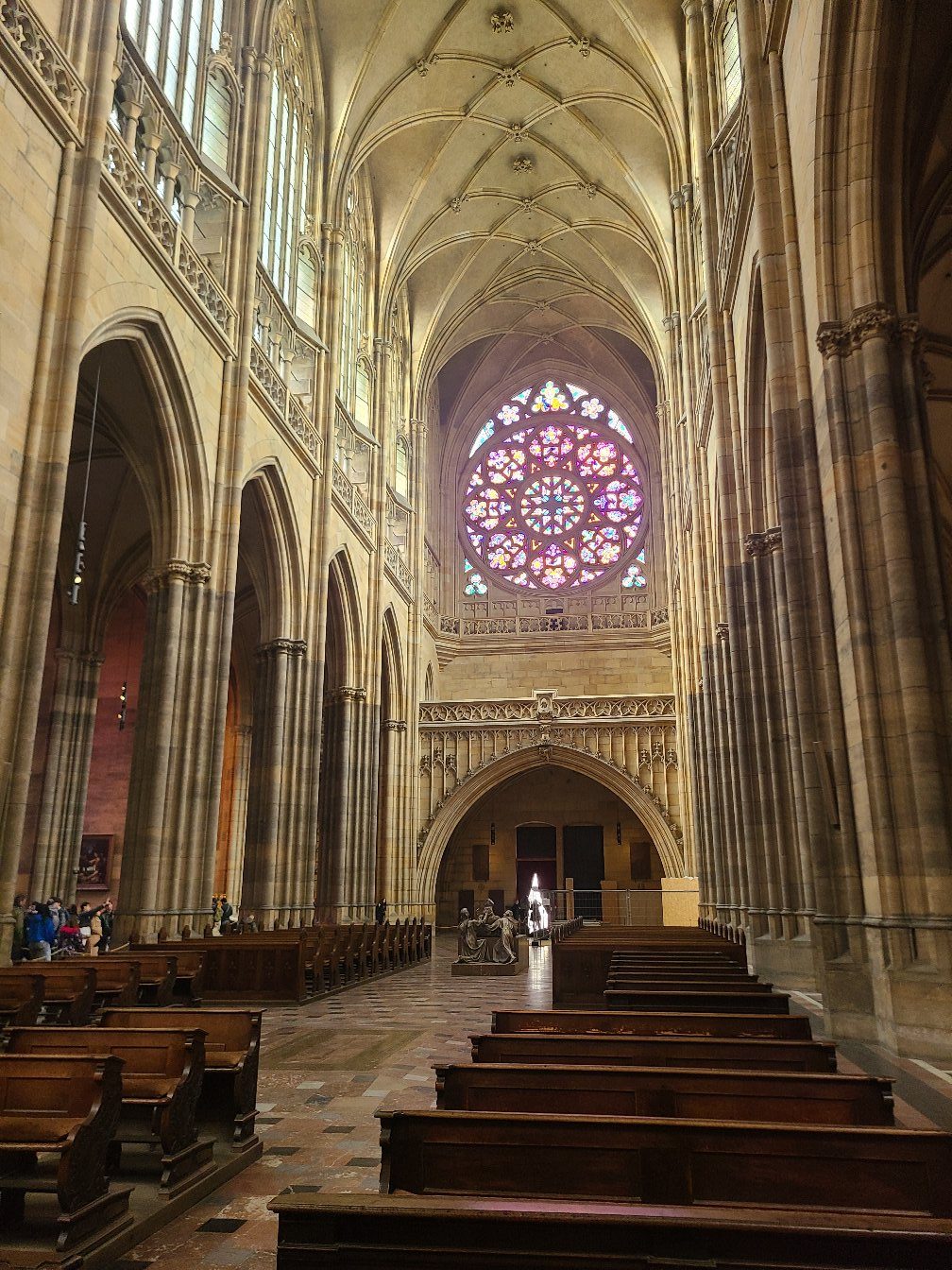
St. Vitus Cathedral. Left: stained glass and fresco. Right: the nave and rose window. How did “Gothic” ever come to mean sulky?
We also took a day trip to Kutná Hora, a small town about an hour east of Prague that was once one of the wealthiest cities in Europe thanks to significant silver deposits under it. It's a lovely hilltop town with narrow streets and a massive Gothic cathedral, St. Barbara's, that the miners built to rival St. Vitus. Fair play to the miners—St. Barbara's is an impressive rerun itself. But, the silver mines long since tapped out, Kutná Hora lives partly on tourism now, and it's not the cathedral that attracts the most tourists.
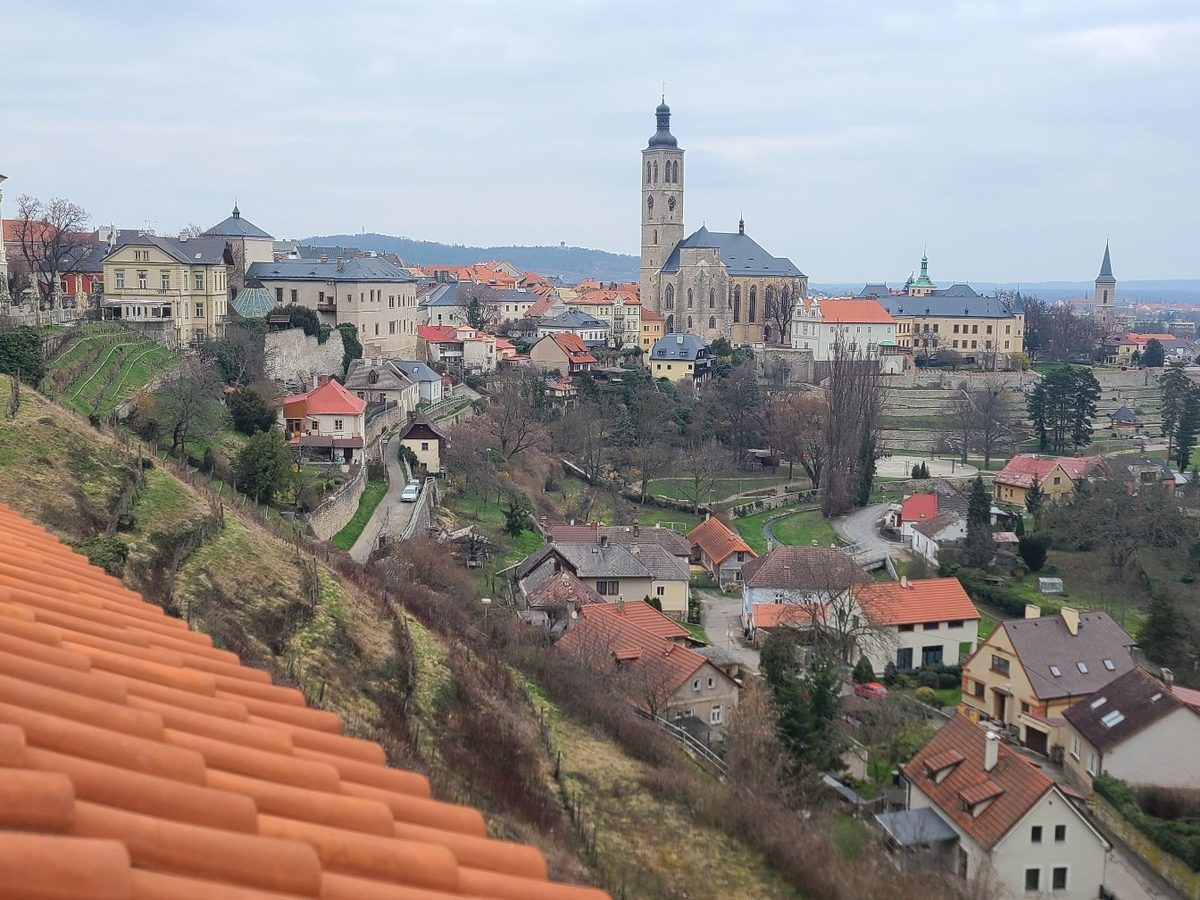
Kutná Hora. Once one of the wealthiest cities in Europe, now a quiet hilltop town with very good bones.
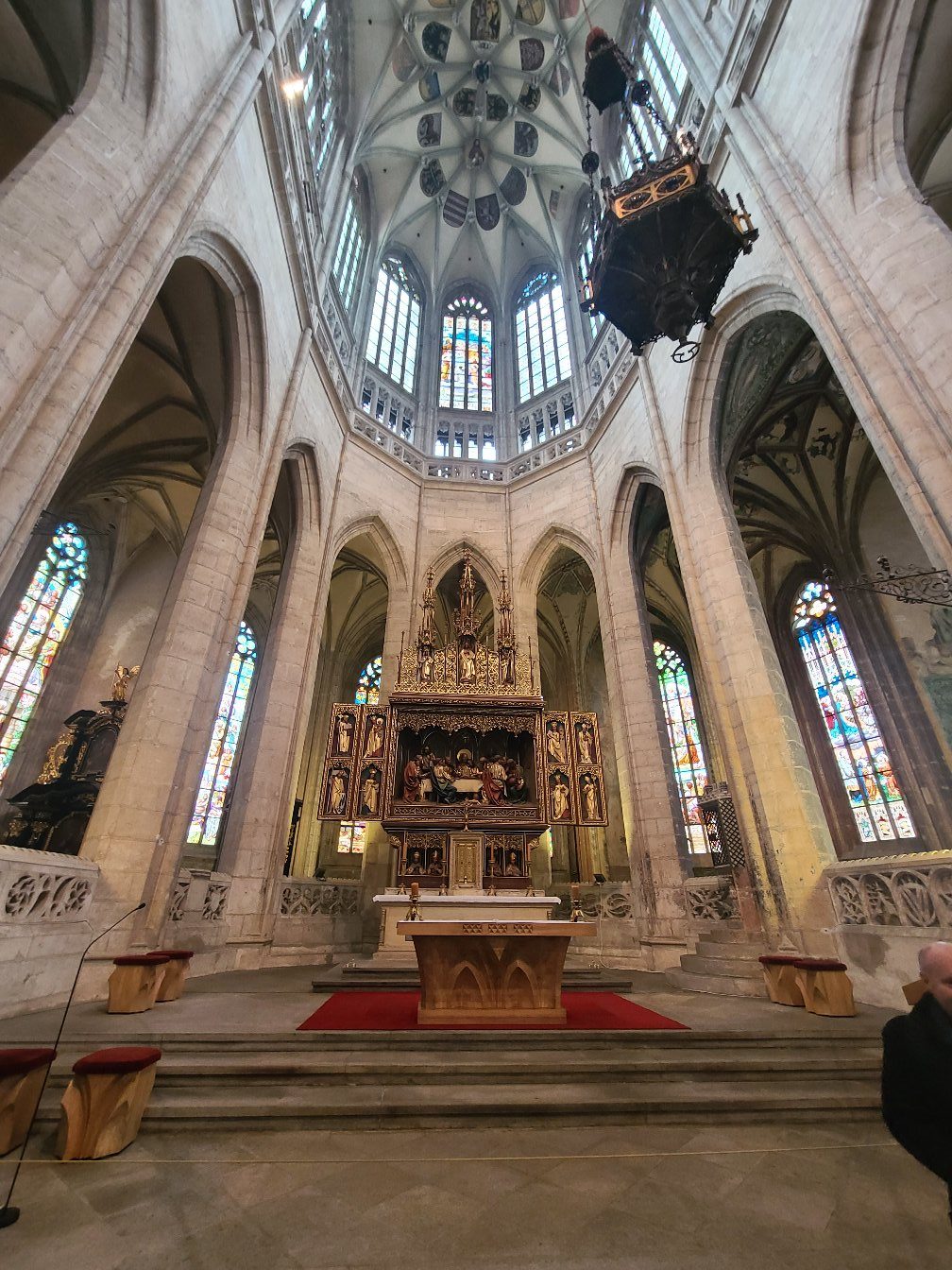
Inside one of Kutná Hora's churches. The silver miners built to impress. Yeah, not bad.
Kutná Hora is home to the Sedlec Ossuary, the famous “bone chapel of Prague” (despite being 75km away). St. Barbara's towers over the small town to one side and the Ossuary quietly buttresses the other end of town. A small Gothic church, the bone chapel makes use of between 40,000 and 70,000 human skeletons for decorative purposes—double or triple the population of the skeletons still in use in Kutná Hora. Photo-taking is not allowed, but the space is small and intimate; light streams through arched windows and dust to cast an airy feel over a space decorated with femur chandeliers, finger-bone garlands, and coats of arms of arranged femurs and vertebrae. One expects an eerie or unsettling feeling but finds instead a familiarity, if a slightly uncomfortable one.
Why do this? Why dig up human remains and turn them into art? Is this, like, an okay thing for a church to do? No answer will be provided here, but experiencing this with American undergraduate students should be an upcharge to the regular entry fee. Americans hide from death. The American healthcare system treats death as a failure; many people have pointed out that Americans dress their dead up like they're going to a party rather than to fertilizer. Academically, one can understand this. Watching twenty-year-olds legitimately confront mortality for the first time in their lives, one sees that our individualistic society has failed to communicate the one thing that all of us individuals have a sacred obligation to do—we must die. To deny this truth is to forget that we are inescapably caught in the cosmic rerun. I love the America that resists these certainties, I genuinely do, but I equally love being there to help students confront their own mortality.
Two of my students struggled with the Ossuary. Good students, good humans, good struggle. At the end of the trip one of the students commented that this had been a very “deathy” trip. Tour guides talking about plagues, monuments commemorating massacres. The revolution happened here, the holocaust happened here, the communist invasion happened here. The Plague happened here, the Hussite wars happened here, the Prussians happened here. The Mongols happened here, the Saxons happened here, the Huns happened here. Death upon death, bones upon bones. It is only from centuries of death that a place like Prague, a place like Kutná Hora can grow. Death is an inescapable part of the rerun and here, at Kutná Hora, we stopped fighting it and made art out of it. I tell my students, you will die, and that's okay. To hide from death is to hide from life, for the two are not separate and only our pretending leads us to think otherwise.
But one's twenties are a time for pretending. Ecclesiastes tells us that there is a time for death but it reminds us that there are also seasons for other things. Pretending that we aren't a rerun ourselves—maybe that's a season, too.
And if it is, my students won't be the first to confound death and pretending. Easily the best photo I took in Kutná Hora was this absolute gem of a stone relief. I have no idea what this creature is supposed to be, but I've been calling it the Dumb Camel of Kutná Hora and I will not be accepting alternative identifications at this time. I feel like this camel, of all the art in the place, only this camel realizes his ridiculous predicament. He seems to share a knowing look with the viewer, doesn't he? Handsome guy.
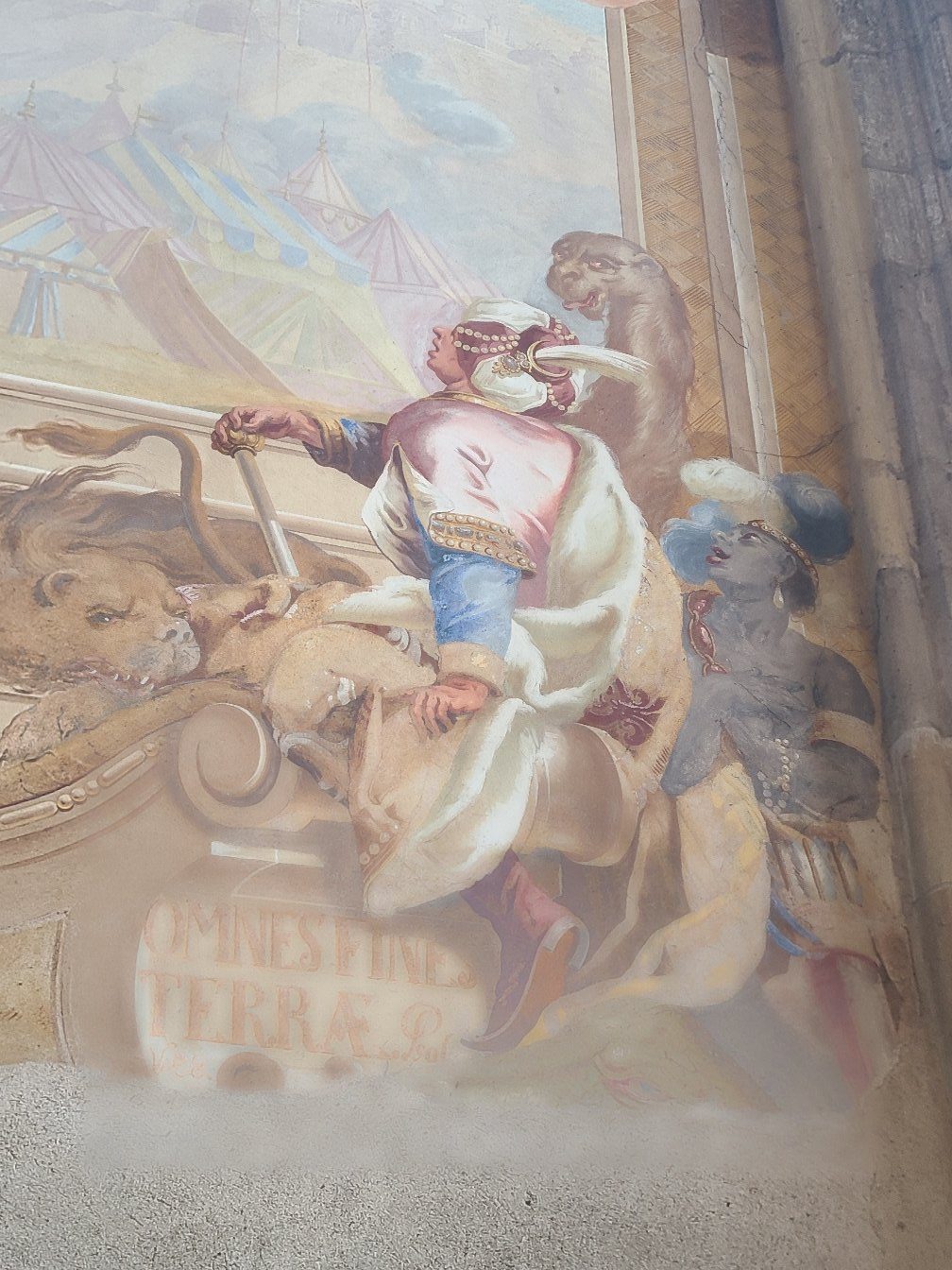
The Dumb Camel of Kutná Hora, eternally trapped in a scene of the Apocalypse: OMNES FINES TERRAE—“all the ends of the earth.” Is it a camel, is it a lion, is it just hungry?
An Even More Beautiful Cathedral
The Dumb Camel of Kutná Hora teaches an important lesson. The DCKH has been looking out at churchgoers for hundreds of years, locked in his predicament, but he's a bit cheeky, isn't he? Doesn't he just grasp it all? In a small town that experienced so much death they had no choice but to dig up their cemeteries so they could start refilling them. Having dug up tens of thousands of bones they said, “eh, might as well arrange 'em nice-like.” That's really the whole point, isn't it? Appreciate the beauty of life, even when life and death are never far apart. We just have to find ways to see and appreciate that beauty.
One of the ways in which I find the beauty of life easy to observe is through football (AKA soccer). The development of angles, the manipulation of space, the emergent synchronicity of tactics… The fierce local identities, the long club traditions, the deep community ties… I get it, I'm a stranger in my homeland with how I enjoy football and how much I enjoy football, but it is one of the lenses through which I see the beauty of the world most clearly.
As an American, this is isolating. We are not a footballing people. However, amongst my European brothers and sisters, my view is much more common, and here on the continent, the quality of football one finds is greater in contrast than the food, and by far. And unlike the DCKH, locked eternally in the Apocalypse, heaven smiled upon this American in Prague and served up plucky little Sparta Prague making an historic run into the Round of 16 of the Europa League. Giants in Czechia, perennial champions, they are more of a footnote on the broader continent; a team known well to fanatics and aficionados, but nothing on the order of a Bayern Munich, Barcelona, or Liverpool.
But just as the stained glass calls down light from above and transforms it into something more beautiful, the football gods smiled on this American abroad and laid tenacious Sparta squarely in the path of none other than the old English giant, Liverpool. One of history's most storied clubs would be sharing the old city with me for one night, and one does not simply refuse a gift from the footballing gods.
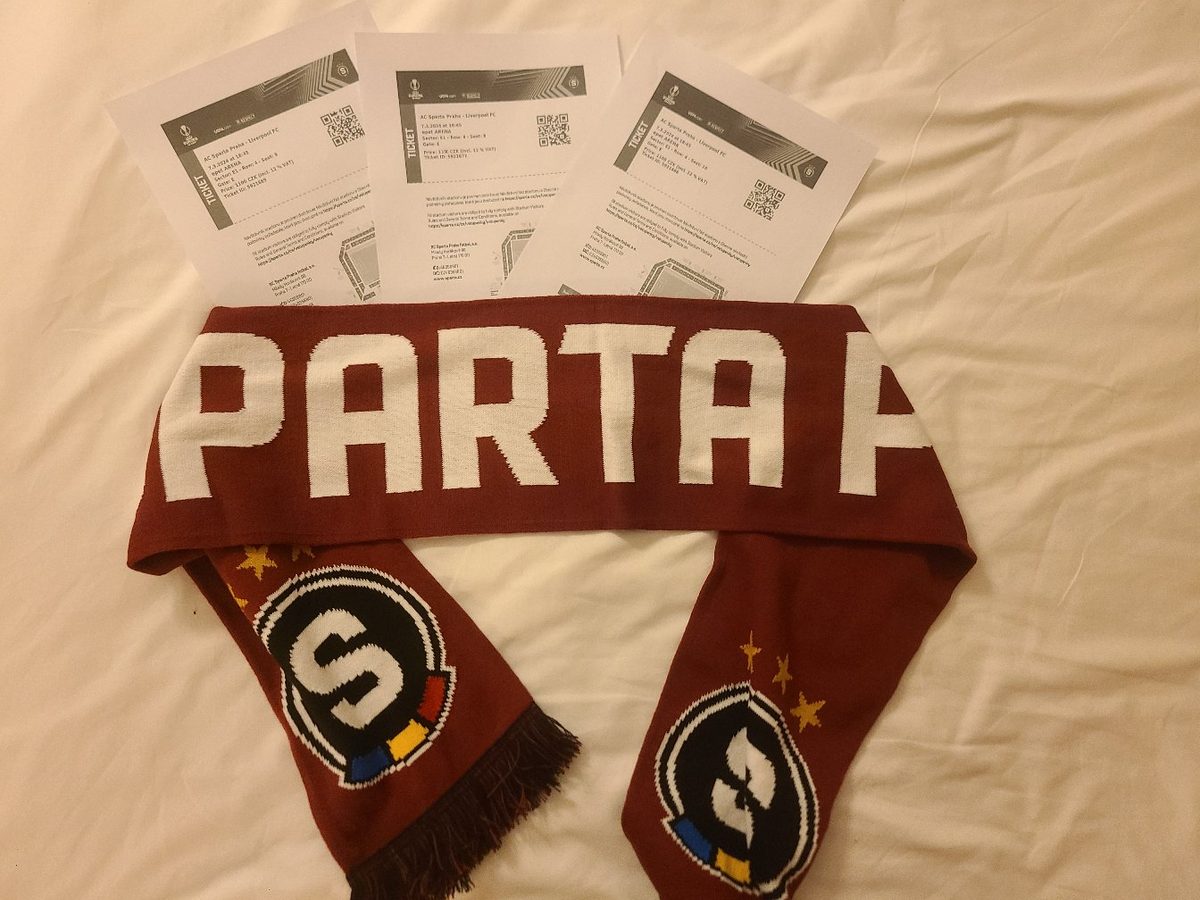
Match day preparation. Huge club in a tiny stadium on a European night… most expensive ticket I've ever bought.
19,000 Adherents
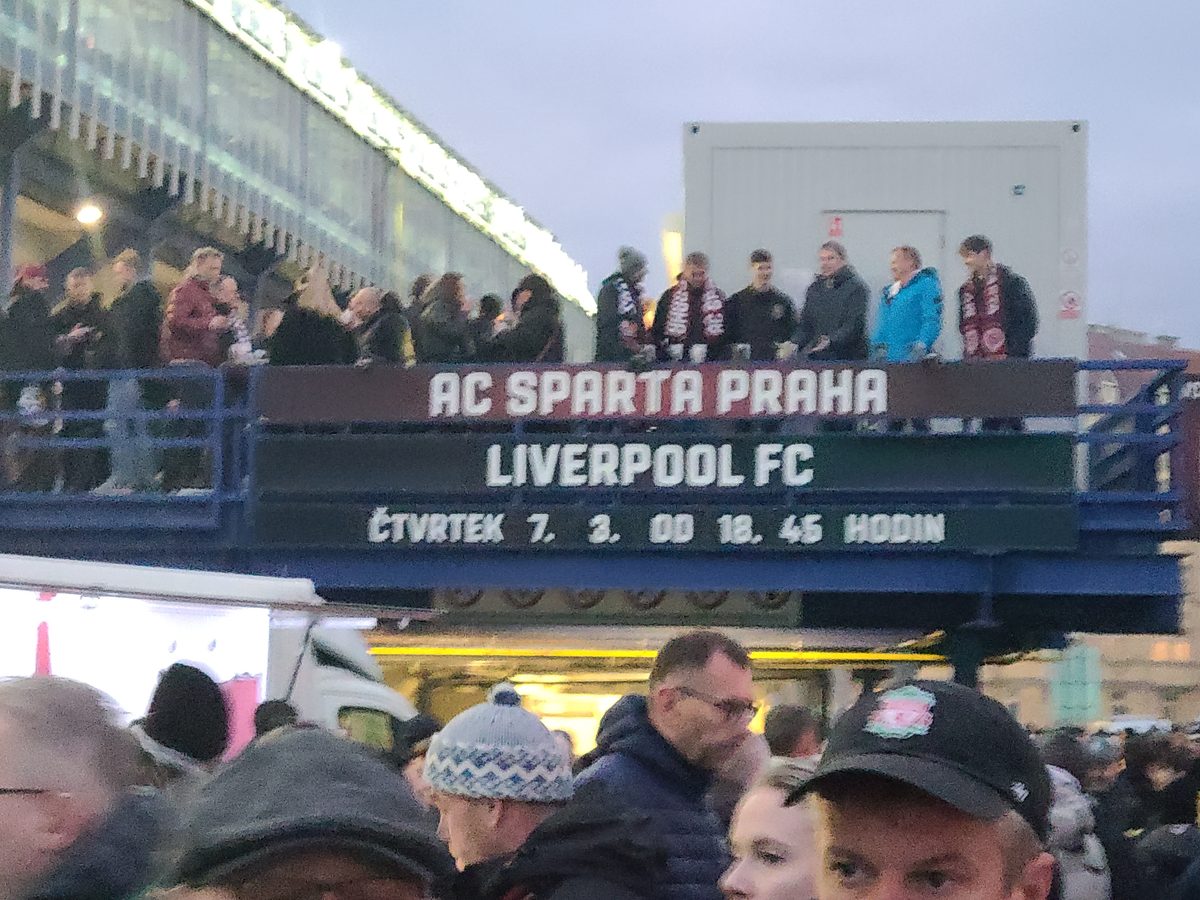
The scene outside the ground. Sparta Prague vs. Liverpool FC. Europa League. Thursday night in Prague.
Of the sixteen teams left in the competition, Liverpool were the biggest and wealthiest club, and Sparta was the second smallest and poorest. And in all eight matches of that stage of the competition, no match was as lopsided as this one. Liverpool scored after seven minutes, and again twenty minutes later, and again twenty minutes after that. 5–1 was the final score line and fate unfolded just as it was always going to. No supporter or player for either side would have doubted the outcome.
But man, you wouldn't know it to be in the stadium.
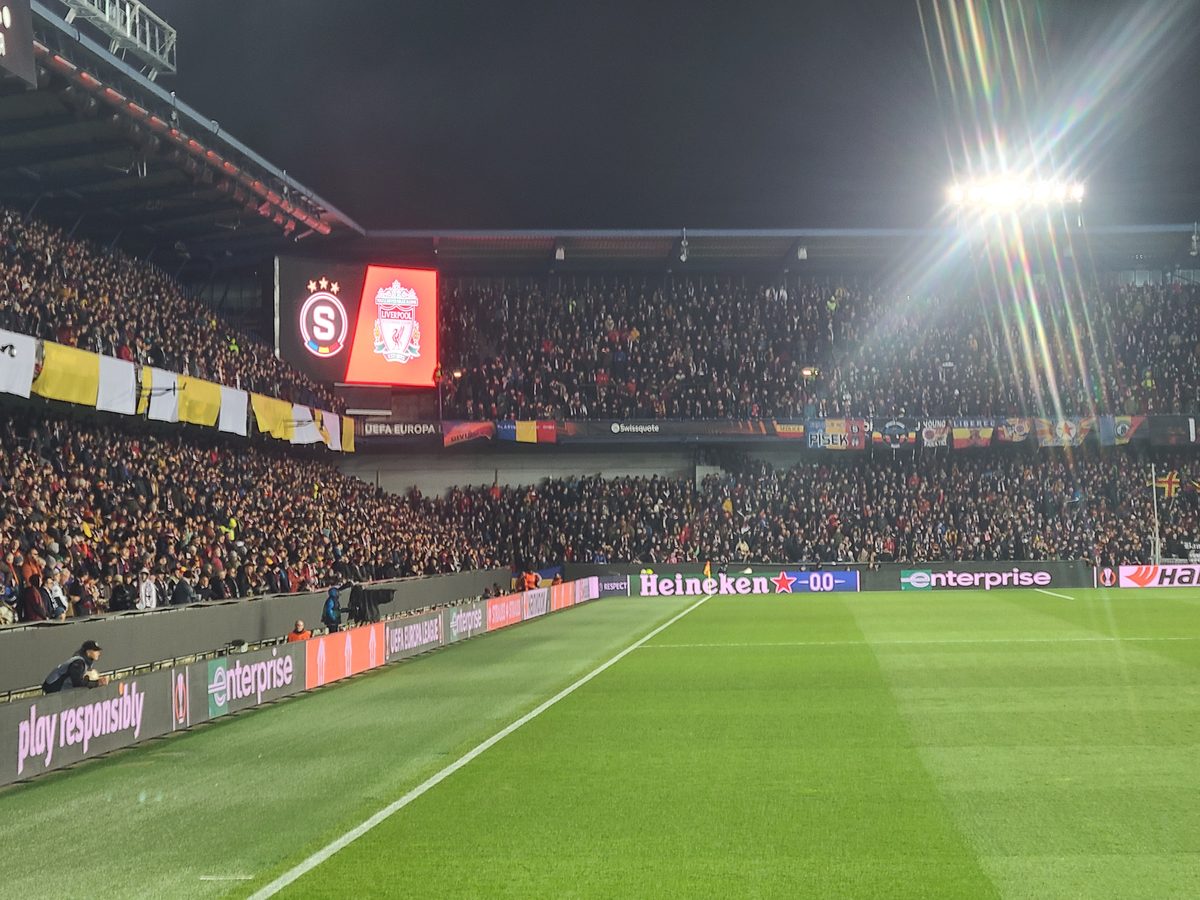
Nineteen thousand voices. Not one of them quiet.
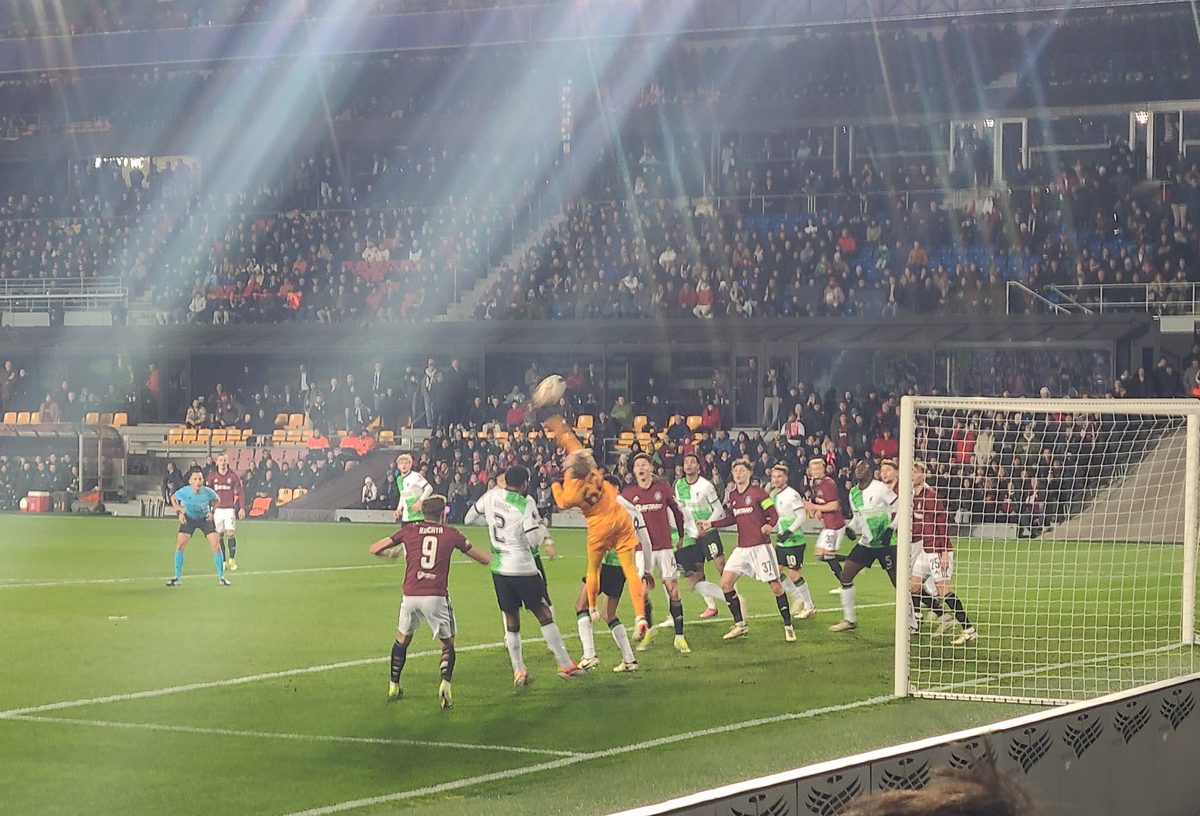
Row 3 in the corner. Close enough to hear the players talk.
The fans sang and chanted nonstop from before kickoff until well after the final whistle. Mo Salah never stood still—bro was a blur in nearly every photo I snapped of him. Dominik Szoboszlai whipped curling crosses from all angles. Darwin Núñez scored two. Virgil van Dijk came on as a second-half substitute and immediately started judging everyone. Liverpool was fully ascendant.
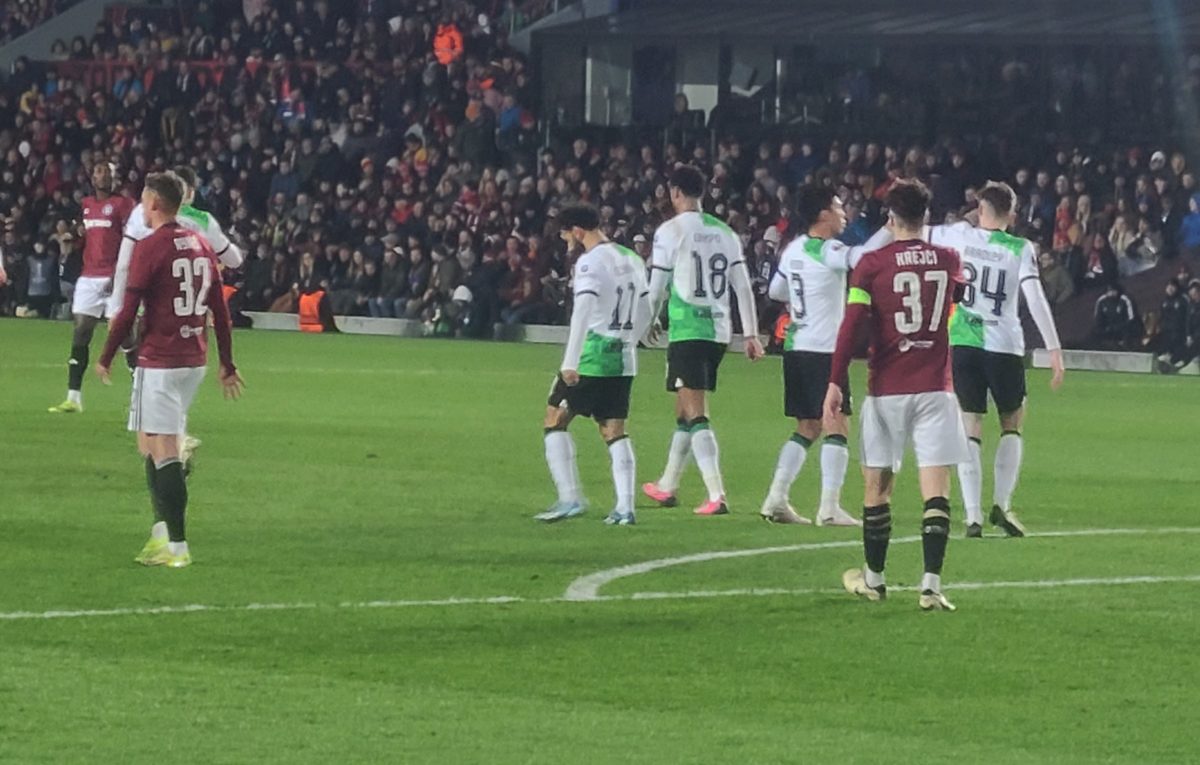
Liverpool's players after another goal. They were clinical. But this isn't their story.
But the stadium was electric the whole time. Liverpool would score but the fans would keep chanting. And, a spectacle to behold, after the match, maybe—maybe 70 fans left. 18,930 fans remained for the customary scene after a football match where the players come and applaud the fans.
This is one of those moments I love best in football. The connection between club and community, between player and supporter, is so strong in Europe. Clubs are often owned by millionaires and billionaires, like American sporting teams, but ticket prices and concessions never reflect the American sporting reality, and this author is aware of only one instance of a club picking up and moving to a new town. In Europe, the sports teams may be owned by a magnate, but they are viewed more as public assets in much the same way as a park. Liverpool may be owned by Fenway Sports Group, but Liverpool belongs to the supporters.
And even in loss, Sparta Prague belonged to its supporters, and the supporters belonged to Sparta.
And here, in a more modern kind of cathedral, with these 19,000 faithful atheists, perhaps heaven is just as close as it is under the spires and stained glass of St. Vitus on the other side of town. Perhaps here, death and life are just as close as in the Ossuary at Kutná Hora, because here, in this cathedral on this night, we celebrated loss. To honor defeat by celebrating the effort and the journey, to celebrate the community and stand in solidarity even during the hardest times—I will happily live that rerun again and again.