 Away
Away I double check my ticket to make sure I’m in the right place, and I am, but the young woman in the next seat is a pile of limbs and clothes and personal effects, and much of it is spilling into the seat listed on my ticket. That’s okay, I know how to handle this.
I make a show of taking off my scarf and putting it on the small rack right over her head and issue a polite but firm, bonsoir madame. Polite but remonstrative is an art form here in France, and as I situate my other items on the overhead racks, she scoops up her pile and offers a slight apology smile. All good, young one, this is how it’s done around here.
But she’s spilling back out of her seat just as quickly as I’m in mine. She has a big neck pillow, her winter coat is in the seat, she has a large backpack at her feet, and a tangle of phone and cable and—how long has she been on this train?
As I get settled in, I feel like she’s looking at me. She seems Italian, maybe? College student or young professional. Maybe she’s looking through me. I stare at my phone.
“Escusi me.” Italian indeed, and she was looking at me. “Are you going to,” a brief pause as she double checks her phone, “Bordeaux?”
“Oui, madame. Yes, I am.” I answer in French first because we’re in France and look at how well adapted I am. She’s happy with the answer and I quickly learn that she’s traveling to Langon and needs to change trains in Bordeaux. “But, I do not understand. And…” she gesticulates at the air, “they say, always in French. I worry I miss the stop. I have to take another train.” She tells me a second time and shows me on her phone. I see: she has to take another train.
I tell her it’s okay, Bordeaux is the end of the line so everyone will get off at Bordeaux. She nods her head but I know that blank-eyed nod because I do it sometimes, too: she hasn’t understood. “When I leave, you will leave.” That lands but she’s still concerned about something, I can see it.
She points to her phone again. “It does not say where is the train.” She points to the blank space where the track number will appear, eventually.
Ah, first time Francing.
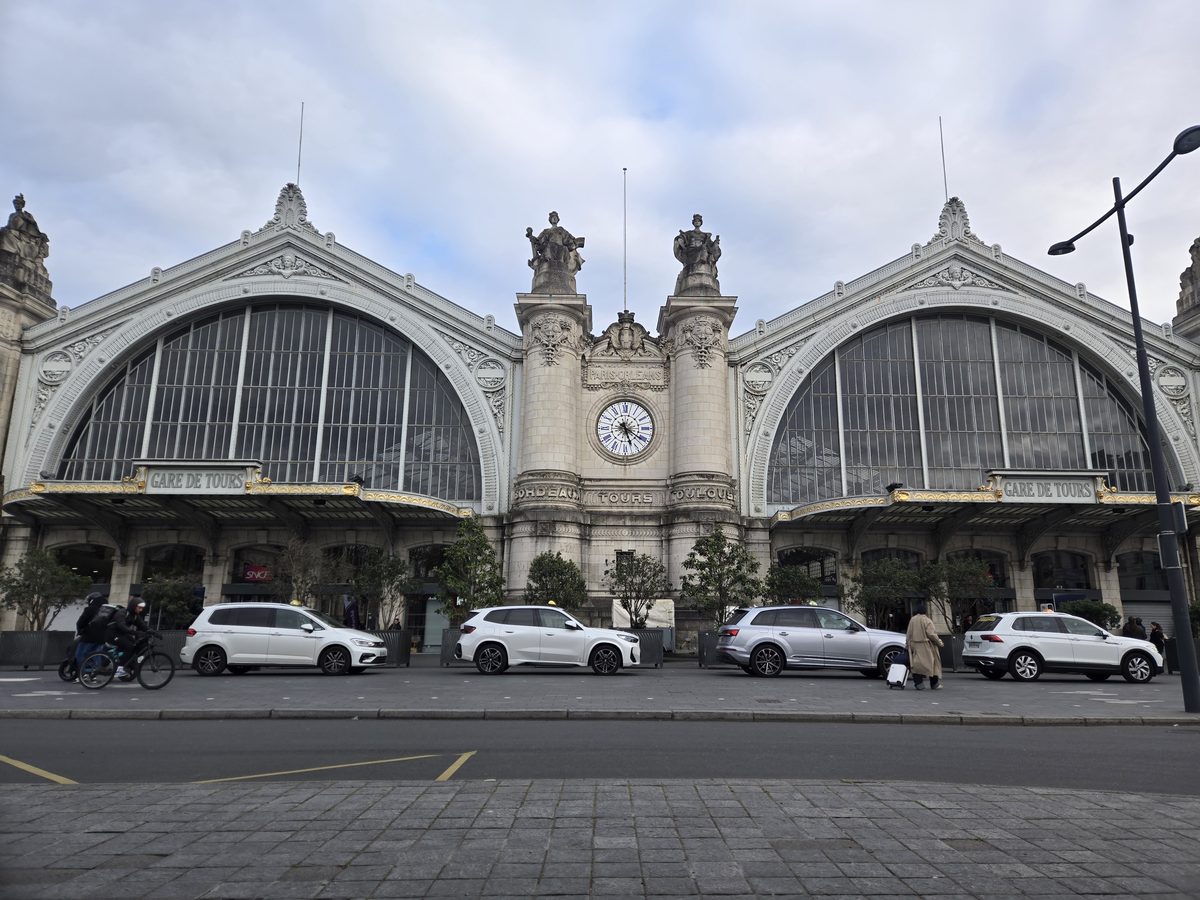
Gare de Tours. My point of origin.
Pilgrims on the Road
My Italian neighbor never quite gets herself all the way into her own seat. For nearly the whole two hours at least some part of her is touching me. It’s not that big a deal; this isn’t even the most cramped I’ve been on public transportation this day. But it’s not necessary, either, and while a younger man would probably be delighted to be in constant contact with a young Italian woman, I am not a younger man and there are Ways of doing things here in France that don’t include spilling out of your train seat. I squirm and she realizes her elbow’s on my forearm; the elbow is withdrawn and now her foot is against my calf. After a few minutes, I shift my leg, the foot goes away and the elbow comes back. Move the arm again and now there’s a knee on me; where did that knee even come from?
I give up after a while. There’s nothing in it, she’s just a little oblivious and it seems her natural state is to be a puddle. So we ride along the rails in some degree of harmless physical contact pretty much the whole way.
About twenty minutes out from Bordeaux I feel like she’s looking at me again. I sneak a peek and—oh, her lips are moving. I hit pause, pop out an ear bud, and join a program already in progress.
“…and it does not say where is the train.” I’ve made it in time for the key detail. “Maybe it is another train station?” She’s all but handing me her phone. I take a look and, no, it’s the same train station, it just doesn’t have a track yet. That’s normal; that’s just how it works around here, kid, trust me.
“It is okay. In France,” now I gesticulate at the air, “they do not like to say where, until the train is here.” She’s nodding along but she’s not understanding. She can form the sentences, but she’s struggling to hear and comprehend English. I sympathize with that. Having a little of the language is like being the biggest kid at the kids’ table; you understand more of what’s happening at the grown-ups’ table than the other kids, but not enough to be seated there.
“It is ok,” I say. “You are in the right place.” She is very restless about it. I can tell that she wants to get up; it’s a particular kind of restlessness. It’s not really time for that yet. One early adopter has got his bag and is by the door, yes, but with twenty minutes remaining we have another ten until we all needlessly get our things and try to cram the exit, as though any of us get there faster that way.
She’s going to ask me to get up in a minute, I’m sure of it, and I’m equally sure she doesn’t want to have to do that. Ok, I can be that guy today. It’s not like she’s embarrassing me in front of my friends; no one on this train knows me. I get up, put on my coat, and grab my bag.
Naturally, that’s the signal for everyone else to do the same, but as I go and stand with the early adopter, I notice that my Italian companion and her impressively large suitcase have shoved their way through the throng and she is again right next to me. I sense our time together has not quite concluded.
It’s my first time being up here at the head of the needless crowd and it’s a bit unpleasant. The crush of people coming from both directions, and all the collective luggage, creates a physical pressure. The contact is out of necessity now, but no one has to worry about falling over if there’s a sudden stop.
She keeps glancing at me as though she’s worried I’ll vaporize. I actually understand perfectly. She’s in a foreign land, this is clearly her first time on a French train, she’s nervous and uncomfortable, and I am the only thing here that she knows. I get that—when we’re out of our comfort zone, the tendency is to cling to anything familiar. Right now, our two little chats are about all that she has to cling to. I’m a guy who knows how the trains work, and that is the only thing she has any confidence in.
I disembark before her, but I make a point of taking a slow arc on the platform so that it doesn’t feel unnatural when she and her suitcase sidle up. I point to the departures screen and say, “we will find your train.” It doesn’t provide much comfort—she is very unsure of this moment.
At the departure board I point at her phone and she shows me her ticket. Yep, right station. Yep, her train is on time. Yep, it’s on the board. No, it doesn’t have a platform yet. I point to the board and say “Langon.”
“It does not say!” She’s approaching tilt. I wonder where she’s going. Travelling for college? Work? If she were visiting friends she would have called and asked them, but instead she’s asked a stranger for help. She’s on some kind of journey.
“It is okay.” I tell her. “It will say. The train—it is not here yet, but” I point to the board again, “it is on time. It will say twenty minutes before it leaves which track.” That was too much of a mouthful and I knew it as soon as it came out.
“Maybe it is wrong station. Maybe I ask,” and she looks back to the train we’ve just come off and takes a half-step that direction. This is it—this is my chance to turn and break free if I want it. This is not my rodeo.
“No,” I say. Apparently I’m seeing this through to the end. “It is okay. Right station. Train—on time.” I point to the train number on her phone, and then to the same number on the board. I point to the departure time on her phone, and then to the same departure time on the board. Her departure is in 27 minutes so I tell her: “seven minutes, it says,” fingers in the air: seven. I’m reminded of the train boards in the stations of her home nation. They have an extra column that isn’t on this Departures board—lateness. Train times in Italy are like prices in America: you have to do some math in your head if you want to know the final calculus.
Here in France, they just wait until the last possible minute to tell you where the train is. That’s just the Way here. The trains are on time—except for when they’re not—the French just don’t always feel a rush to assign that train to a platform until they have to.
She’s getting it now but she still doesn’t know exactly what to do about it. I point to the tunnel that connects to the other tracks. “You will go there. Board,” I point to the departures board again and she seems to get what I mean: go down there, there will be another board; look at it. “Seven minutes, it says.” I tell her calmly and confidently with a gentle American smile.
It lands this time. Visible relief. Her smile comes back. A quick thanks and goodbye and she heads toward the tunnel and I toward the front of the station, and that’s that; we’ll never see each other again. She will make it to Langon, but she will ask someone else for help within the next seven minutes, I’m sure of it.
In an ironic turn, I have trouble finding my exit in the train station. Sometimes arrows seem to be in a different language, too, and it’s only accidentally that I end up outside on the intended end of the train station. It’s very dark and—this is odd—there are no crosswalks. I check my map and do the swervy-phone thing to make sure it knows its North from its South and it confirms, I am to cross this dark, crosswalk-less road and head down that dark, crosswalk-less road. Well, it’s Europe. People don’t usually get murdered here.
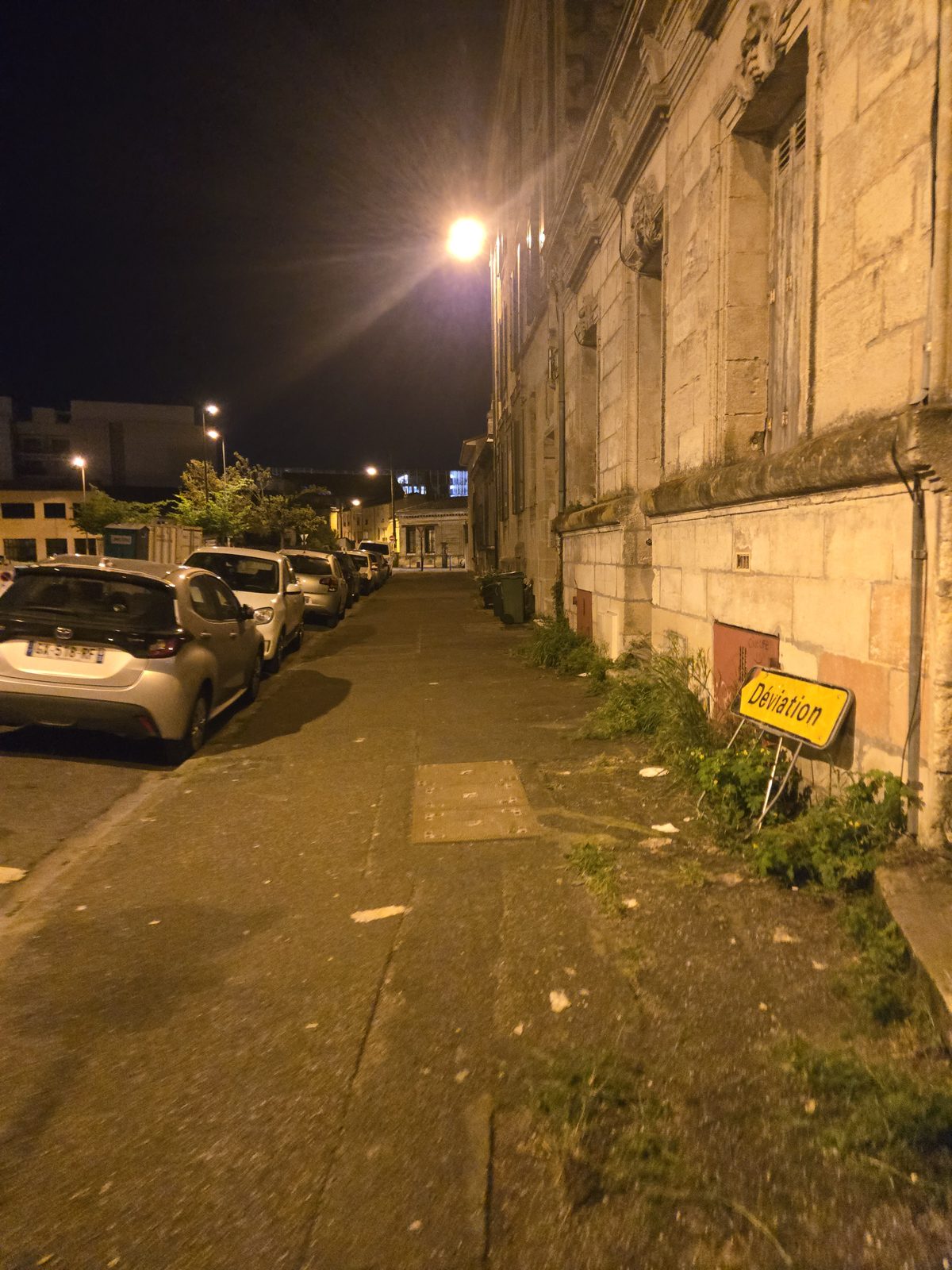
I have barely five hundred meters to cover to reach my hotel but I have to say, Bordeaux is not showing me its best side. There’s a fair bit of rubbish in the gutter and the sidewalk is overgrown with weeds as I make my way; the darkened buildings have crumbling facades and the odd bit of graffiti. A detour sign has been cast aside here on the sidewalk and it suggests a deviation, but I double check; this is the right path.
On the next block the situation changes—half of this street is the same as what I’ve just seen, but the other half is new and nice. It’s not hard to choose which side to walk on, and in mere moments I’ve walked right past the main entry to my hotel. The only thing that clues me in is a guy walking toward me with a pizza box who turns through a door that looks like the side entrance to an office building. Instinct kicks in and I stop, back up a few paces, and discover that this is the place. The sign is tucked away within; you have to look in to see it. I will accidentally walk right past this door two more times on this trip.
The hotel is a lot nicer than I would have thought. I’m trying to do this trip inexpensively and so I’ve elected, for the first time of my own volition, to use one of these European tourist hotels that has both communal sleeping spaces and private rooms. Naturally, I’ve elected the private room, but I like the space on this first floor quite a lot. There’s a bar, there’s work pods, there’s an air hockey table and video game machine. There’s a little play area for kids, there’s a couple of vending machines, and there’s a warm-looking fellow waiting at reception.
“Bonsoir, j’ai une réservation au nom d'Erik Taylor.” I even inflect the syllables of my name, uhREEK TAYlohhrrghgh. That’s French, baby.
We go through the usual steps. Yes, two nights. Payment par carte. But then he asks if I have stayed with this hotel before. It’s a more complex question and it takes me a second to decode it. “Non, c’est mon première,” but I bollocks the pronunciation and say it like an American. Like my Italian friend on the train, this takes a good bit of concentration for me and the unexpected question has caused a stutter in my focus. I spill it. “c’est mon pruhmeer… uh, fois. It’s my first time.” I switch to English after my bungling.
“Awwwwwww nooooo!” That is not the reaction I saw coming. “You started with such a polished bonsoir and we had such a good thing going but you had to go and ruin it.”
This is, without a doubt, one of the greatest compliments I have ever received in France.
I chuckle. “Merci beaucoup! J’apprends encore.” I am still learning.
“French is the most difficult of the Latin languages to learn,” he tells me. I notice the flags on his name badge that indicate his languages. He would know.
“Some say French is a designed language,” he goes on. This is a very un-French interaction. “They believe that when it was spoken four hundred years ago, they made the rules complex and difficult, so that only wealthy and educated people could speak it.”
“It remains a complex language with many rules,” he continues. It feels like he’s building to something. “So it is best understood when soaked in wine.” He leans back and laughs. He’s made me feel like I’m seated at the adults’ table. I sure like this guy.
Not long after, I go back through the almost-hidden door and head the opposite direction from the train station. I’ve spotted out a chain restaurant that I know will suit my needs and it’s about thirty minutes away. I’ll have to walk along the riverfront and across a bridge to get there, so I feel like I’ve made a good plan. I want to see Bordeaux. But fairly quickly I hit a construction blockade with no alternative passageway. The only choices are to turn back or try this random left.
I take the left and again, Bordeaux is not showing me its best side. It’s another dark road with buildings in poor repair. I feel less than comfortable with my surroundings, and this goes on for longer than I prefer.
I’m getting hungry and I’m starting to wonder if I should just turn back when I see lights up ahead of me. Not long after, I see a tram go by and it looks like a few restaurants and—aw crap, it’s just the frontside of the train station.
All I’ve done is make a long tour of the station’s backside. Well, at least it’s good to know that the station has a nice side. I scope out the restaurants across the street and they don’t immediately strike me as the vegetarian or not-super-slow variety, so I duck back into the train station. There is one restaurant in France that I can always count on for a good vegetarian meal, and I can always count on it to be in or near a train station.
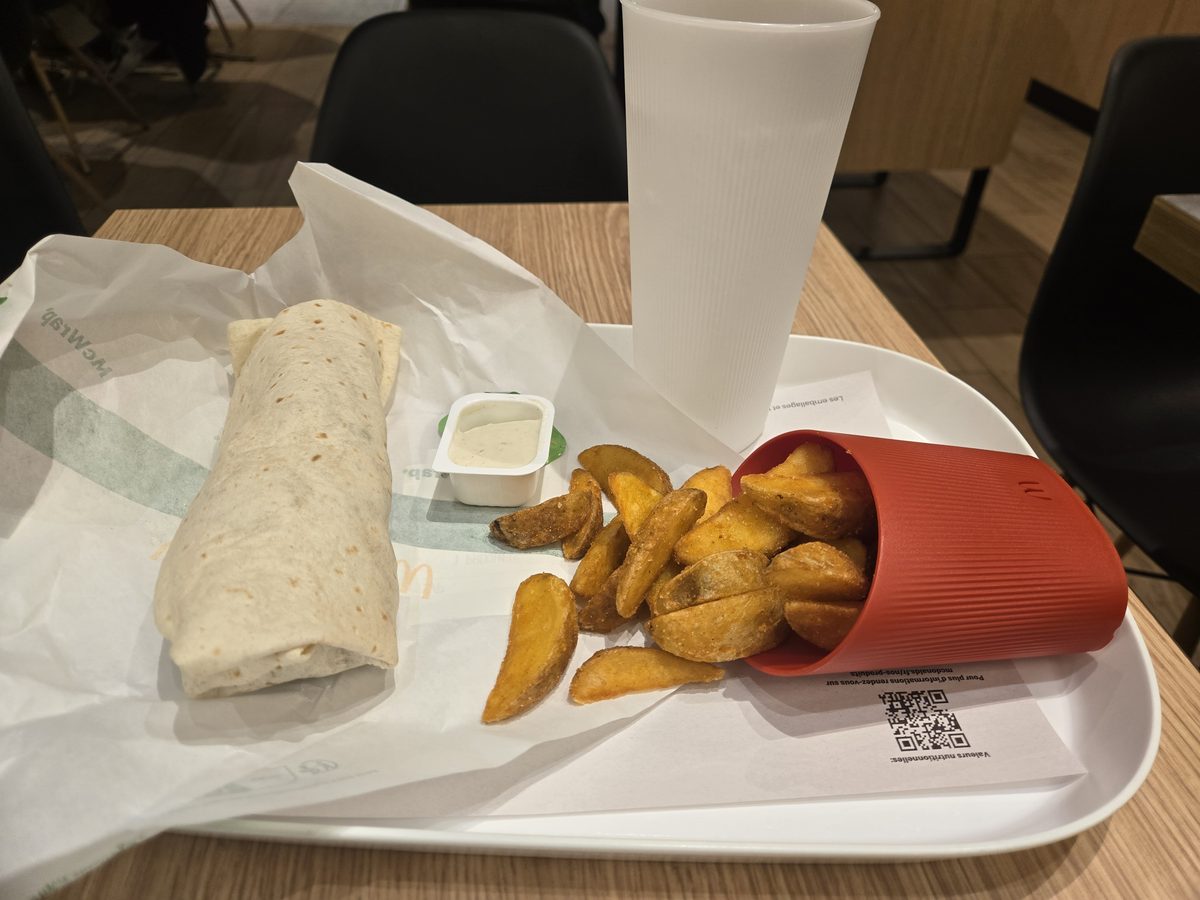
McVeggie wrap, potato wedges with creamy deluxe sauce, sparkling mineral water. Between French food quality laws and a full vegetarian menu, McDonald’s is a highly reliable choice for the traveling vegetarian.
A Pilgrim’s Path
There’s an extra layer of security that European bank cards carry that our US issues lack and I make it harder on myself because I only carry an American Express and my Debit Mastercard. In my home country, Amex is a solver of any and all travel problems, but here on the continent it creates more problems than it solves and when my Debit card doesn’t work at the ticket kiosk for the metro, I’ve fallen into my own trap.
This happens not irregularly. I was able to use my card at the kiosk at McDonald’s the night before, which almost never works, but here at the tram stop I have to be that guy who tries twice only to have the screen flash “Payment card not accepted” for the people in line behind me to see. The only thing that spares me from embarrassment is that I’ve seen this happen enough times to enough out-of-towners that I have internalized it as a mere hardship we travelers endure.
There’s an app and I download it but by the time I’ve got it set up and wired with funds I’ve missed three trams. And when I finally board, the validation box makes that unpleasant sound and flashes red so as to attract the attention of all the other tram-goers. Social shame is a big part of how Europe works, and those staring eyes are motivation for me to try again, but it’s the same outcome.
I open the app and sort through a pile of in-app pop-ups and on the 7th try it makes the pleasant sound and flashes green. That I really don’t feel any shame or embarrassment for having struggled so with this ordinary feature of everyday life for the Bordelais is a testament, I tell myself, to what a hearty traveler I am. I’ve sorted it now and next time, armed with prior learning, I will surely coast through like a local. I think this, but I won’t actually get it to work properly until my fourth tram ride.
I approach my first itinerary destination from the backside. Built between late 1300-something and mid 1500-something, Basilique Saint-Michel is an expressive Gothic specimen with ornate detail under the window arches and long-running and elaborate flying buttresses. It’s meant to draw eyes and hearts toward Heaven but I’m having a hard time getting my eyes off the ground. Here on the earthly plane, the Basilique is joined by fencing, construction equipment, delivery vans, a fair bit of rubbish, and a graffiti-covered pissoir.
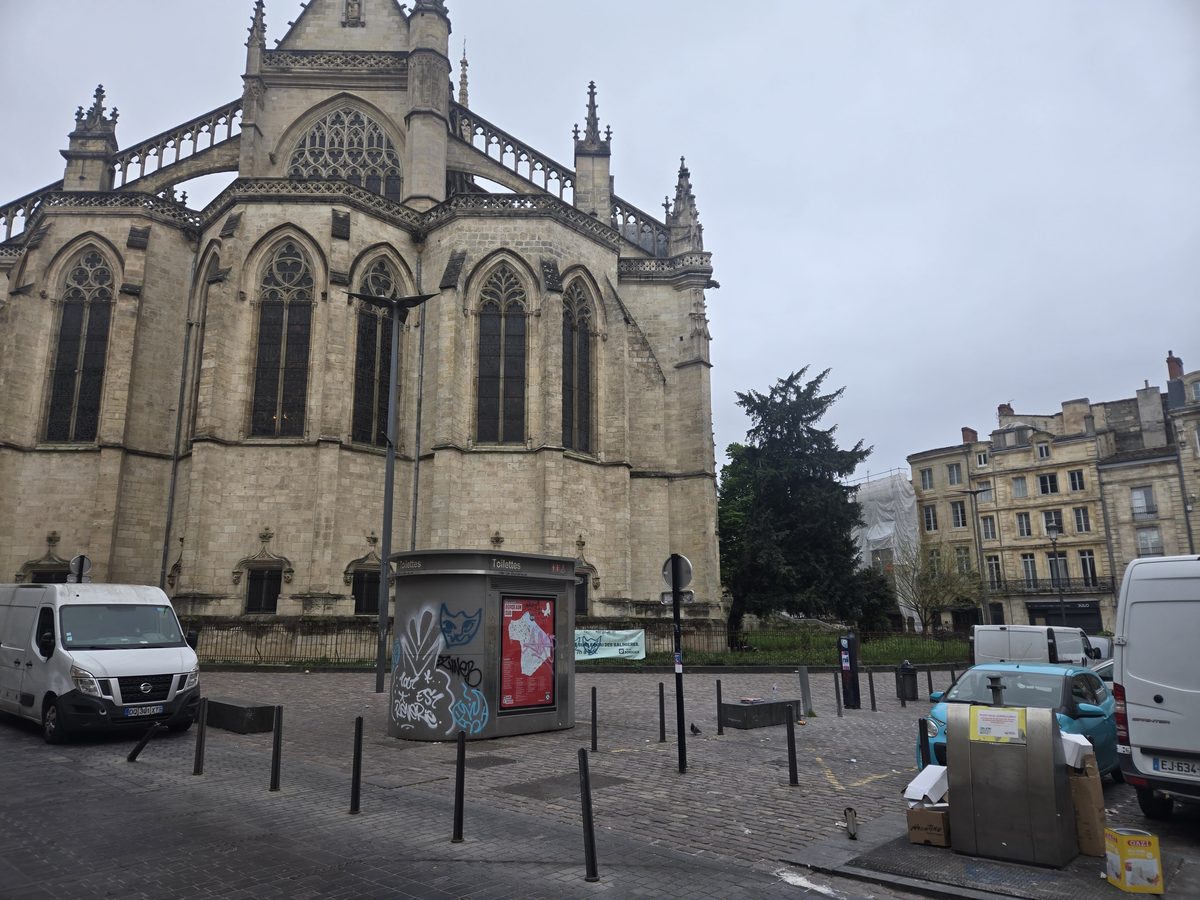
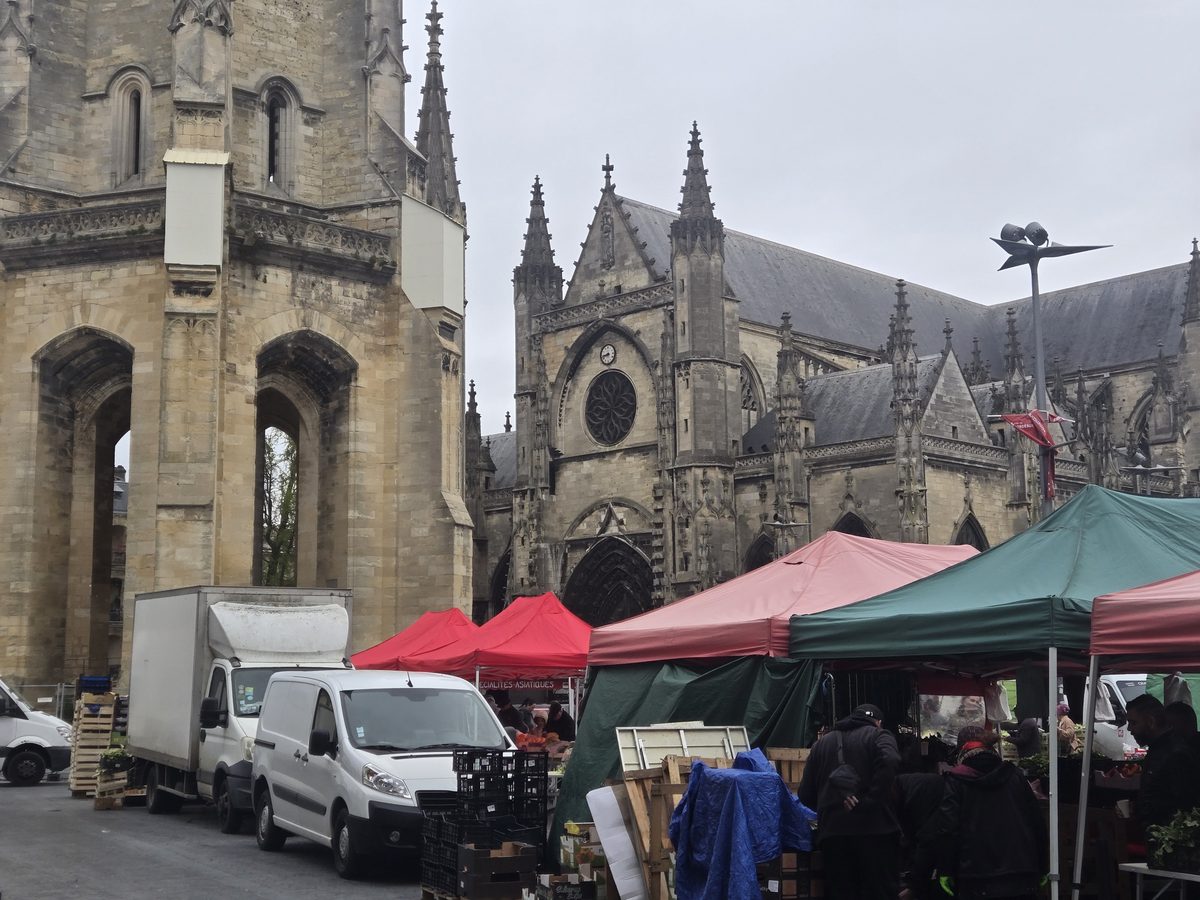
A market, a basilica, and outhouses on a campanile.
I walk around to the front and it’s not a better sight. The spire for this Basilique is detached from the rest of the building, a campanile—added later and so added separate. It’s visually interesting and when I see it later from a distance, poking out over the buildings on the waterfront, I’ll be more impressed. Just now, though, I can’t get a picture of it that doesn’t also contain all this earthly debris. Even on the spire itself are structures that appear like added-on outhouses. I presume this is part of the work, perhaps repairing the statues or gargoyles. I suppose I’ll have to come back one day when they’ve removed the outhouses.
There’s a market taking shape in the square in front of the Basilique. It’s like a full grocery store but every department is a different truck or tent or vendor. Here’s your melon guy, there’s the beef bro. It smells good and it looks lively, which are two things I cannot say about Saint-Michel yet, so I walk through the market for a minute. It’s an immigrant community and there’ll be no shred of doubt that I’m the tourist here. That’s freeing, in a way—I don’t have to try to fit in because I simply don’t.
I walk around the market until I do, in fact, start to feel weird about it—imagine a dumb tourist walking around Walmart and gawking—but I’ve managed to work my way around the construction site to where I can actually go into the Basilique.
Instantly it’s a different experience. The inside is old and stale. The limestone is oxidizing to that blackish-gray. The flagstones are worn and warped, the gates to the various chapels old and unpainted. It feels lived-in; it smells like an old book. All throughout the interior are signs of life. There are signboards about church and community events—more than one usually sees in a tourist spot—and on columns and chapels through the nave are portraits of ordinary people with Bible verses underneath.
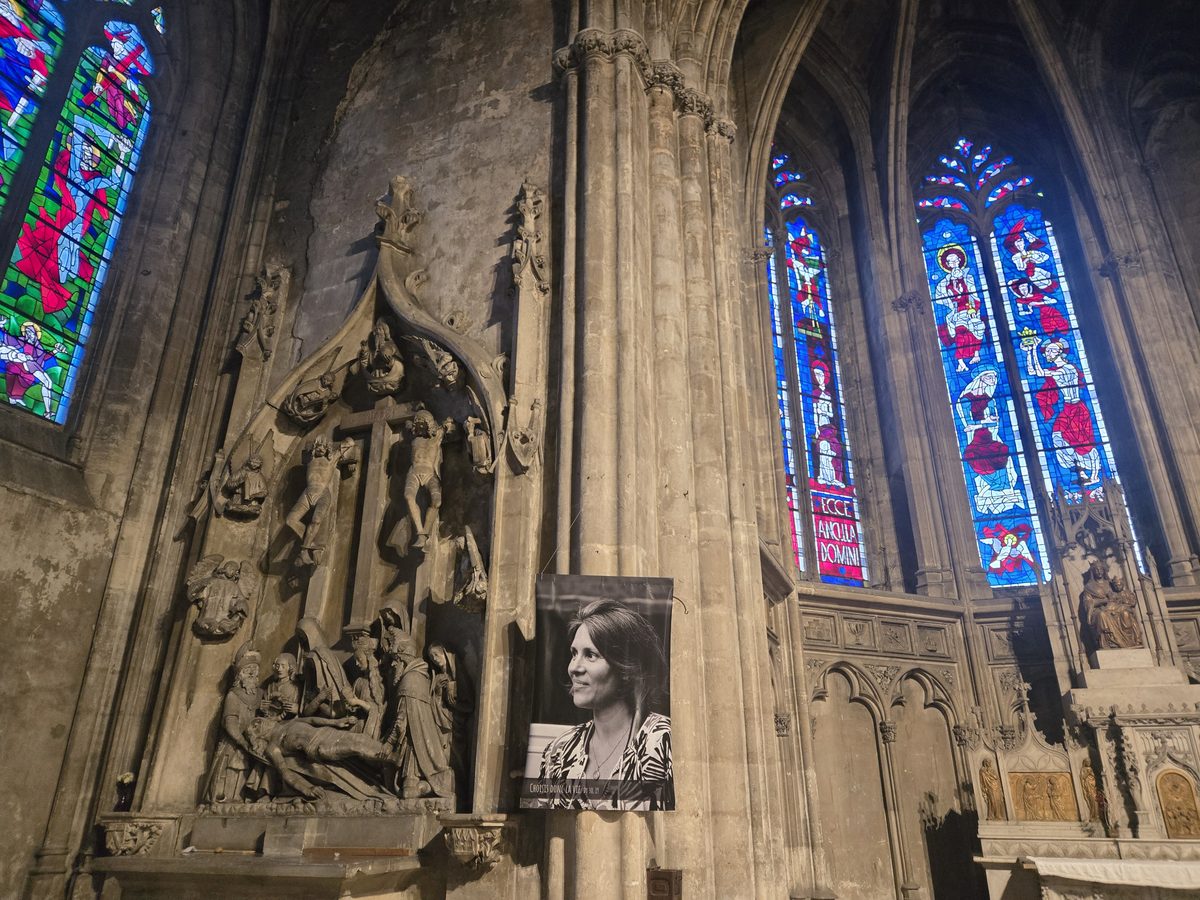
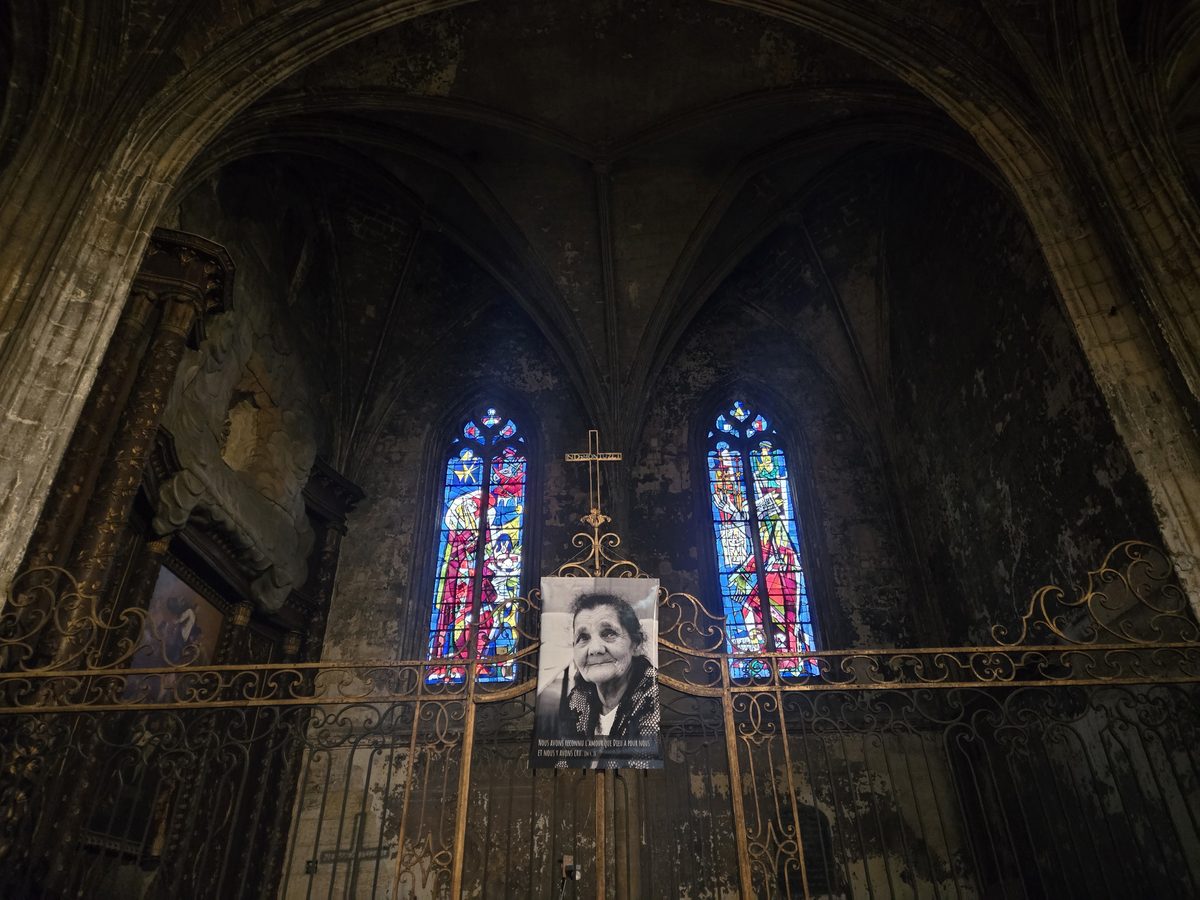
Inside Saint-Michel. Half a millennium of prayer and dust coats the interior.
I can’t help but compare it to Notre Dame in Paris. In terms of scale, grandeur, and the feeling of immense importance, there is no comparison. But in its post-fire restoration life, Notre Dame feels new and that feels a little strange. This place—this place feels old. It’s worn, this church. It’s served its congregation and you can feel it. I imagine the photos to be the real faces of the real members of the community, and the Bible verses feel real and relatable. They’re about community, and place, finding strength and solace in Jesus. It’s so dark in here and the paintings so old that it’s a tad difficult to understand what’s in each chapel along the nave—the residue of half a millennium of prayer and dust coats the interior. A cute young Italian on a train may not spark anything in my heart, but this place does.
I’ve had the place entirely to myself and I’ve been able to be slow and really soak it in, but now there’s a loud noise at the door—someone enters the Basilique while still in conversation with someone outside and he’s practically shouting. His footfalls are heavy and he closes one of the chapel gates with a clang as he comes in.
It’s only after he’s clanged the gate that he notices me, and I didn’t need the surprise on his face to know he thought he was alone.
There’s a bonjour exchanged and he’ll be much quieter from this point on. I see him cross himself in a perfunctory manner as he moves to the next chapel. He could be the priest or he could be the caretaker, but whatever he is, I recognize the comfort level. It’s not that this isn’t a holy space to him; it’s just that it’s such an ordinary part of his life that it doesn’t hold the same magic for him as it does for me.
I genuinely don’t mind. In fact, I feel like I am seeing this Basilique in its most natural state—as a regular part of this community.
The man goes about his activities, flipping these lights on and those lights off. I hang about, taking it in a little longer. Eventually I hear the nearly-silent footfalls of another visitor. I make a deliberate choice not to turn around and see the other person. I had it to myself for a little bit; I’ll leave this person their anonymity so they can enjoy the same taste.
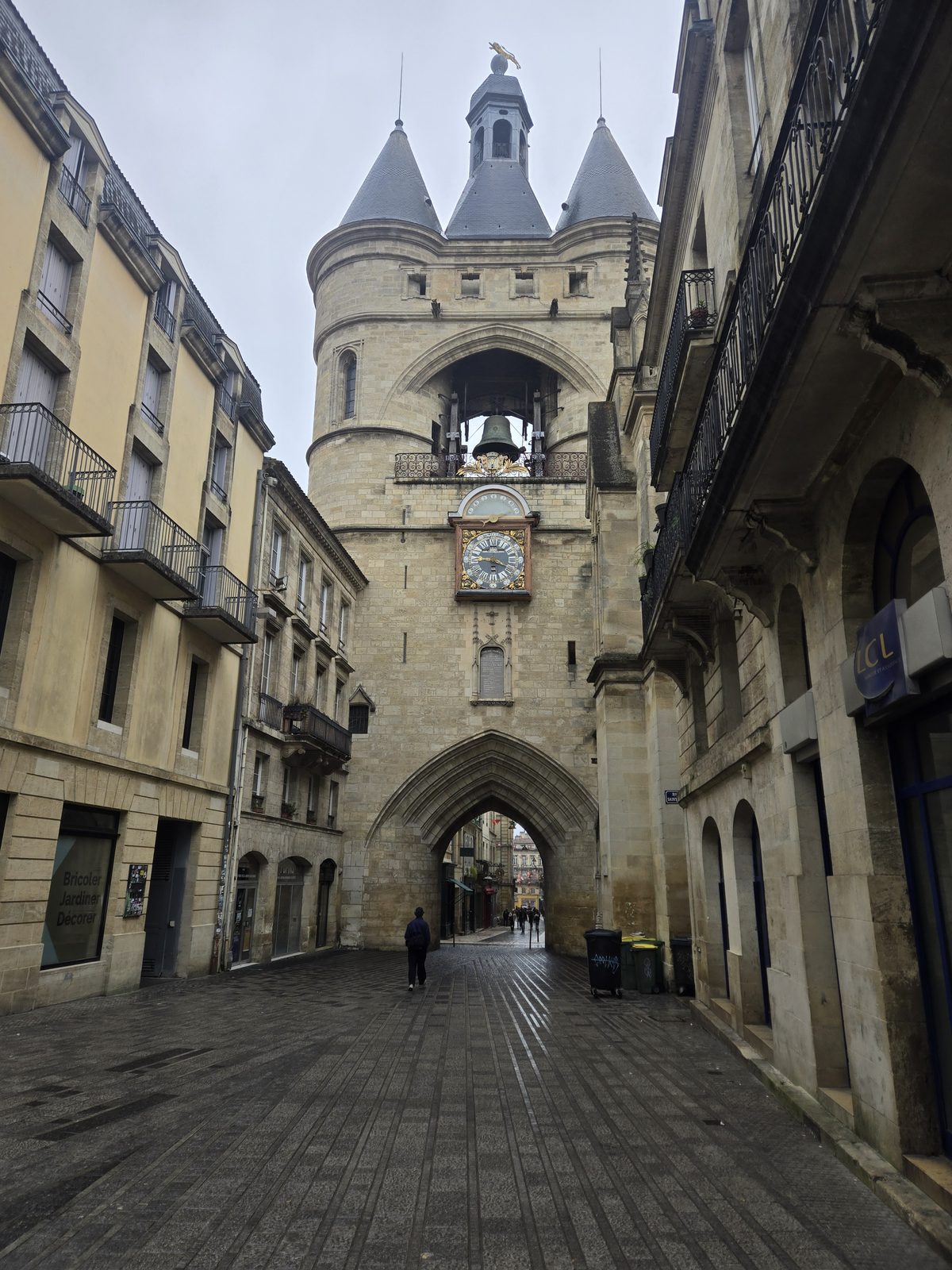
The Grosse Cloche. The Big Bell of Bordeaux.
By the time I let myself out of Saint-Michel, a misty rain has descended on Bordeaux. It’s that light rain-plus-fog combo and it’s not long before the lenses of my glasses are coated. I don’t have far to go to my next itinerary item, though: the Grosse Cloche, which Wikipedia calls “The Big Bell of Bordeaux.”
Meh, I’ve seen bigger bells.
I mean, it’s cool I guess. It’s neat to be walking along and then something like this just pops up. It was built in the 1400s atop a prior gate on the rampart, but—why isn’t this doing it for me? Normally I’m all about this sort of thing. I have a very refined appreciation of old walls and seek them out in Europe whenever I can, and that’s exactly what this is; it is one of the gates into the walled medieval city. Pilgrims pass under this gate on one of the main passages of the pilgrimage to Santiago de Compostela, and a big part of the history in Tours is its role as a key stop on this same pilgrim path. Every day in Tours I pass down the boulevard that remains part of the pilgrimage, and those pilgrims eventually pass under this very gate. I expect to feel a thump of connection in my chest, but none is forthcoming.
So far Bordeaux has not shown its best side to me and this older part of the city feels like a dozen other medieval European cities. There are fewer tree-lined boulevards, there are no Haussmannian-style buildings with mansard roofs, and I feel like I haven’t tasted the flavor of this city yet. The Big Bell of Bordeaux is a celebrated clapper whose history contains many joyous rings for weddings, harvests, and celebrations, but I also know that medieval cities were about control.
I pass under and it is neat to see the narrow and sloping streets of the old medieval structure glistening in the misty rain. The street behind the gate opens onto a small square, and looking back up toward the gate from there makes for an attractive view. I chastise myself for having been so unimpressed and give myself a small, internal lecture on not taking travel for granted. It’s a privilege to be here and maybe I shouldn’t render judgement on the Way of Life from hundreds of years ago.
The weather is not especially fun, either, and maybe that’s a part of it. It’s still early yet but I am getting wet and, much as the calling of the bell would have ruled life here in centuries past, the calling of the water closet is affecting the rhythm of my day. Someone’s had too much espresso.
I had espied a small café as I came into the square so I circle back. For the mere price of yet another espresso I can buy a bathroom break. I order a cappuccino and—why the hell not, I’m in France—a croissant.
It’s a cozy space. The lighting is soft, plants hang from the ceiling, and an assortment of wood-and-unfinished-pipe shelves hold books and tchotchkes all throughout. There are elements of a jazz theme with familiar faces in frames and the occasional music note appearing amongst the bricolage. Indeed, none other than Louis Armstrong himself watches as I answer the tolling of the water closet bell.
When I receive my cappuccino and croissant, I know I have made a good choice. This is a proper cappuccino and croissant. This is France at its best.
I savor it in the French way: slowly and while observing life. The café is steadily filling up. Small groups chat in French, a few solo artists like myself sit and watch, or sit and read on their phones. It’s comfortable, and it’s expected that one will sit in a café like this rather than slam that espresso and run off. Those places exist; this is not one of them.
I read more about Saint-Michel and the Grosse Cloche, making sure I’m not missing anything. I am, it turns out, but not in a way I can do anything about. There used to be mummies and an ossuary at Saint-Michel but that was all done away with in 1979. I’m too late. I make a note to set the time machine to 1978 for Bordeaux and turn my attention to my next target, Cathédrale Saint-André.
It’s barely mid-morning and I notice my phone battery is already draining, but I’ve brought my blue backpack—my trustiest travel companion—and within it my laptop, so I swap small screen for slightly less small screen and continue my reading. Eleanor of Aquitaine, Henry II, political alliances…
Suddenly the host looms over me. “Excuse me, sir. We do not allow computers here.”
And this moment, this exchange—this is peak France.
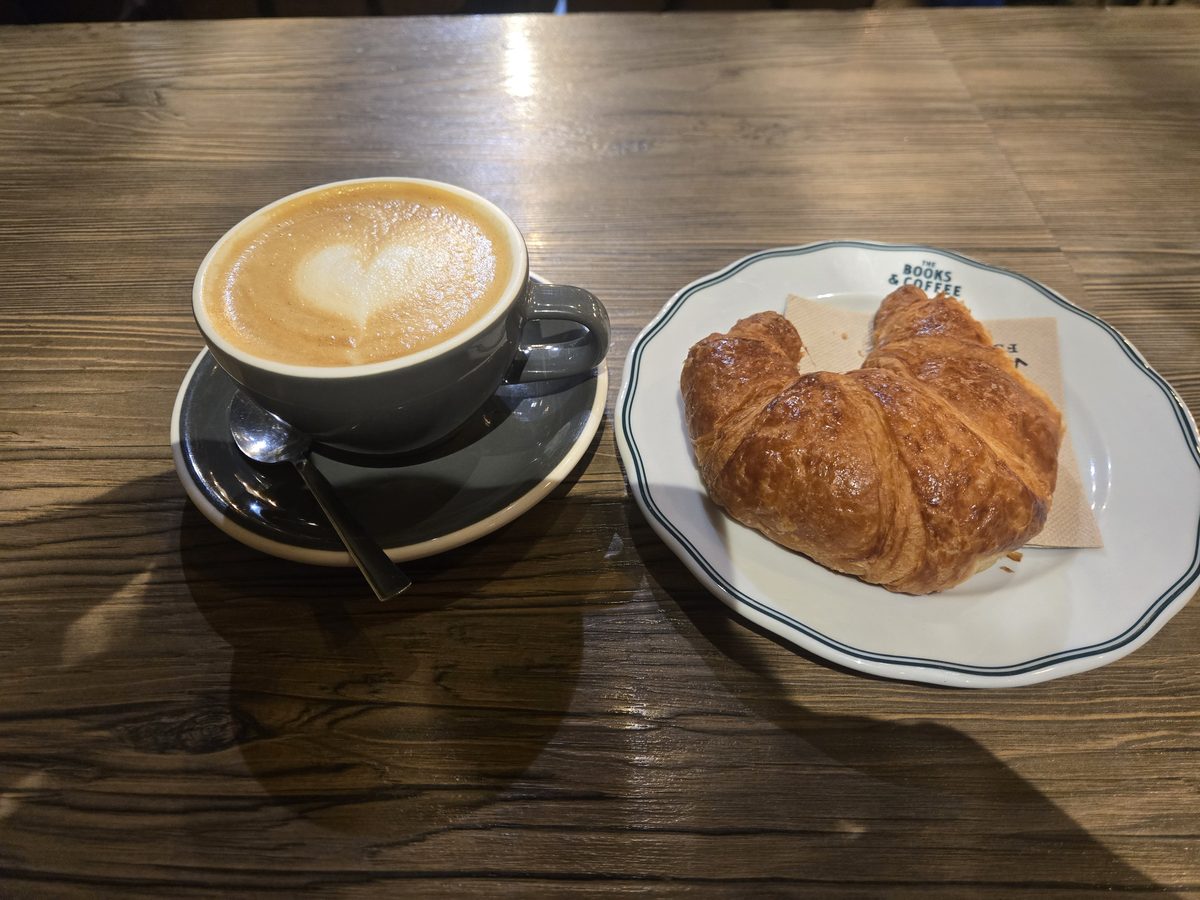
The best of France. This one was inexpensive in currency, but costly in self-pride.
The Way of Life
In the deeper and more friendly encounters I have with the locals in France, invariably one arrives at the question of what kind of work has brought me here. It happens regularly enough that I’ve learned the most communicative answer is to say that I’m a professor of economics working with French researchers. It’s accurate even if there are more accurate ways it could be put.
This elicits a surprisingly consistent response from the French locals: “Oh, good, we need help!”
France is a fascination to me, economically-speaking, because it’s both strong and robust, and at the same time plodding and slow. They are major economic players and they belong at the big kids’ table, but France’s economy is also slow to adapt, mired in bureaucracy, and credit does not grease the wheels in France in the same ways as it does in other countries. France is not especially well-positioned for economic growth. They are simultaneously on the global economic stage, and dragging a leg behind the body as they strut across it.
That’s not entirely unique to France but France has its unique Way. And it’s that leg dragging behind the economic body that appeals to tourists and Francophiles because it’s a foot planted in the Ways of old. Being slow to change, keeping a foot firmly planted in the past, is what gives us that high quality food and the culture that insists you take your time to savor it. It’s why they protect namesakes like Champagne and Bordeaux, and it’s a big reason why so much of France has old-world charm. France changes and adapts—I wasn’t made to come through the Grosse Cloche under ringing bell and watchful eyes to enter Bordeaux. But it adapts slowly. This is how France protects its Way of Life. Like its complex set of language and pronunciation rules, or like the bell that used to ring out the order of life in this city, France insists that you do culture the Right Way, too, and they’re no less serious about it. But it creates conflict between the old and new, and that bears out in both the economy and in cafés.
Here, in this café and in this modern Bordeaux, under the watchful eyes of the Big Bell and the barista alike, the expectation is that we set aside the modern and stay in touch with the old. We uphold the Way of Life. Talk to a friend, read a book, watch the world turn under the rain. Reading on my phone was one thing. That’s a concession the café has made. Like the economy itself, France lumbers into the future, and accepting the phone as a substitute to the book is an acquiescence. But a laptop is a decidedly different symbol. It may be a subtle one to my American eyes, but it’s an unwelcome symbol here: I’ve brought a work tool into a socializing space, and that is not the done thing.
I bustle away my laptop and loosen my scarf. Suddenly it’s much warmer than it was a moment ago, and I’m aware of the eyes of others.
I have violated the social contract, the Way of Life. I am decidedly an outsider here, and I have just been busted back down to the kiddy table.
The River
The rain has not washed off the residue of that unpleasant café encounter, nor has the Cathédrale absolved me of my sin, when I finally reach the river. I smell it before I see it. A tidal estuary, the river Garonne rises as much as 20 feet with the tide. Like London on the Thames, this is a particularly potent geographic point—to be so far inland is to be protected from ocean-based raids, which is not a trifling matter in ancient and medieval times, but to have such a substantial river is to be accessible to ships that can voyage across the whole globe. Places like this are destined to become economic engines.
That is precisely Bordeaux’s story. History first touches this land around 300 BC. At that time, the Bituriges Vivisci were settled here and already engaged in regional economic exchange. With the arrival of Julius Caesar a couple centuries on, Bordeaux joins the players on the main stage. Burdigala—the Roman city established on the foundations of that Gallic community—is quickly integrated into the imperial system as a crucial trading node but also a defensive outpost to help protect important Roman assets here in Gaul and in Iberia. Burdigala becomes the regional capital and some of the first non-Latin Roman elites will come from here. A place like Caesarodonum (i.e., Tours) was a Roman outpost; this was a cosmopolitan Roman city.
The river is the key. Look at a map of France and you will see in Aquitania—the bottom-left bit that borders the Pyrenees and Spain—that the Garonne is a wide body that strikes deep into the side of France in much the way knives found the side of its famous conqueror in the forum in 44 BC. Few will describe the smell of such a tidal river as a pleasant one—it invokes an alley behind a seafood restaurant—but it’s a familiar smell and it replaces the acrid aftertaste of my café encounter, so I abandon my walking plan and head straight for the river.
Now this, this I can relate to.
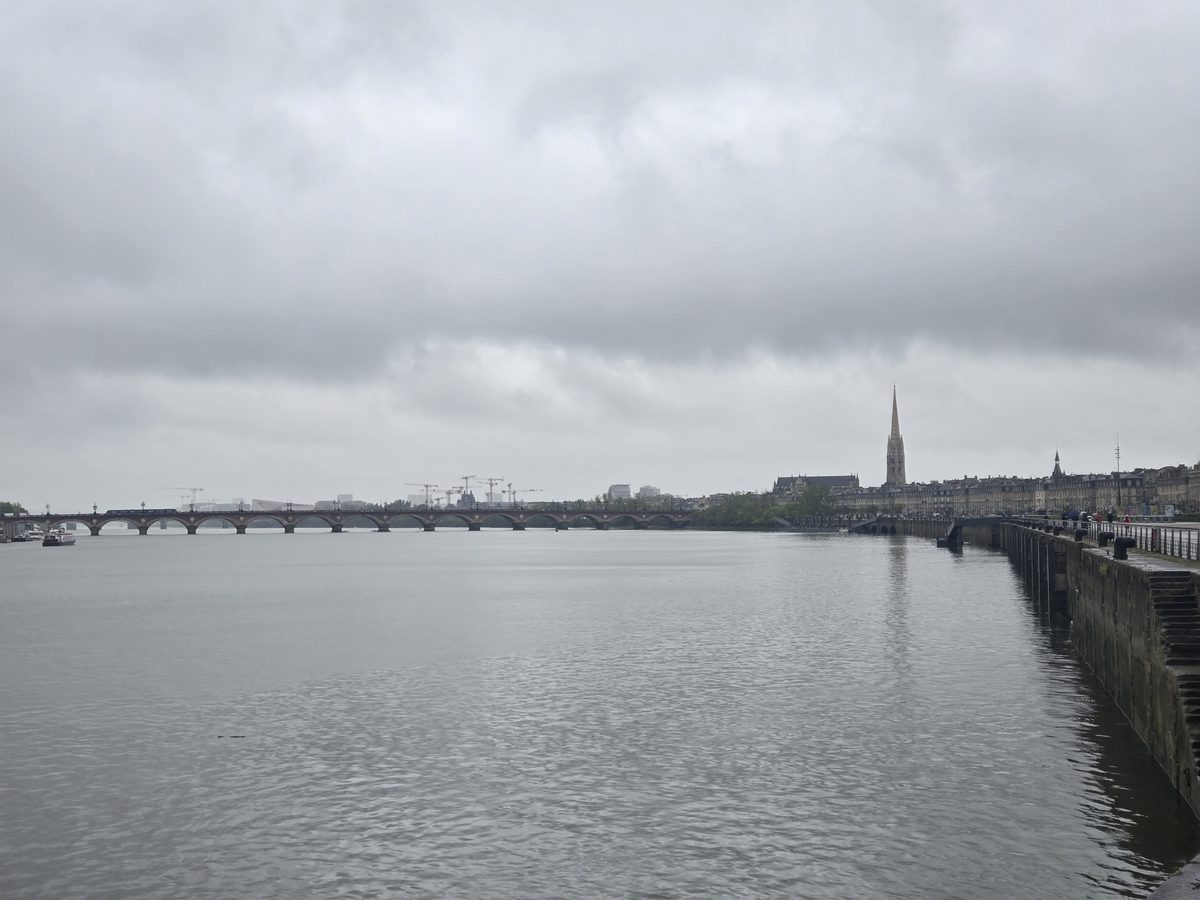
The Garonne. Wide, brown, slow, and smelling faintly of a seafood alley. A comfort, somehow.
The river is wide and brown and slow. It’s mid-tide and the muddy banks are visible, various quays dot the scene. There’s a lovely stone bridge over arches that stretches across, and a building on the other side has emblazoned across its top floor, CE QUI NOUS LIE. That which binds us. Like much in France, the phrase is replete with layers of meaning. Wine, surely—many philosophers have arrived on this same conclusion, and many wine enthusiasts have turned philosopher on the same point. It also echoes culture as connective tissue and, for me, speaks also to the economic ties. This river has connected Bordeaux to the rest of the world, and turned it into a truly global city.
I look at the river and imagine the ships that have come and gone down the millennia. The slow rolling water is a comfort I have not yet found in my Aquitanian amble, and I’m inclined to roll along with it. I abandon my itinerary for a little while to walk slowly along the river. It reminds me of another river I used to be close with and just don’t see enough of these days.
I look back toward the city behind me and see the campanile of the Basilique peek over the building tops. It is more romantic from this angle and I have to concede that from the riverbank, this is an impressively lovely city. Probably I was meant to start here, with this view, and then find the less appealing bits, but I’ve done it backwards.
That the visitor is meant to start at the river is not an incorrect presumption. Bordeaux unfurls itself along the riverbank; it puts itself on display. Sailors coming into port over the last several hundred years would not have doubted that they were entering a global economic power. Bordeaux is turned to face outward, toward the river, and toward those global trade patterns that bind us all. This is a proud city.
And my ambling has accidentally brought me squarely to the centerpiece of all of it, the Place de la Bourse. The literal translation is “stock exchange square” but the visceral translation is strength and assertiveness. Its symmetry and order imply power and control, and the crescent-shaped buildings reflect themselves off the glistening stone plaza as though aware of their own grandiosity, and not afraid to sneak a peek in the mirror. This is the image of Bordeaux.
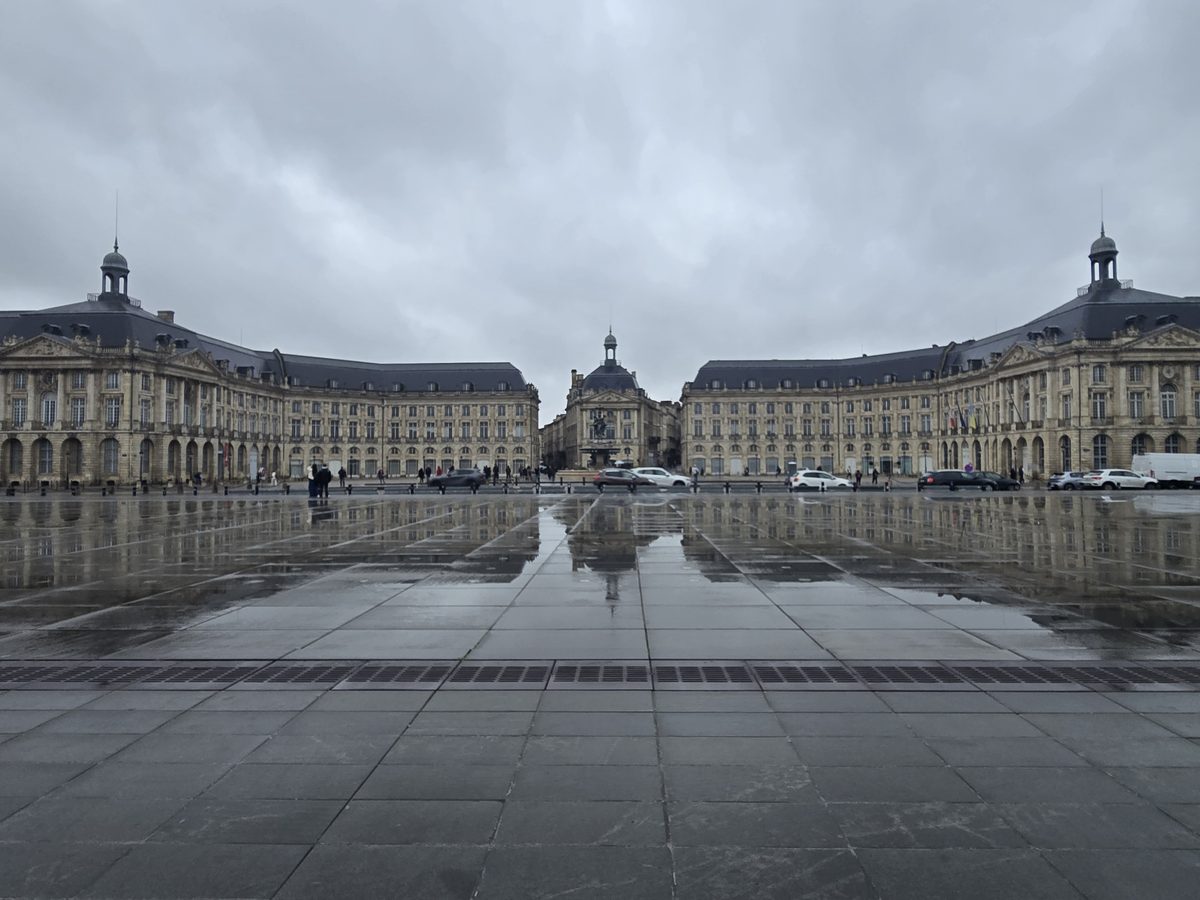
Place de la Bourse. Complex in its construction and its history.
It will be overrun with the Instagram crowd later, but now, still early in the day and still shrouded in rain, it belongs to me and a small clutch of senior citizens, fellow early risers. The entire complex predates the Declaration of Independence and it’s that fact that, for me, lands with the greatest resonance. This really is a spectacular achievement for the mid-1700s. If I could eschew the charm of the medieval townscape, I must yield to the magnificence of this accomplishment.
But yield I shall not.
I recognize its beauty and the architectural achievement. I appreciate the life of privilege that brings World Heritage sights before my eyes, and I take a photo or two that will be a desktop background or appear on a vainglorious personal website. But I will take no bad selfies with this complex, for I know its dark history.
That Which Binds Us
The very same Garonne river that has finally washed off the unpleasantness of my faux pas is the same Garonne that fueled the engines of the Atlantic slave trade. The Place de la Bourse, in all its glory and grandiosity, reflects not only itself but also the spoils of that insidious network.
Slavery died an oddly undramatic death on the European continent. Across medieval Europe, and not in straight-line fashion, slavery was slowly replaced by serfdom and indentured servanthood. In France, Louis X abolished slavery in 1315 and proclaimed that “France signifies freedom.” It was not always practiced nor fully enforced, but it is the general arc.
Slavery reemerged in a big way as the European powers expanded to new territories starting in the late 1400s, because they expanded into lands that supported the growth of labor-intensive cash crops, like sugar cane, coffee, and cotton. Growing these crops at scale required tremendous laborious effort under sweltering and unsafe conditions. The French colony that we would recognize as Haiti had a slave mortality rate approaching 10%—as many as one out of every ten slaves died in a given year—and in a century’s time about a million slaves die in French captivity there. They endure 12-hour workdays and are expected to grow and provide their own food, but only after the 12 hours they are expected to work. Few pregnancies reach full term, and few of those who are born will survive. The need for slaves never diminishes.
But the sugar cane they produce on the island is hotly coveted in Europe and sells at a massive profit. And Bordeaux is a primary profit point.
Bordeaux plays both a direct and a systemic role. Slaving parties are organized here, and slaving ships sail outward on the Garonne during these decades. Bordeaux is, in fact, second among French ports for this direct involvement in the slave trade, behind Nantes. Other coastal cities play a larger direct role than Bordeaux, too, like Bristol, Lisbon, and Liverpool.
But Bordeaux was at the tip of the pyramid of triangular trade. Finished goods arrive from across the continent to Bordeaux and sail down the Garonne on their way to Africa, where the goods are traded for slaves. The slaves are taken to the colonies and then cotton, tobacco, indigo, and sugar cane are delivered to Bordeaux. Here, the crops are either sold for a profit, or turned into finished goods and sold for even more profit. Much of the financing for these voyages happens here; the cargo is insured here—no, not the human cargo, of course. And much of the profit from all of it is re-invested here.
Bordeaux doesn’t back away from its history. One can visit the Musée d’Aquitaine and see slave ship logs and other clear evidence of Bordeaux’s involvement. In a way, the city has done well to strike a balance between not hiding from its dark past but not tearing itself down because of it, either. And trying to lay more or less guilt on this group or that group is a fruitless exercise; other, less insidious trades also happened here, were financed here, contributed here.
But I am struggling to really enjoy the Place de la Bourse, and I don’t overstay my moment.
Burdigala
It is only because it is so far from everything else that I’ve arrived last, but if there was one bit of history I was going to see here, it was this. Known locally as the Palais Gallien, and tucked in amongst a completely regular Bordelais neighborhood just a few blocks from a tram stop, a section remains of the 3rd-century Roman amphitheater of Burdigala. It held more than 15,000 Romans in its day and hosted everything from gladiatorial contests to animal hunts, and it is awesome.
That so much of Rome still stands and can be found and touched is one of the facts that attracts me so to Europe. Wherever I can, whenever I can, I seek it out. I make regular visits to touch the last vestiges of Rome in Tours, and I dragged my family to see so many of the works of Marcus Agrippa in Italy that it’s still a running joke—“that’s not how Agrippa would have made it.” But this is a rare artifact because amphitheaters of this size were not especially common; this symbolizes a major, cosmopolitan Roman city, worthy of the finest in Roman entertainment. And that so much of it, such as it is, can still be seen—that it wasn’t totally cannibalized for other building projects or built atop of—is a very special treat, indeed.
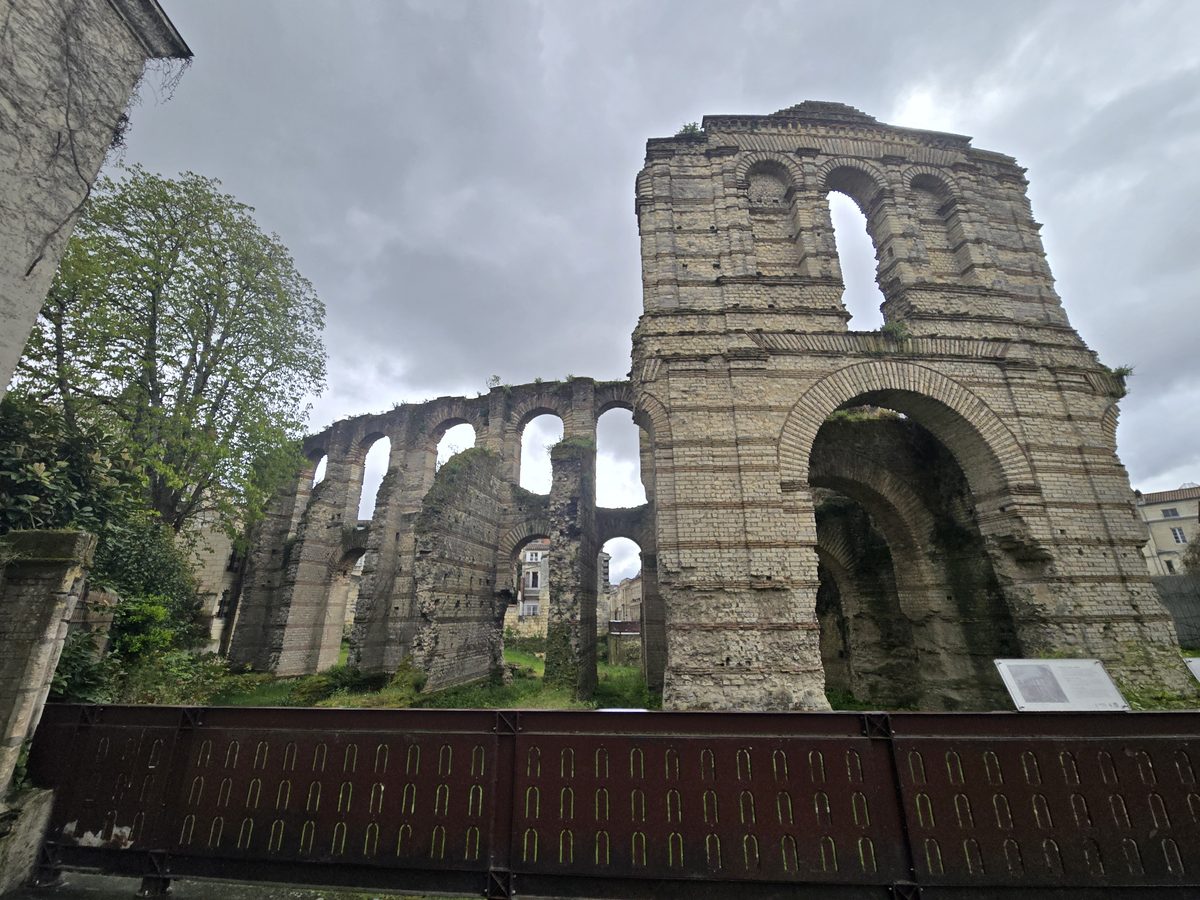
Palais Gallien. The 3rd-century Roman amphitheater of Burdigala.
When I had put in the address initially, Google Maps warned me that it was temporarily closed but I’ve come anyway, because even a mere sliver of a view of it will warm my nerd heart.
It is temporarily closed and looks like it has been for several years. The temporary fence is worn, and while photos of it on Google show a mowed and well-kempt environ, it looks as though nature is slowly taking it back. I can’t go and touch it, but it is fully visible and it is a marvel. It is the only thing I’ve seen today that I deem worthy, finally, of sitting on a rain-soaked bench to behold. I can suffer a cold ass for this.
Lingering for a half hour and doing little more than looking at it and getting a cold ass, I see exactly five other tourists. A grandfather-father-son trio come through. I snap some photos for them and we share a funny moment where I’ve hit a wrong button and the phone locks and we have to try again. The older two tell the son facts about gladiatorial battles here and he tells them how much he enjoys imagining it. It’s all in hushed French, I have no idea what they’re actually saying, but they seem to be having a nice time so I let myself presume. A pair of women come through later and could certainly pass for middle-aged woman and senior citizen mom. Maybe they’re strangers that met on the tram, what do I know, but I enjoy thinking that this is the historical monument you take your family to. This is family fare, not that R-rated Place de la Bourse.
Eventually I’ve run out of thoughts about it and sitting is less comfortable than standing, so I call it job done and start back down the road. I’ve filled a very long day and so the long tram ride feels earned. It’s a linear path—I’ve used the same tram line all day, so returning to my hotel is also retracing much of my day’s journey. I see the campanile of Saint-Michel emerge in the distance, and I see the Garonne roll past out the tram window. I see the Place de la Bourse again, its reflection in the stone swallowed up by an infantry of Instagram enthusiasts. Next to the Place is the Charles Dickens Pub, the Wall Street Bar, and El Sitio Tapas. The string of out-of-place businesses had amused me earlier and felt appropriate, given Bordeaux’s global status, but on the return journey the awnings have been unfurled, the tables are out, and the scene is active; the names of the establishments have been completely swallowed by the flows of life and activity, just as the reflective image of the Place de la Bourse has been replaced by tourists. Life has hummed into action here, and suddenly nothing seems out of place.
I exit the tram at the stop nearest my hotel and start the short walk that direction, hoping a shawarma shop happens to be on my path, but I hit the other side of that same construction project and have to turn back. I go up one more block and try again, and—well crap, this way is blocked off, too. There are no signs indicating a closure. Apparently I saw the city’s only detour sign the night before. Cars, runners, and other pedestrians are encountering the same fate—turn around and try a different way. I end up walking an extra mile and past two tram stops I could have just as easily used. I’m genuinely tired and getting hungry when—aw, crap.
The friggin’ train station again?!
It’s like this town is trying to spit me out.
I go into the train station, order a McVeggie sandwich, grab a table, and take out my laptop.
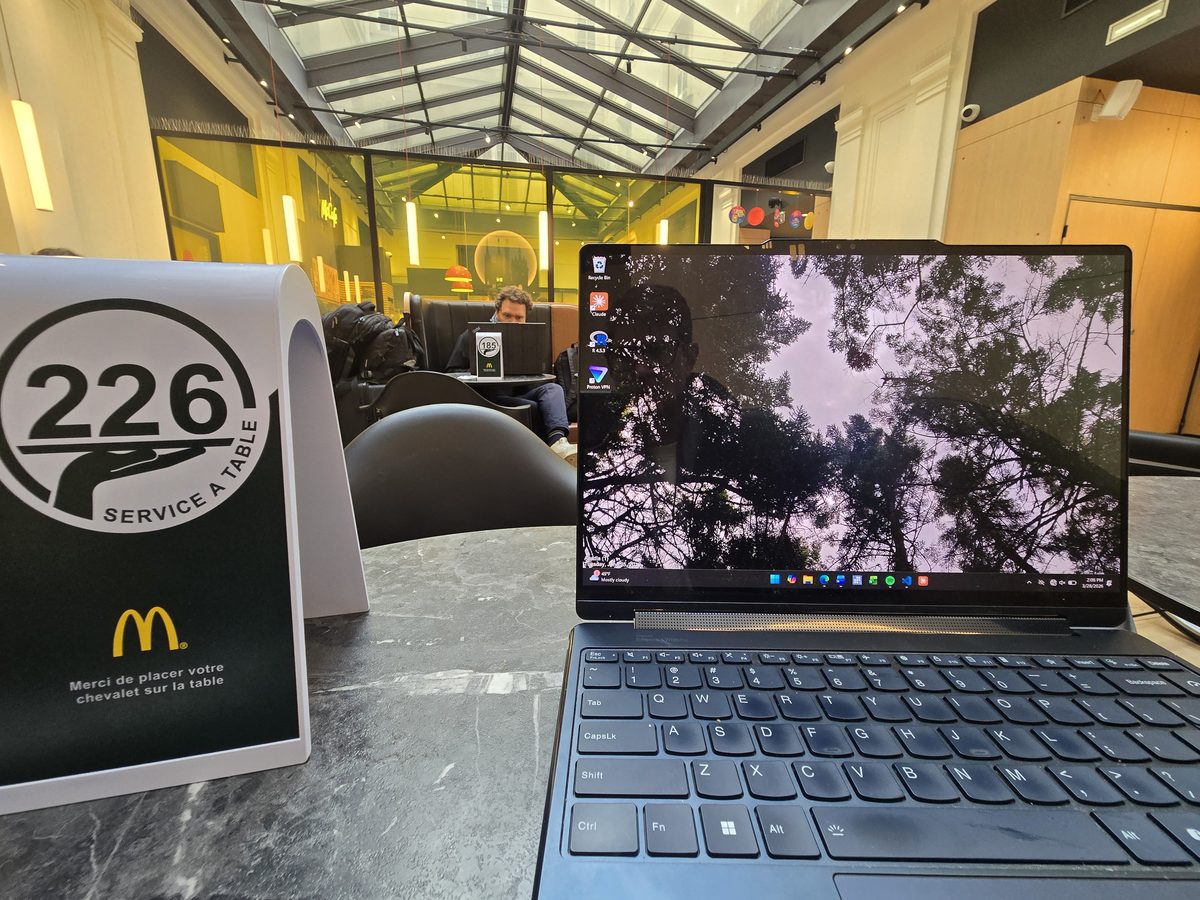
Ce Qui Nous Lie
What the hell, Bordeaux? This wasn’t the trip either of us had envisioned.
In one sense, it’s a perfectly appropriate trip. I knew full well what I was going to see, and the economic history that has underwritten it. From the very beginning of the trip, right from the train station, it was a slightly uncomfortable and awkward experience, and I unintentionally saw Bordeaux from ugliest to prettiest, in order. I had an unusually friendly encounter with a front desk clerk, and I had a perfectly usual unpleasant encounter with a waiter. I saw things that awed me, that made me uncomfortable, and some that bored me. It’s a full range of experiences.
As many more are unmentioned here. I spent more than half an hour just sitting in the Cathédrale Saint-André. I went walking down random streets and stumbled into a Jesuit église with its crosses and statues shrouded in black to emphasize the absence we feel during the Lent season. I saw more of the medieval quarter, and of the riverfront, and the echoes of the Revolution found here. I earned a second trip to McDonald’s.
And for all that it was odd, at least some of the message feels obvious, and it feels like a question: are we who we tell ourselves we are?
I visited a basilica that was in borderline disrepair and it felt like one of the most holy places I’ve been—take a back seat, Notre Dame. And I saw stunning architecture that hides an unforgivable past. I saw one of the most beautiful cities in the world, but I saw its ugliest, dirtiest sides first. I helped an anxious traveler with my insider knowledge. And I proved myself a total outsider before the next sunset.
But cities and basilicas are stationary; life happens around them. We humans are more dynamic, but also simpler, and we are easily fooled by our own façades.
The traveler is ultimately faced with himself, wherever he may go. And in travel, the self will ultimately face the question, am I who I tell myself I am?
The answer is frustrating: sometimes.
To be dynamic is to be ever-changing, and this Aquitanian adventure has brought much of that dynamism into sharper relief.
On the train, I was the safe and reliable insider—the one who knows the Ways. At the hotel, I was an accepted interloper—a big kid at the adults’ table. At the café, I was a chastised outsider—a novice who belongs elsewhere.
The encounter at the café had a particular sting but being an outsider in a foreign country is to endure a hundred little such injuries. They’re like mosquito bites; a few can be tolerated but too many makes the skin start to crawl.
And the ups and downs just keep coming out on the road. In this same day I have a Spanish-speaking family flag me down for directions. They don’t speak English but they do speak French, and they’ve got turned around and can’t find their hotel. Remarkably, I know where it is and can direct them: “C’est là-bas, prenez le pont, et puis les escaliers, et à gauche.” It’s not how a French teacher or French regular would have done it, but it’s serviceable and they won’t have to sleep on the streets this night. At another time, a homeless man comes up from behind and grabs my shoulder to aggressively ask for something to eat, and I scurry away saying “I’m sorry, no French.” Whatever it is that we think we are, wait a minute, and you might find out otherwise.
In a way maybe Bordeaux has the answer. Should we tear down these beautiful buildings because of their dark history? In doing so we would also tear down all of the positives, too. Like the Big Bell of Bordeaux, which rang for both hangings and festivals, it’s all just mixed together. It’s all one story. I condemned Bordeaux for its role in the slave trade but marveled at the Roman ruins of Burdigala, and the Romans have much darkness in their history, too—I haven’t even been consistent in applying my own rules.
So my chapter on Bordeaux comes to an end that’s less than satisfying, and less than fully comfortable.
And, in a way, that feels exactly right.
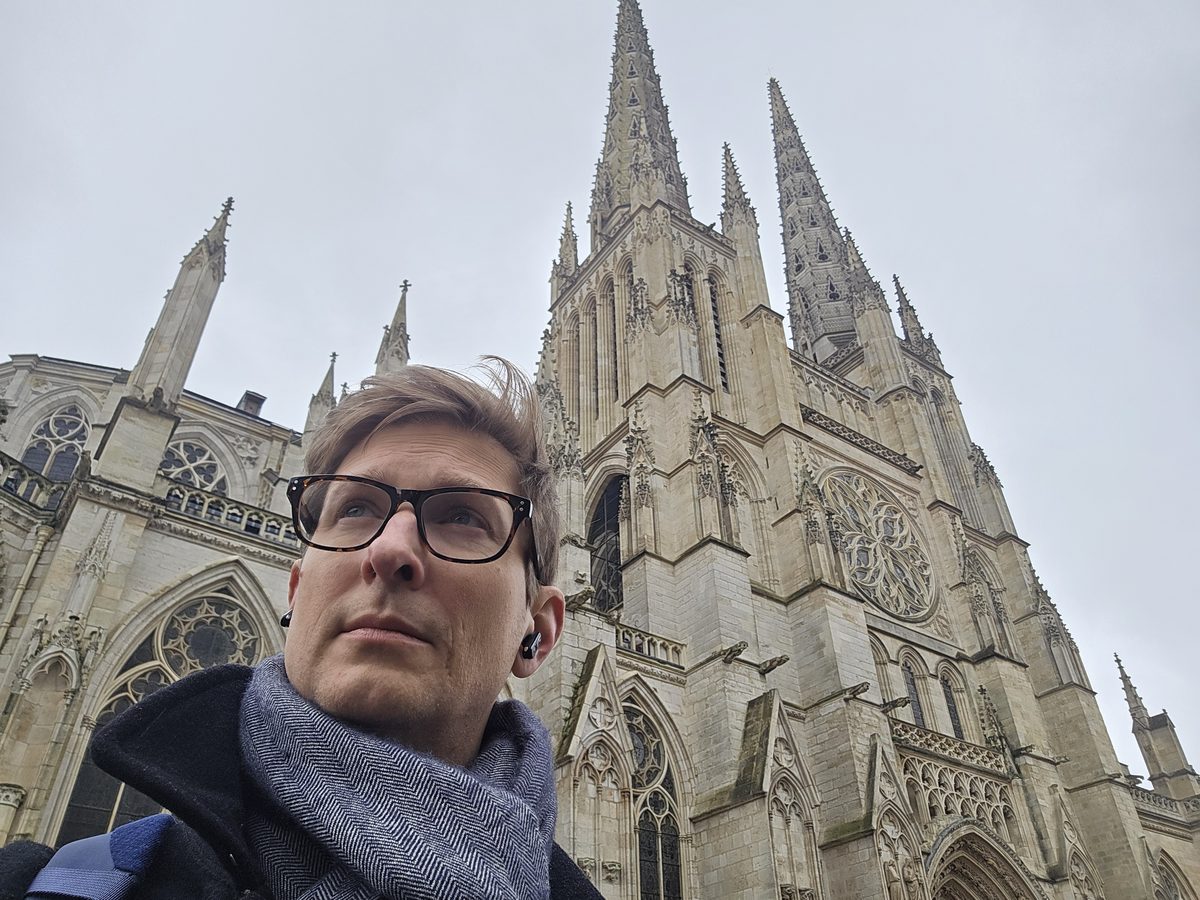
Cathédrale Saint-André. The only bad selfie I felt compelled to take in Bordeaux.