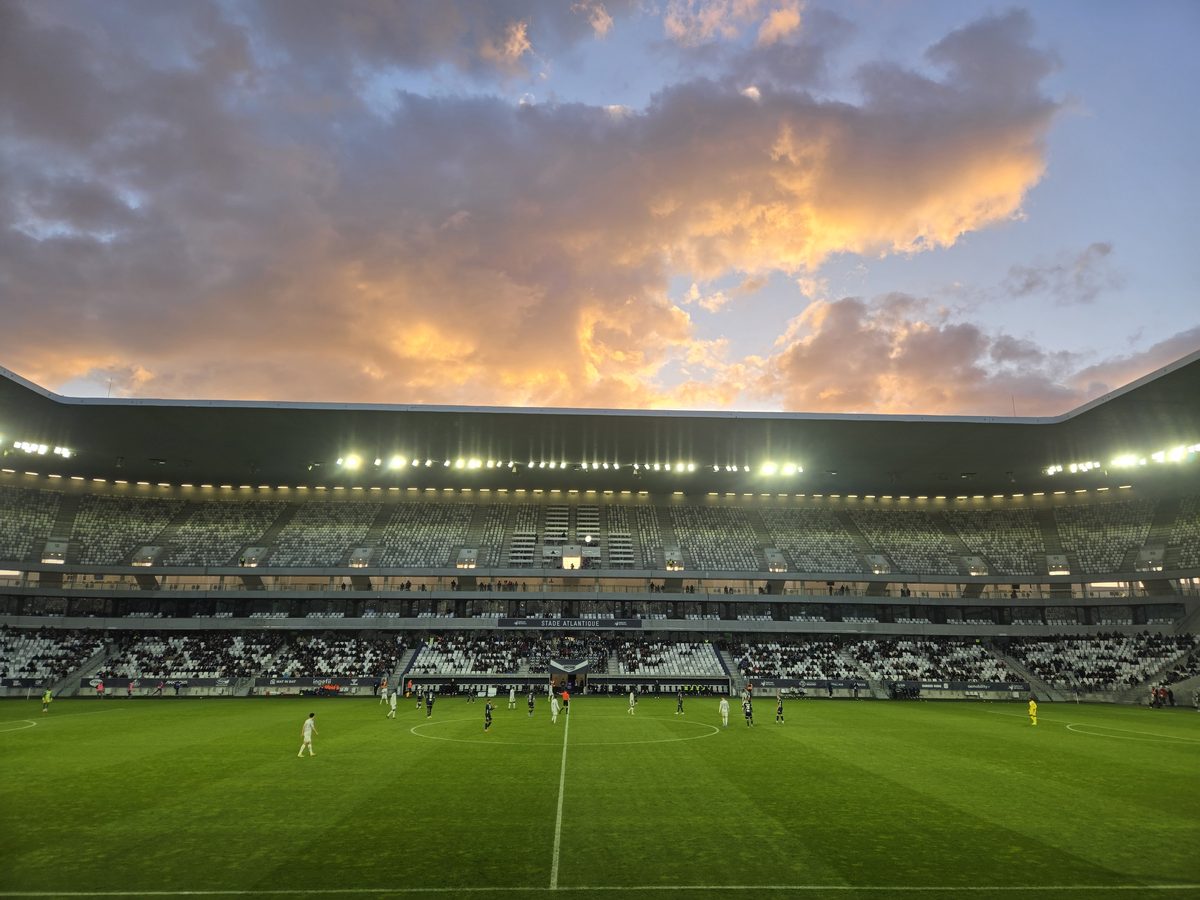
Away
Away When I tell my French colleagues where I’m going for the weekend, it elicits a combo soft smile, head nod, “mmmmmm”—like when someone tells you they like your favorite band. “Ahhhh, you ’ave zee good taste,” it suggests. The French are proud of their beautiful cities, and it seems to please them when this foreign interloper ventures forth in exploration.
When they learn why I’m going to Bordeaux, though, the face turns incredulous. There’s a wryness, as though they may not believe me, or perhaps those stereotypes about ignorant Americans are accurate after all. One even tells me directly, in the soft voice you use when a child slurps their soup at Sunday dinner and needs to be lightly corrected, “you know, it is not what it was.”
Oh, but I know. And that’s a part of why I’m on this pilgrimage.
I have come to pay respects to a fallen giant.
The Approach
I’ve accidentally seen the ugliest bits of Bordeaux, a city which has 40% of its surface area designated as a World Heritage Site, but this time, the ugly bits are a sign that I am in the right place. I expect these ugly bits.
And the first tell-tale sign of “right place-ness” is an abandoned parking garage in an overgrown field. It is an odd sight, even on a weekend of odd sights, and it is so abandoned. We’re out on the edge of town where such things can often be ignored but there are other, normal establishments out here, too, and it makes the transition to total abandon all the more jarring.
But it is expected.
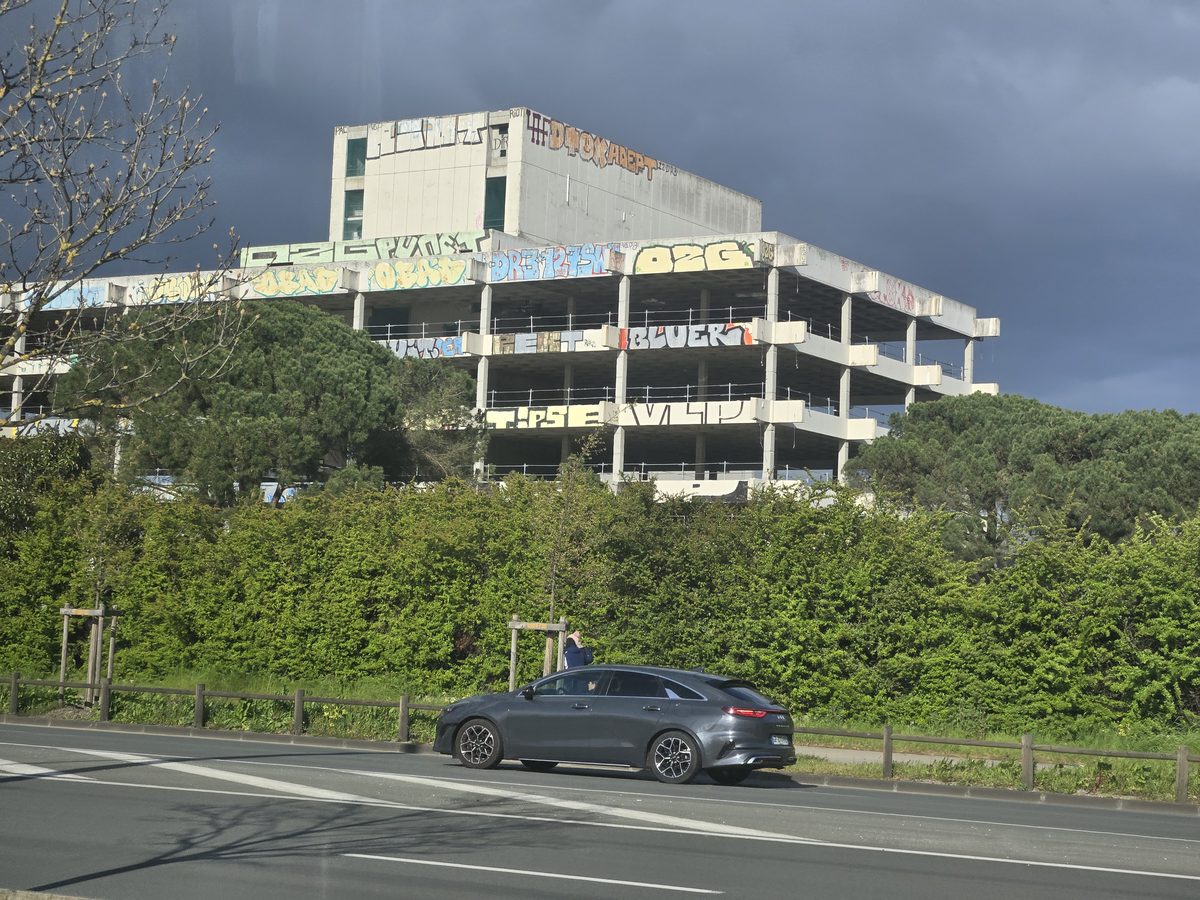
Built in 2015. Abandoned by 2024. Barely a decade old.
And as the tram empties and the throng moves in a singular direction, I notice that everything on this particular lot is in a state of abandon. Every sign is covered in stickers and graffiti, every slab of sidewalk has weeds coming up, and—oddest of all—none of it actually feels that old.
And it isn’t. This entire complex was built in 2015. It’s barely a decade old.
As I approach the stadium, more of this new-abandoned contrast is evident. Food stands pepper the walk, and they look much like those found around American stadia. Some even have English language signs, which seems like something of a trend.
But none of them are open, not a one. And some of them have been taken over by graffiti.
Nevertheless, the groups of people having dinner out of brown bags or standing around drinking beers are much larger than I would have thought. It’s so odd! This land is pub culture, café culture, not tailgate culture, but this is basically a French tailgate.
And there are some throngs of people. They amass behind one of the narrow ends of the stadium, making the long sides echo the abandon of its surrounding habitat. Why is this club not selling beer and baguettes to this throng?
But the answer to that question is mixed up in the answer to the question of why—why on Earth—has a football enthusiast from another continent traveled all this way to watch a semi-professional team in the 4th division of the French football pyramid.
Because in a way, this is the closest thing I have to a football heritage in Europe.
1994
How does an American kid growing up in the 1990s come to be a European soccer nut? Today’s kids are spoiled with access, and the beautiful game is the fastest growing spectator sport in the USA, but in the 1990s there is no soccer on television, no media coverage of the sport, and there will be but one single USA-facing website that covers European club news by the time I start driving. Sure, youth league soccer has always been big, but all of us from that generation will remember there was a very clear pipeline—you played soccer until you were big enough, or tough enough, to play football. Soccer was the fun game for kids. Run around and kick a ball, you little shits.
The USA hosting the World Cup in 1994 was the sea change moment. It was that event that launched the MLS, America’s soccer league that, frankly, still is not taken seriously among enthusiasts. It was that 1994 World Cup that led to increased funding for our US National Soccer Team. And it was that World Cup that introduced a generation of American kids to the beautiful game.
And that same World Cup launched me on my journey here, to Bordeaux, and to a 42,000-seat stadium that will sit mostly empty tonight for this meeting between two semi-professional teams—teams filled with players who also have day jobs. But in a way, I feel I was always destined to land here.
The VIP Suite
I have a ticket for the VIP suite. I’ve never had a ticket for a VIP suite before. I’ve toured stadia, I’ve been in those lush spaces, I’ve even been in the Royal Box at Wembley—look how much better you could have had it, the VIP lounges say. Look at how better people enjoy the sport. Another canapé, sir? May I refill your champagne flute?
But this VIP suite—well, no one offers me a canapé.
It’s heated, which is nice on a cold day. And that’s the end of the list of luxuries.
There are those small stand-at style tables one finds at a reception, but they are not draped in layered tablecloths nor topped with trays of hors d’oeuvres. It’s just the table and whatever you bring to it. There are two stands selling concessions. Coke products, M&M products, one type of beer, one type of wine, two types of water.
With no food to attract my interest, and nothing for me to do but stand around in this hollow space, I decide to go out on to the patio and stand idly around in the larger hollow space, the nearly empty stadium. It’s cold but it’s also threatening to turn into a nice evening after a very rainy day. The sky is a battalion of thick gray clouds, but the battalion is on the march, and the ranks are just starting to break, slivers of light beginning to penetrate.
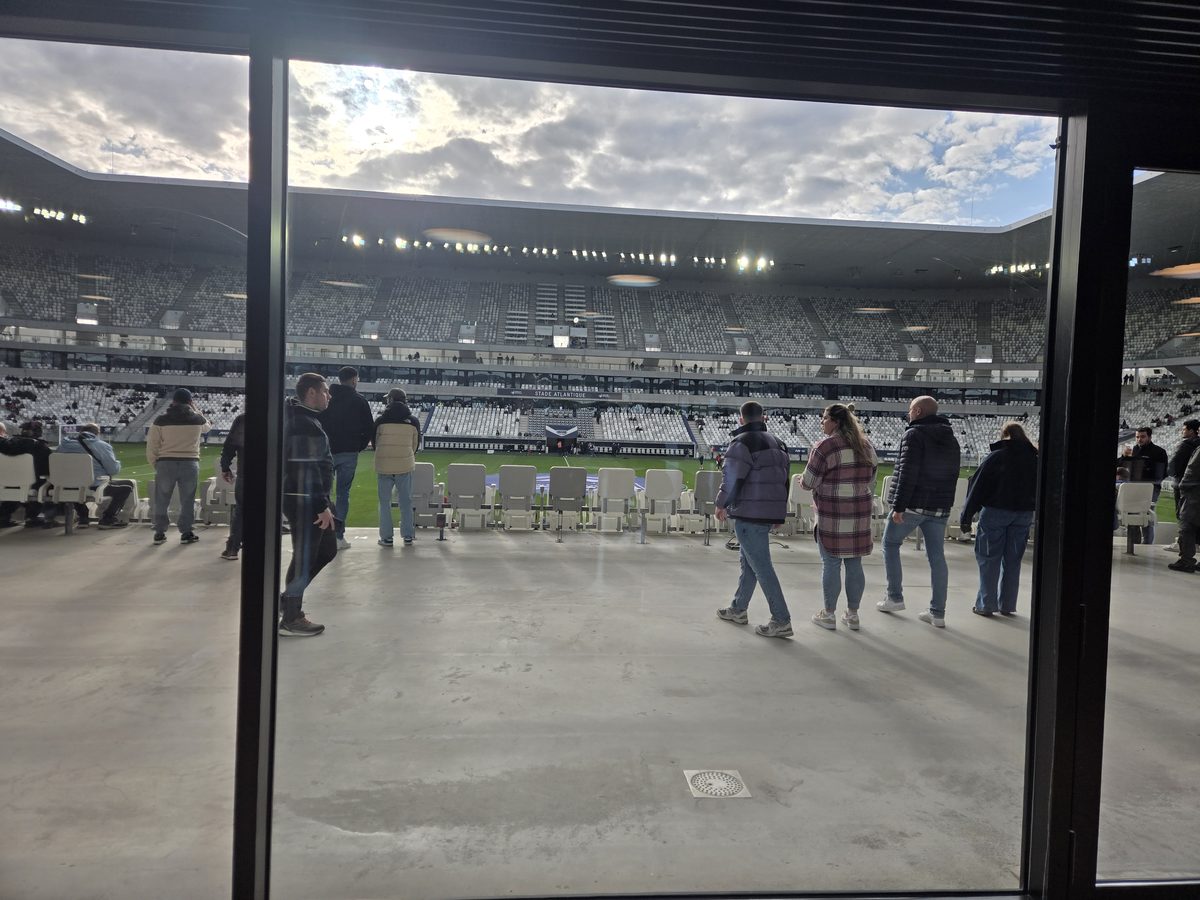
The VIP view. No canapés. No champagne. Just 42,000 empty seats and a pitch.
The stadium is nice. Fairly new as it is, that’s not unexpected.
It is also almost entirely closed off. With seating for 42,115 spectators, it is the fifth largest club stadium in all of France, right on the heels of monolith PSG’s Parc des Princes. Today, though, here at the Stade Atlantique, only certain lower bowl sections are open—the behind-goal stands where the ultras amass, and the VIP sections along the touchlines. Security guards block the way to the in-between sections and to the upper bowl.
There is a section for journalists in the upper bowl that’s probably meant for thirty or forty, but today it will seat five. There are more security guards than journalists there.
The stadium is very modern; it has a distinct feel that Europe’s newer stadia share, right down to the food stands now standing empty outside this ground. The seats are a little bigger than some of the older stadia I’ve visited, plastic not wood and with padded seats. The glass of the VIP booths along the mezzanine glistens as the evening light bounces around the stadium.
It’s a fitting ground for a side with championship pedigree. And that is exactly what this is—a club with major historical credentials.
The Fallen Giant
FC Girondins de Bordeaux are six-time Champions of France. They last won the Ligue 1 title—France’s top league and the fifth highest-ranked league on earth—as recently as 2009. They’re four-time Coupe de France winners and were runners up in the 1996 UEFA Cup, the tournament known today as the Europa League.
This club has serious pedigree.
But as I make my way to my seat here in the VIP section, the only evidence of that pedigree is the size of the stadium itself. And the hollowness of it now, even as the players warm up on the pitch and the fans make their way through the tunnels, echoes the current state of the club. Founded in 1881, Bordeaux were a fully-professional football club from 1936 until 2024, when they were forced to surrender their professional status. Now, they can’t even afford to keep the food stalls outside the ground open.
How has this happened? How does a storied club go from Champions to bankrupt in 15 years? The answer is the pursuit of money.
In 2018 the club was sold at a significant price to an American investment group formed of General American Capital Partners and King Street Capital. The latter is a well-heeled hedge fund; the former was a boutique investment company that believed European football clubs were an undervalued asset and, with better management, could produce significantly higher revenues. So they developed a management plan and convinced King Street to finance the purchase through a leveraged buyout.
Log it in your journal as a financial experiment gone wrong. The thesis was that General American would handle management and focus on promoting the brand, selling players for a profit, and generally extracting more revenue from the club’s operations, and both investment groups would become wealthier as a result. Standard venture capital playbook. A year of incredible mismanagement ensued, though, and included, among other head-scratchers, appointing a manager who didn’t even possess the necessary credentials to coach in this league and was, naturally, barred from doing so by the footballing authorities. A year on, and on the heels of several equally-boneheaded actions, General American would be forced to admit that their management had been “embarrassing,” and the hedge fund bought out their shares and took over in December of 2019.
But then 2020 arrived, and with it the COVID pandemic.
In terms of football, the French league was hit especially hard. The television company that broadcast the leagues’ matches went bankrupt, and with their bankruptcy went one of the League’s strongest revenue sources. Between that situation and playing in empty stadia for the year—and losing out on ticketing revenue and merchandise and concession sales, too—it was a challenging time across the league. Club owners were forced to invest in their clubs to keep operations going in the face of rapidly-diminishing revenues.
But hedge funds are not founded on the notion of continual investment into underperforming assets, so they did what hedge funds do when an investment turns into a dog.
They walked away.
They simply said, “We’re done.” They refused to put another dollar into the club; they refused to carry on managing the club.
Amidst the financial crisis, the poor management brought on by the American investment consortium delivered the expected results—terrible performance. And for the first time in over 30 years, Bordeaux finished at the bottom of the table and were relegated from France’s top division in 2022.
In the ensuing bankruptcy, they would surrender their status as a professional club and be forcibly relegated two divisions further, into the fourth division, where I find them today.
The club’s stated ambition is to return to Ligue 1 and reclaim their seat at the table, but it is a long, long climb back to the top. The value of PSG’s squad, if each player were to be sold off at market value, is €1,210,000,000. The value of Bordeaux’s current players on the market is €100,000.
This is a fallen giant.
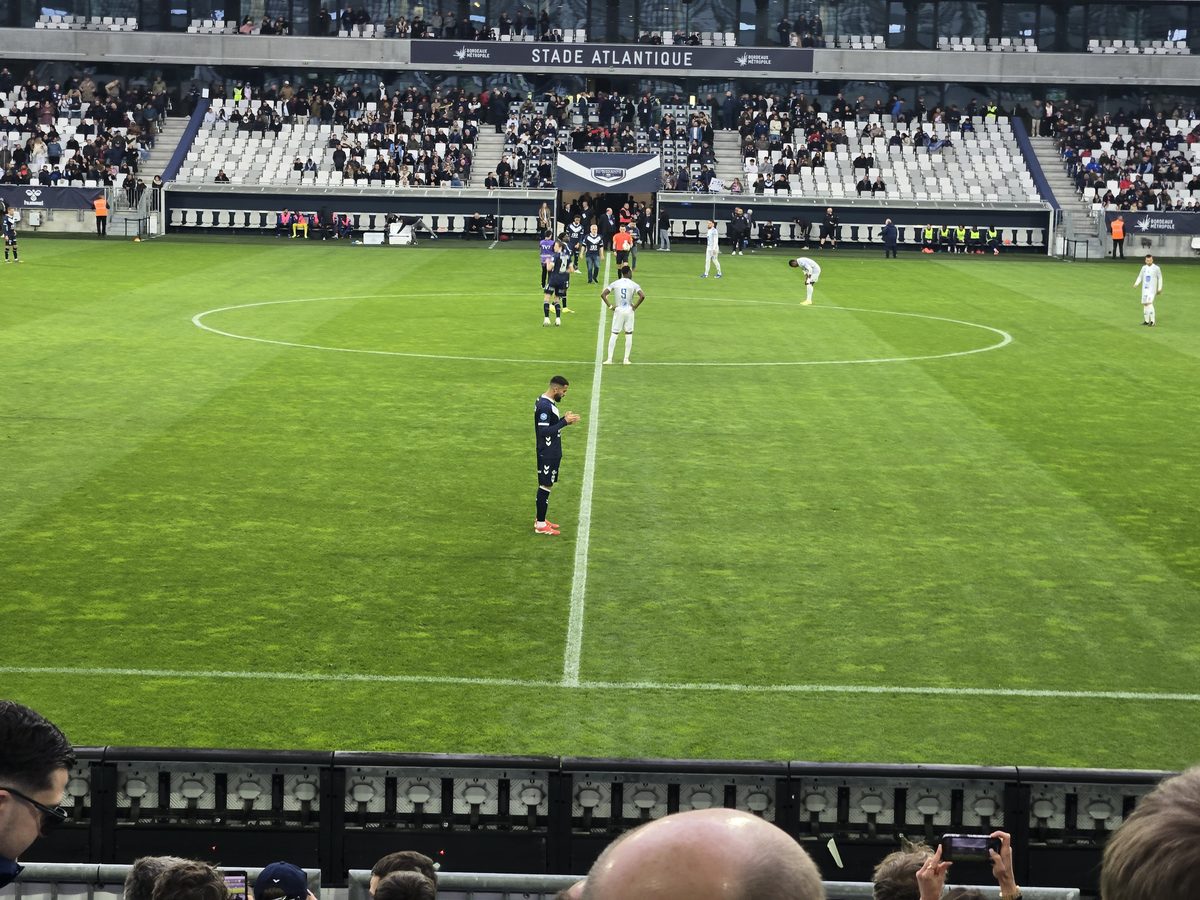
42,115 seats. Tonight, most of them will watch the match without anyone sitting in them.
But there are bright sides. I was able to get a VIP ticket, for instance. And it’s not hard to get to one’s seat in a mostly-empty stadium. My row has exactly three people in it—a man with his girlfriend or wife, and a young man who’s come by himself. There’s a seat between the two men, and that one’s mine. I scoot down the line and squeeze into my seat. We will have this entire row to ourselves the whole evening, but we are bunched up right on the center line so there is no incentive to move over and give ourselves more space. I guess. I feel like it’s on these guys if they want to move; I’m middle seat guy. But I’m dead-center at midfield, so I’m not leaving.
Not long after I find my seat, the throng that had been milling and drinking behind the ground marches in, singing, chanting, flags waving. The ultras have arrived. And I’m not unimpressed. It’s not Dortmund, but it’s not bad. In what is a coordinated and timed action, they’ve arrived in time to cheer the players off the pitch as they return to the dressing room for final preparations, and the players come to the goal line to applaud the ultras in turn.
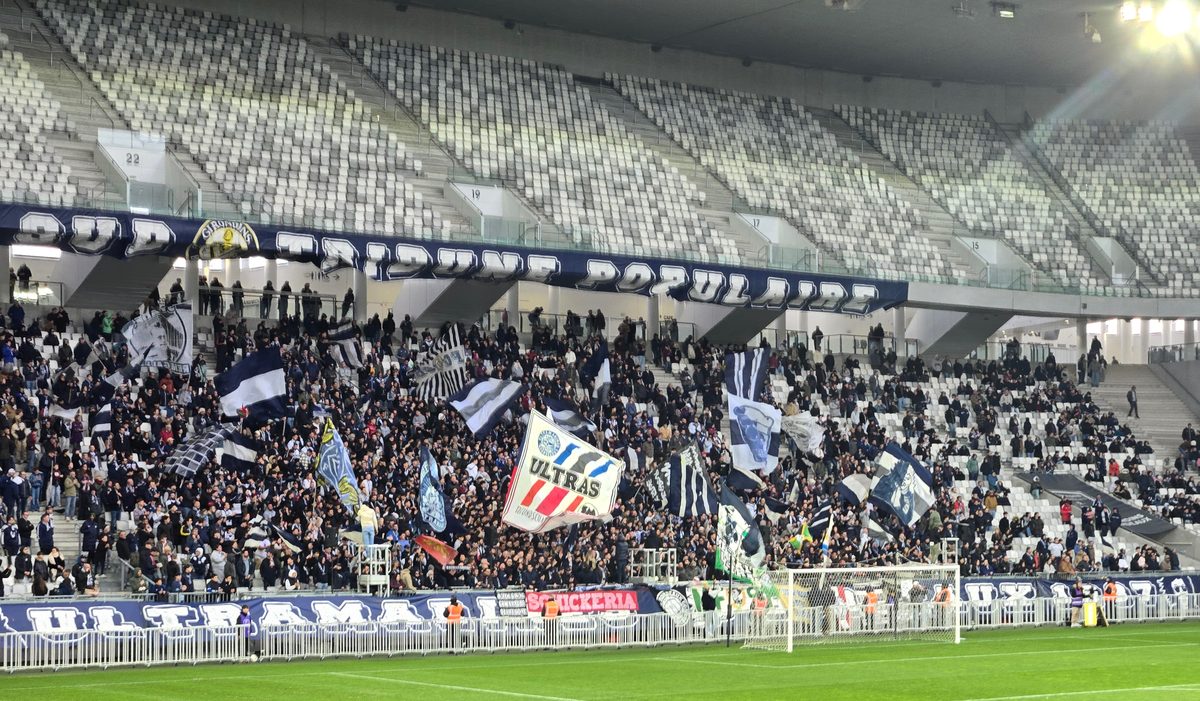
The ultras. Not Dortmund, but not bad.
Frankly, on the heels of the ultras coming in, I’m feeling up about this experience. The rest of the stadium is still an echo chamber of empty seats, but the ultras have really brought the atmosphere.
While final preparations happen in the dressing rooms, the announcer comes on to the pitch to do player introductions. Unlike in America, where players come out one by one to their names being called, like kindergarteners going to the playground, in this sport and on this continent, the players come out as a team. Perhaps this is logical if one assumes the players know their own names, and that the introductions are really for the fans.
The announcer comes to the center of the pitch for the roll call. He says the first name and fans shout the last name—an age-old football tradition for intros and, frequently, when a player scores a goal. He’s working himself up into a frenzy. He gets louder with each one, and with each one drifts closer to the ultras section. They’re the only ones answering back; those of us in the VIP section are too important for such idle shouting.
The announcer’s voice is cracking. He doubles over with the effort. He is putting everything he has into bringing some electricity into this stadium. The ultras are with him. And despite the empty seats, I’m starting to wonder if maybe I’m in for more of a normal football match than I might have anticipated.
I let hope creep in. I have come a long way for this. Pilgrims don’t leave their homes in pursuit of disappointment.
The Savior of Italy
I remember two things about the 1994 World Cup. What I remember most vividly is Roberto Baggio.
The man himself does not cast a very wide shadow; a slight 5’ 9”, the most notable thing about the image of Baggio in 1994 is his curly-haired mullet, tied into a rat tail. But for all that he was a slight figure, he was a giant of the game. In a 1999 FIFA poll, Baggio came in 4th for the title of “Player of the Century.” He’s the only Italian to have scored in three World Cups, he was named by Pelé—Pelé!—as one of the greatest players in history, and when Fiorentina sold his contract to Juventus in 1990, massive riots broke out in Florence. He was the reigning FIFA World Player of the Year and Ballon d’Or winner in the summer of 1994.
He was Italy’s leader as they marched into the World Cup final against Brazil and when the championship match came down to penalty kicks to decide the winner, it was Roberto Baggio stepping up with the World Cup on the line. “The Savior of Italy,” said the television announcer as Baggio stepped forth, 94,000 spectators watching in the Rose Bowl, two billion viewers watching on television, one mullet rat tail blowing gently in the Pasadena breeze. All of Italy’s hopes and dreams came down to this, and there is no one you would have put more faith in than Roberto Baggio, Savior of Italy.
And then he missed it.
His shot skied over the crossbar, and the Brazilian players collapsed upon one another in rapture, in laughter, in tears. A fourth World Cup, an unprecedented achievement by Brazil. A joy that only a small, select few have ever known—World Cup Winners.
And there was Baggio. The Brazilians were celebrating behind him, and there he stood—right on the spot where he just missed his kick. He just… remained.
I was twelve, which is old enough to know things but young enough that the world is still shrouded in mystery. I remember watching this, and I remember understanding that I wasn’t understanding something. It was beyond my comprehension. I had never seen athletes celebrate so emotionally, but I had also never seen what I was seeing from Baggio. His face, his body language—it didn’t fit with anything I knew or could relate to. I didn’t understand.
Like so many parts of life, it would only make sense in the rearview mirror: it was my first time seeing a broken man.
I might not have understood, in full, what I was seeing, but I did understand that the emotional stakes were higher than what I was used to seeing in sport. And that stuck with me, too. That was the moment that it stopped being soccer and became football—in that childhood moment, even if I didn’t understand it at the time, I saw it for the glorious, beautiful game it is, rather than just a way to keep those little shits occupied for a bit.
Baggio’s body after the missed kick was the other end of the pole from the announcer here in Bordeaux—the emotion contorts his body, the enthusiasm crackles through his limbs. I sense he’s run out of energy before he’s made it through all twenty-two players on the roster. Eventually, though, he fades into the technical area and the players, whose names have just echoed around this nearly empty cathedral, emerge from the tunnel.
It’s a thrill to see the old, familiar uniform. Navy top with white chevron, navy shorts and socks. It’s as handsome today as ever, only now there are a lot more sponsors than just a name on the front of the kit. There’s a company name on the front, as is usual, and then another small one near the shoulder, and yet another one on the back, under the player’s number. There are ads on the backs of the shorts, and on the sides of the shorts, and on the shirt sleeves—just squeeze ’em in wherever you can.
And as the players form up for the opening kick, I ponder how noticeable the gap in quality will be between this and the top leagues of Europe.
It turns out I don’t have to wait long for an answer.
Oh La La
Bordeaux have the opening kick, and they use a tactic that PSG used all throughout the last season on their way to winning the Champions League, the top club competition on Earth—they immediately kick the ball deep and out of play in their opponent’s half. When PSG do it, it’s an intimidation tactic. “Here,” say PSG, “have the ball. Go ahead, try to beat us.”
In this instance, FC Chauray take the gift, quickly pass the ball through the middle and across to the other flank, where a speedy winger delivers a cross into the box. An attacker and a defender both jump to get a head to the incoming ball, but their collective jarring and jostling leave them both short of it. It falls toward the next-nearest Bordeaux defender, and he does exactly what you or I would do—he ducks, instinctively. The ball falls right to the feet of a Chauray player who is so surprised he can only bungle it goalward, but the goalkeeper is equally surprised, and the bungling ball finds itself in the back of the net. Forty seconds have passed and Bordeaux are already down a goal.
Oh la la.
The ultras section hisses and whistles. This has all happened in their end, right in front of them, and I assume they’re hissing and whistling at the celebrating Chauray players.
The game is reset and Bordeaux seem to have reconsidered the PSG tactic. They move the ball to midfield as the attacking players prod spaces forward down the pitch. But the midfielder in possession takes a heavy dribble and pushes the ball too near a defender, and when he tries to make the pass to the next player it’s already too late; Chauray snag the ball, move it swiftly through the middle, out to the wing, cross into the box, and again it falls right to a Chauray player who makes weak contact, but the goalkeeper somehow still can’t get to it. It’s two minutes, two goals to the opposition.
Oh la la la la.
This time it seems like some of the jeering is directed at the Bordeaux players. That was an atrocious turn of play, and in just two minutes they’ve made six errors and surrendered two goals. I remind myself that this is a semi-pro league and at least some of these guys have regular jobs. Maybe the goalkeeper is just tired from his day job, I speculate.
The two guys on either side of me are losing their minds. One seems to be pleading with the team to, I don’t know, stop sucking so much? The other guy is gesticulating in such a way that I think he’s telling them to go somewhere specific, and wherever it is, I don’t think it’s a place they’ll like.
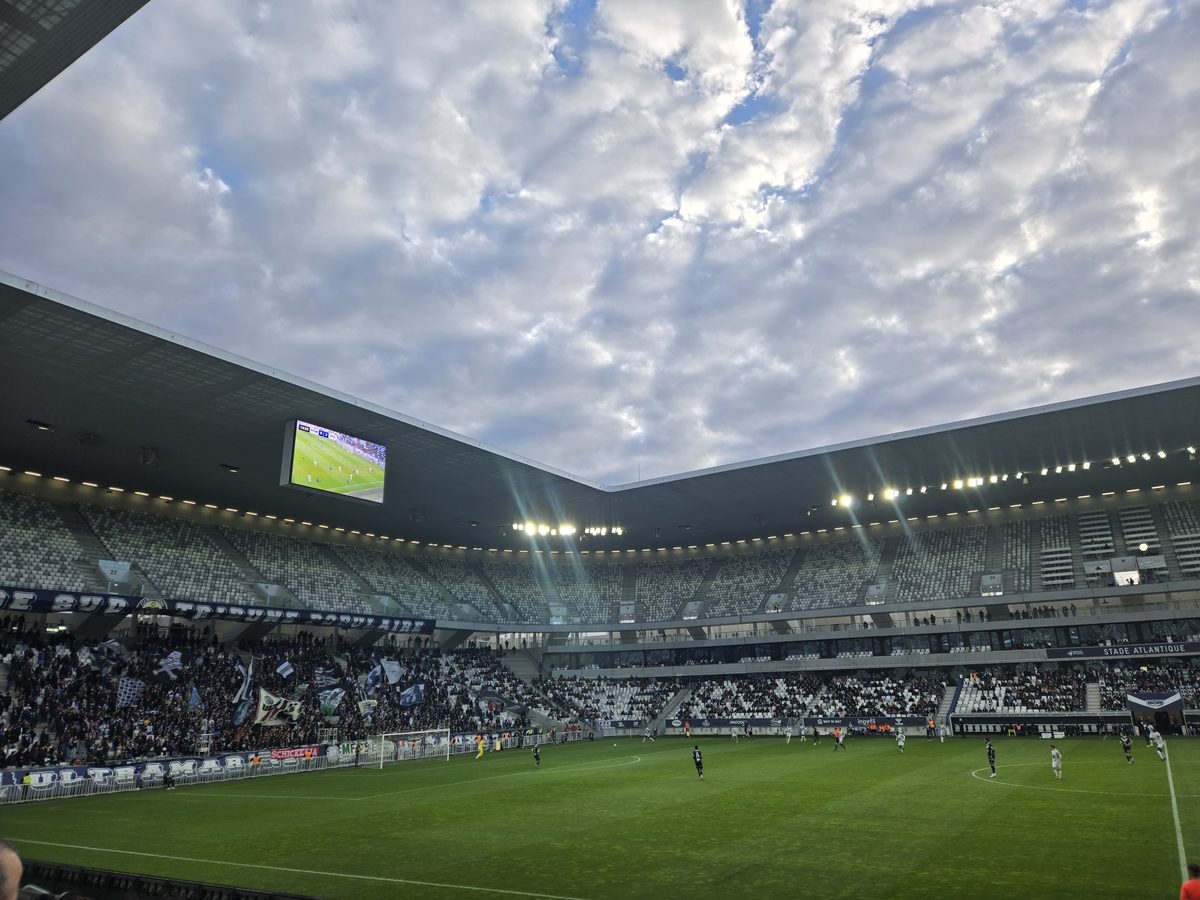
The cathedral, mostly empty. The echoes carry further than usual.
Bordeaux do not get a first shot at goal until after twenty minutes have passed, and even then, it’s a poor angle from outside the box and the player shanks it into the stands. Chauray have a traveling ultras section that marched in prior to kickoff—about 35 of them—and they’re having a bit of a laugh at the shot.
And, worse still, on their next promising attacking move, Bordeaux again surrender the ball in midfield on the end of a careless touch, and Chauray quickly move it through midfield, out to the flank, cross into the box, and at 3–0 this game is over, even with 75 minutes still to play.
There is no doubt now who the jeers are for. Now there are full-on boos, too, and not just from the ultras section. To the left of me, the guy with girlfriend is incensed. He’s shouting at his team. His girlfriend appears to be stifling laughter. To the right of me, my fellow solo attendee appears to be on the verge of tears. Behind me someone is shouting loudly at the pitch, and a few rows down a boy of 8 or 9 turns and gawks in that way only a child can. He and I are both learning new vocabulary tonight.
In front of me are a pair of Chauray fans and one is so excited he’s bouncing up and down on his seat. The seat breaks clean off its hinges, and he crashes to the concrete beneath. He and his fellow Chauray friend think it’s pretty funny, and they’re right, it’s pretty damn funny. He tries to fix it for a minute but, no, the seat is not coming back, and I presume it is still broken today. No trouble—in an empty stadium, just slide over one seat, problem solved.
Oh! And look—one of the Chauray ultras snuck a flare through security. Well, who says you can’t get the full experience from the fourth division?
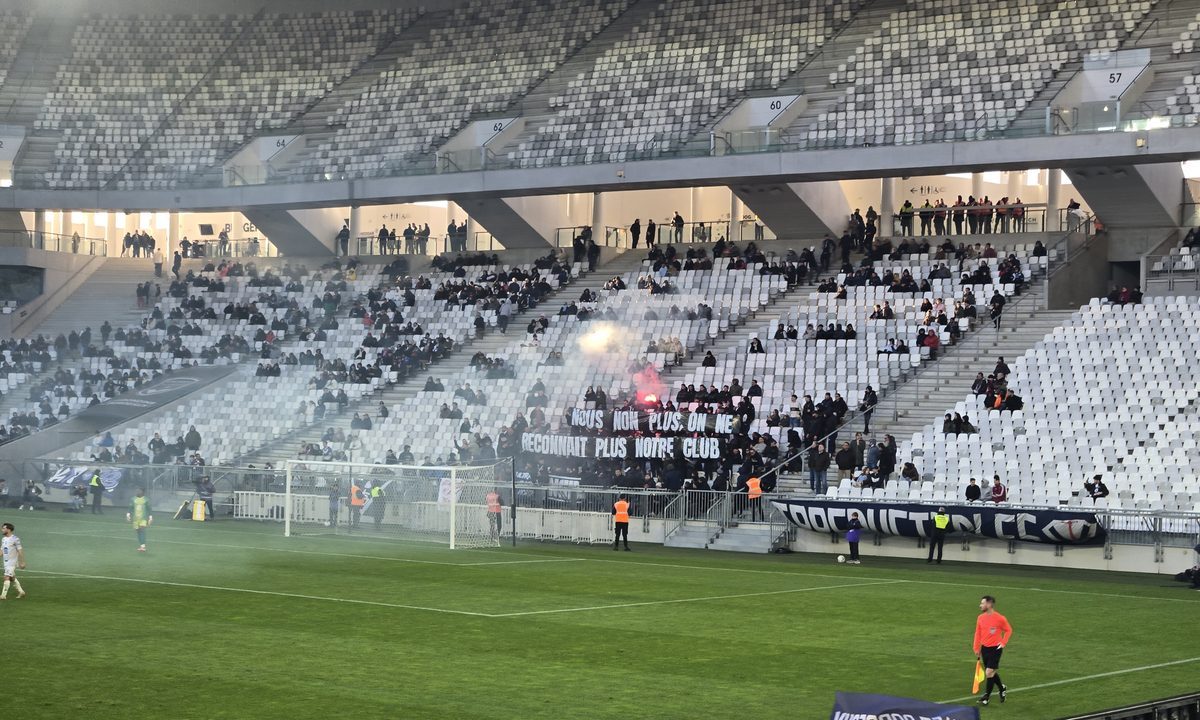
My First Club
Besides the image of Roberto Baggio’s soul leaving his body on the penalty spot, the other lasting impression I have from the 1994 World Cup was that I wanted to go out and kick a ball. It probably wasn’t until college or even after that I really enjoyed watching sports. Young and full of energy, seeing sport made me want to play sport. And while we did lots of that as kids, we were also the kids growing up in the early days of video games, and we would often get tired of playing outside and carry our games on in the virtual world.
I lived the entire evolution of football video games. This is easily my least impressive accomplishment, but I remember when Pelé! came out on Sega Genesis and a friend got it as a Christmas gift. It was national teams only—just forty of them, at that—and it truly wasn’t a game that could hold your attention for more than half an hour, but it was a first meaningful entry, and it would only be a matter of years until more sophisticated football video games arrived, and, eventually, games that featured European clubs.
It is through those video games that hundreds of thousands of American kids came to know European football clubs. Even today, casual fans near my age seem to always know the clubs with distinctive uniforms, like Juventus and Newcastle, with their black and white stripes. I think it’s a holdover from when that was all we knew about the European clubs. A lot of us built our first affection for any given club through those video game controllers, and what else did we have to go by other than cool crests, neat kits, and favorite colors?
For a colorblind kid, in a world where one team was not required to wear white, as was true with American sports at the time, choosing a team in the video game was a crucial decision—I needed teams whose color scheme would never fool my underperforming eyes. I developed a fondness for teams with blue and white kits—colors that seldom leave me second guessing. Schalke in Germany. Tottenham Hotspur in England.
But the first club I ever tied my video game allegiances to attracted my eye because of their navy kit with a very aesthetic white chevron.
My first club allegiance was to FCG Bordeaux.
The Bitter End
A number of fans have left after three Chauray goals in twenty-five minutes. And why not—it’s not exactly an open question of whether Bordeaux can stage a comeback. Overcoming a 3–0 deficit is not unheard of, but it’s the lead story on the news when it happens, and Bordeaux are less “off the rails” than “never got on the train in the first place.” There will be no comeback.
I can observe what Chauray are doing; their tactics are fairly plain. They like to move the ball quickly, get it out wide, and deliver service into the box. They use a quick-passing, triangle-based scheme where every player occupies a certain space on the pitch and, for each player in possession, a teammate turns to face the player, serving as an outlet pass, while a second teammate runs at an almost perpendicular angle to the player in possession. The basic setup is to pass to the outlet, release the runner on a vertical, and the outlet player sends it forward for the third player to run on to. It’s a very familiar setup.
But while I can see from the stands how Chauray move the ball through this Swiss cheese defense, the players on the pitch seem clueless. Bordeaux are playing with an inverted full back who becomes a low-lying midfielder, and the midfielders rotate in and out from high to low. The problem is that they struggle to retain the ball in possession, and when they turn it over, they have players out of position, and Chauray can slice right through.
These guys are good athletes and talented footballers. They may be semi-professional, but they are getting paid thousands of dollars to play football, and thousands of people have paid money to come to watch. No one pays money to watch me do anything, so these guys deserve some credit.
But the skill gap is also on display. Midfielders dribble with their heads down and don’t always see the coming defender. Passes and shots go awry. Ball control lacks precision. Chauray are using a team offensive concept that neutralizes the skill gaps; I genuinely can’t tell which of their players are better than the others. They’re all just filling their roles.
Bordeaux are trying to rely on player skill, but very little skill is on display.
Their right winger, who is on the side closest to me, is the only Bordeaux player that draws my attention in a positive way. His spatial positioning and off-ball movement are smart and sharp. These are two fundamentally important skills, and can be the difference between a good player and a great player. He clearly has game awareness. But Bordeaux want to play up the middle, and the ball is not finding him.
When he finally does get a chance in possession, he displays the first bit of dribbling skill that warrants applause from the crowd. Okay, this might actually be something positive for the team. And then he makes his first pass and, well by God, that was awful.
And this would play out other times, too. Great positioning, great movement, deft dribbling, terrible pass. Some of his skills are worthy of a much better league, but his passing belongs right where it is.
I don’t notice how quiet the ultras section has fallen until the referee whistles halftime. And when that halftime whistle blows, the boos rain down on this stadium and echo and carrom off thirty-five thousand empty seats. If the stadium were full of boo birds, it wouldn’t be any louder.
I retreat to the warmth of the VIP box for a little while during halftime. It’s been a cold day and, even though the skies are clearing and a nice evening is emerging, it is quite cold out there. I check the weather app on my phone as though my senses can’t be trusted and—yep, look at that. Cold.
Funny, though—it’s actually one of the highest temperatures I’ve had while attending a match in Europe. It is, however, my first time finding the cold to be a distraction from the game itself. I’ve normally been in tightly-packed crowds at other football grounds, and the warmth of the other bodies neutralizes the cold. Here, so near the coast and surrounded by empty concrete and plastic, the cold is amplified. Thank goodness I’m a VIP.
Lots of people are heading for the exits during halftime. A lot of the families are calling it at this stage. I’m tempted. While I’m delighted to be here, and this match is what brought me all the way to Bordeaux, it has been a long day, and a cold one, and I can’t deny that the temptation arises. I linger in the warmth of the suite and for a moment, I’m on the edge of going. The thought of going back into the cold and suffering through another 45 minutes of what I’ve just witnessed—it doesn’t make the heart race.
But pilgrimages are not about comfort, and I do feel a tie to this fallen giant. I’ve come to pay my respects, and so I honor the journey. I push back through the glass doors, greet the cold like an old frenemy, and shove myself back between my two rowmates.
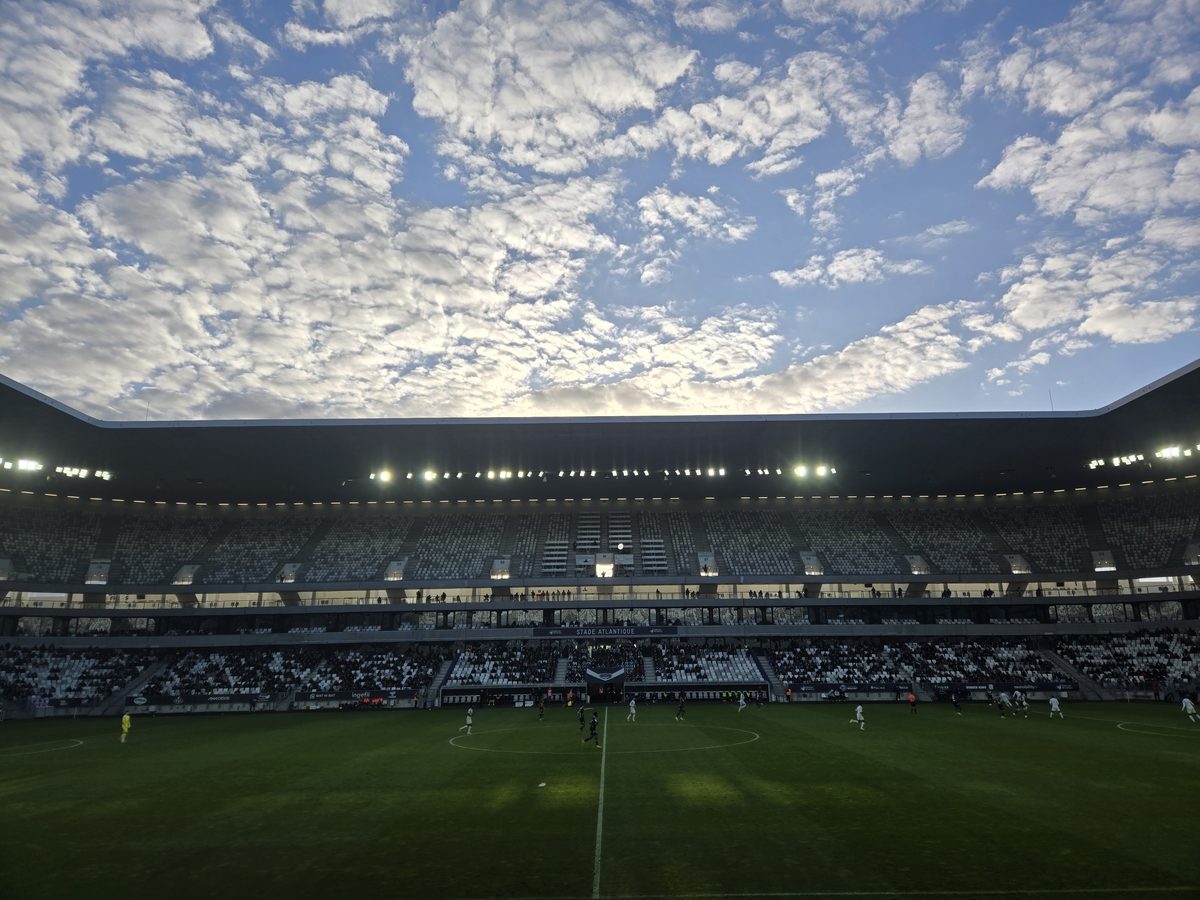
Bordeaux’s manager makes three halftime substitutions—a blatant signal from a manager that he has given up on the original plan and the original players. Most notably, one of the halftime subs is the goalkeeper.
In the United States, making wisecracks about someone’s mother is the gravest insult. But this—to yank the goalkeeper at halftime—this is worse than all the mama jokes out there. If he had shoved the goalkeeper into traffic it would’ve been less of an insult.
The benched goalkeeper is not, in fact, benched, in the literal sense. He never reemerges from the tunnel after halftime. He has either sulked off in shame, or has been sent home in shame, or maybe he’s been sent back to his day job in shame. Whatever the case, shame is involved, and I suspect he won’t be enjoying his Sunday.
Things improve for Bordeaux in the second half; a coherent structure emerges, they play through the winger I’d been watching, and the game is more even. Bordeaux will reclaim a goal but it’s a chaos goal, more akin to a hockey game than a work of art.
One of the journalists appears to have left at halftime; only four oversee the second half. I would read one of the articles being written up there as I ride home on the train the next day. The author would describe an embattled first half and Bordeaux’s valiant second-half attempted comeback. The author suggests that there is still time for Bordeaux to win promotion and begin, in earnest, their climb back to the top. It’s better fiction-writing than journalism.
Bordeaux must climb back up the pyramid to save this storied franchise, there is no disagreement around that point. But they are at the step where the football pyramid begins branching horizontally—there is one league above them but three parallel leagues here in the fourth division. Bordeaux’s league and those parallel leagues each get but a single promotion place to Ligue 3. Bordeaux will need to be champions of this league to get out of it.
And they’ve been in pole position for about half of the season. In the ultras section is a banner that reads, roughly, “Warrior Mentality: 8 Matches, 8 Wins to Reach the Top.” It’s here today but it was custom-made for last week. Coming into last week, Bordeaux were the league leaders, exactly where they need to be to start that all-important climb. But they lost last week to the second-place team and swapped places with them. Here, with just 7 matches to play, the warrior mentality has again failed to materialize, and they’ll end this week in a hole that’s not easily overcome. Right here before my eyes, the dream of climbing the ranks is fading into a harsh reality.
This year will not mark the beginning of Bordeaux’s triumphal climb back to the top. They will suffer another year without food stands, without a full stadium, and without canapés in the VIP lounge.
Fans steadily leave throughout the second half. The guys on either side of me have reversed roles; guy-with-girlfriend now seems on the verge of tears, and young solo artist is—is he laughing? This club has turned him into a madman. He leaves around the 80th minute, right in the middle of a passage of play, not prompted by anything in particular. Who knows why madmen do what they do.
As the match burns down to the embers, the semi-professional nature of the players is highly evident. Several players are cramping, most have slowed noticeably and aren’t in for much running. It’s happening with both teams.
It’s hard to be judgmental. Many of these players have regular jobs Monday through Friday. Some may even have families. And then they spend their evenings at training, and their weekends at the stadium. These won’t be the players that wear the kit if Bordeaux ever do make their return to the higher leagues.
And it is definitely if Bordeaux make that climb back to the top, not when. This club could actually fold under. And even though the players are showing their limitations, and the match has long since lost its entertainment value, I’m glad I battled it out with them. It’s a great honor for me to be here, to be connected to something that ties me back to my foundations in this beautiful game. No, this is not the Bordeaux that I grew up on. This is not the Bordeaux that were in UEFA finals, and it’s not even the Bordeaux that won all the trophies that are likely consigned to storage.
And although these players will never achieve the pedigree of those gracing the upper echelons—even though these players know they will be replaced with more talented ones if that climb back to the top ever gains steam—that they have given of themselves, that they have depleted their energy in fighting this losing battle—these acts of self-sacrifice for a higher calling are precisely the acts that attract pilgrims. This is indeed a losing battle, and the contestants are spent before the battle has concluded, but they have given their effort to this cause, to this club. They have endured much in service of Bordeaux and the redemption dream.
Not everything in life ends up pretty. So I suffer the ugly bits of football with Bordeaux, and that’s really all we can do sometimes. That’s how we honor the journey.
So I stay to the bitter end. I sit in the cold in this nearly-empty stadium as the clock runs down, and I watch the sun set over this team.