 Away
Away There’s an orderliness to Copenhagen that doesn’t take long to notice. It’s a little tidier, a little neater, better organized than a lot of places. There are bikes everywhere, trash nowhere. Today there’s lots of Americans, too. My Academy’s annual conference has left its home shores for the first time and landed in Copenhagen, along with some 11,000 professors. So many of them are Americans that when I come through Copenhagen airport, the customs agent makes a friendly joke about “another American professor.” She nails it, too. Either the Danes and Americans have similar senses of humor, or she’s been practicing all day. Log it as the friendliest interaction I’ve ever had with a customs agent in any country.
I’m staying at one of the official conference hotels and when I come down to the lobby for a quiet cup of espresso, I find neither quiet nor a path to the espresso bar—the lobby and lounge have been taken over by professors; they mill about, professing. I let myself out onto the street.
I walk through the business district and through some regular neighborhoods. I walk past a school, I walk through a shopping district. I walk and I walk and I walk and it’s cool, everything is nice, everything is clean. Everything is quiet and orderly. Here’s a nice water feature, there’s a lovely elm-draped path. There’s a park, lots of people out today. It’s crowded but everyone seems to have their own space. It’s like everyone is aware of everyone else and simultaneously giving them their privacy.
What the hell is this place? Why’s it so damn orderly?
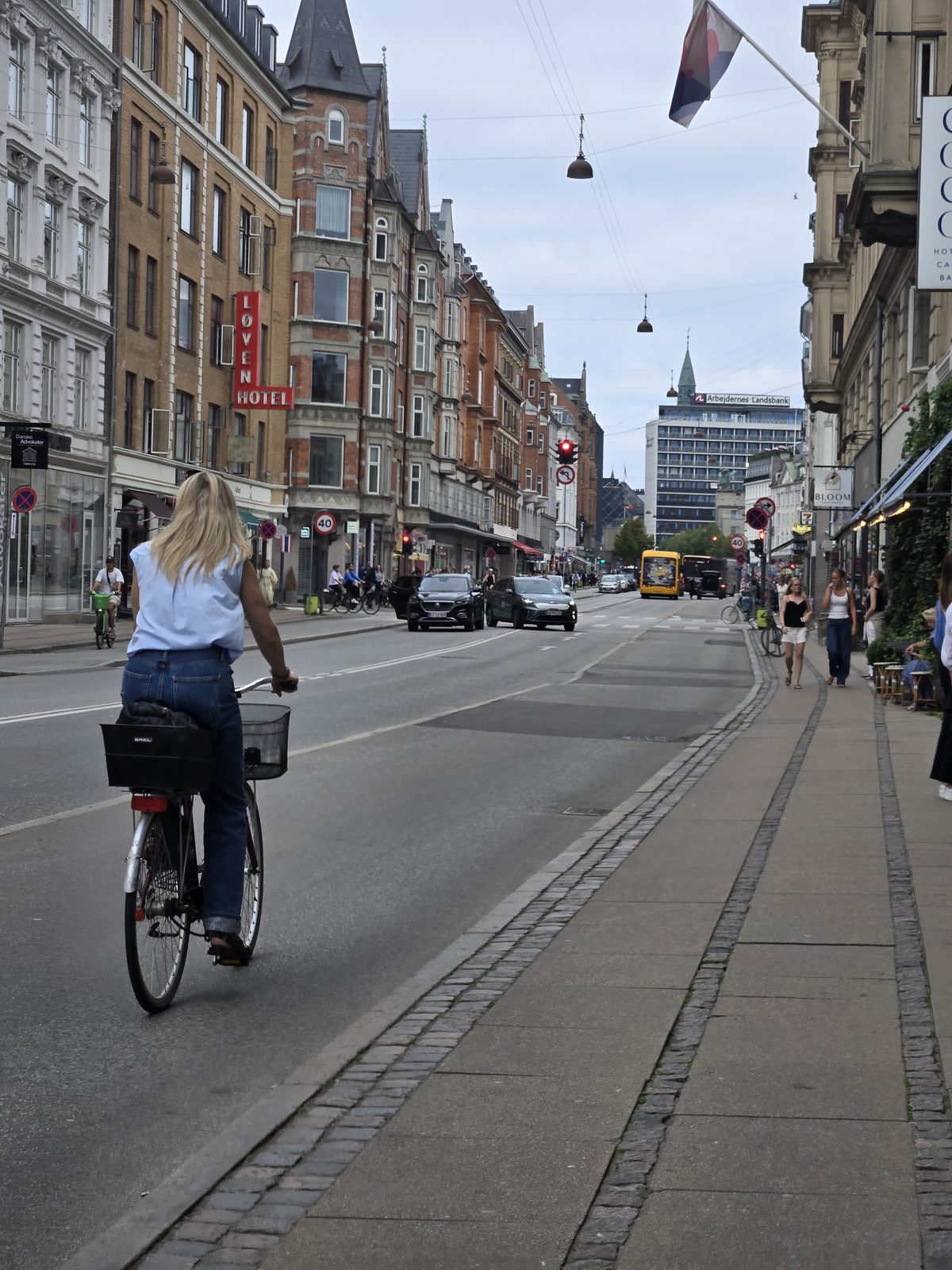
Nyhavn
Eventually I make my way to Nyhavn. Crawling with tourists from all over the world, Nyhavn feels more familiar. People walk in all directions on all sides of the sidewalk. It’s noisy. Jaywalking is happening.
It’s a beautiful quarter. I suspect it rates as a highly familiar site; Microsoft uses a stock image of Nyhavn, so hundreds of millions of eyes have tried to ignore it while logging into their computers. In real life, it looks straight out of the picture book, or screen saver. In a way, the Microsoft stock image really has captured it, because it’s not a big space and one good photo can just about do the trick.
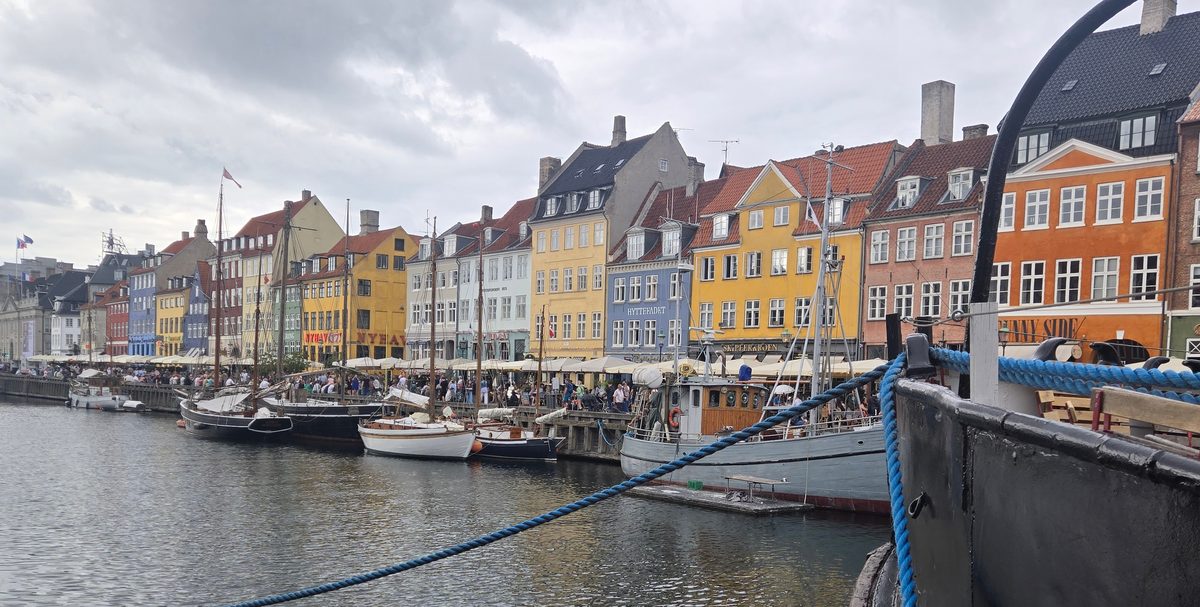
Nyhavn. One good photo can just about do the trick.
It’s a small quarter but so is Denmark, generally, when one looks at the map—finger-sized. A specific finger, in fact: if you look at your modern map and focus on Germany and Denmark, I think those two nations look like a fist extending a middle finger. My American friends see it and think it’s funny, but I’m yet to amuse a single European of any extraction with that observation. It’s not mere glibness, though—it’s not actually glibness at all (well, Germany being the fist is a little too sweet to resist). I think it’s appropriate, and it points, kinda literally, to an important fact: Denmark sits right between the North and Baltic seas on a busy historical trade route. In the grand arc of history, a positioning like that is akin to Microsoft’s unilateral license with PC builders—it gives them control over the chokepoint. That Nyhavn is a common sight on Microsoft machines is a lovely little cosmic coincidence; they share a DNA, Microsoft and Denmark—control the traffic, capture the revenue.
I’ve found a little space on a large concrete abutment at the base of the canal and have taken about forty pictures, three of which turn out decent. It’s very crowded and I can’t believe I claimed so much real estate for so long. Now the other tourists are closing in, though, and I yield my spot to the Instagram crowd and go walk the North side of the canal.
Most of these boats don’t look like they leave port. For all that this was once a center of world commerce, the world of commerce has outgrown it considerably. Even before World War II, ground transportation and other ports were taking traffic away from Nyhavn, and after WWII, ships became so large that our modern eyes can’t see anything but a tourist stop here; it wouldn’t hold the front end of a modern ship.
There’s deep history here but it’s hard to feel it. This is indeed a beautiful space, but it is overrun with tourists today, including me. It doesn’t lend itself to perching and thinking and observing, so I stroll and I watch the other tourists as much as I watch the buildings and the boats. Lots of ice cream stands, lots of cafes serving beer. There’s a churro stand that really isn’t that out of place when you consid—nope, that churro stand does not belong here. Even I can’t stretch that yarn.
I walk and I try to feel that deep history, but it’s not coming today. It’s a nice day and this is a beautiful spot, and that’s enough for now. The sun shines and it’s always fun to be in a different place. When I travel alone, I even like the crowd. I actually prefer it. It’s an odd feeling, and I only feel that way when I’m traveling alone, but I enjoy the crowd of tourists. I’m both a part of it and outside of it—a participant and an observer in this sea of life. I walk and pause for someone’s little Instagram shoot. After an exchange of smiles and international body language, it’s okay to scoot on through. Walk, pause, Instagram, scoot. Walk, pause, Instagram, scoot.
Here’s Hans Christian Anderson’s house, but no one seems to be noticing it. I guess the only thing that’s different about it from the rest of these buildings is that it has a little, tiny sign on it saying it was H.C. Anderson’s house.
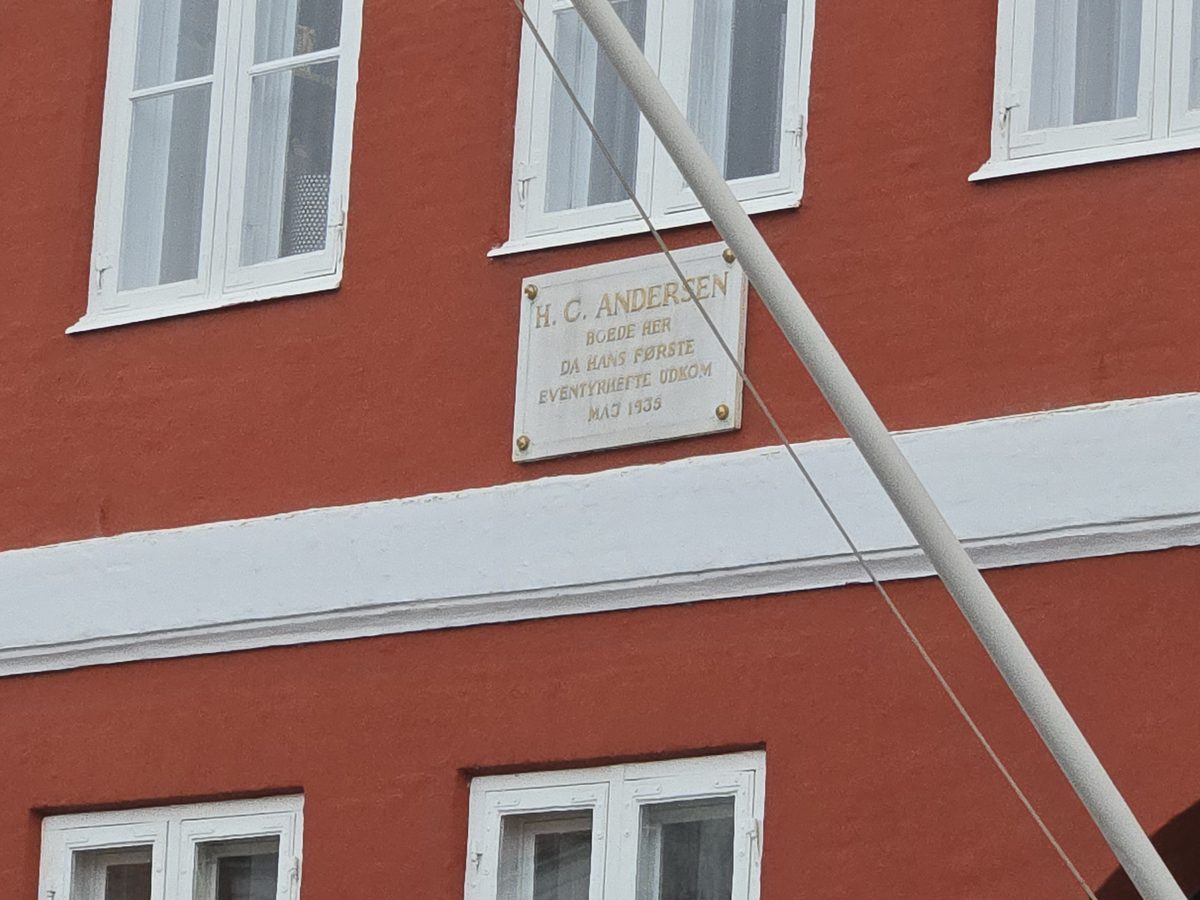
One of the most famous addresses in Danish literature. You’d walk right past it.
Now that’s interesting becau—nope. Again, I have nothing. I remember from my advance reading that he lived in Nyhavn for 18 years, but in this moment, that is the only fact I can recall about H.C. Anderson—I suddenly can’t remember who he was at all. I hear Bruce Dern’s voice from The Burbs saying his name, and that’s the only other memory that surfaces.
It’s only later, back at the hotel and armed with Wikipedia, that it comes together. Hans Christian Anderson was a prolific writer; he helped shape the genre of travel writing, he wrote successful plays and novels and poems. Most significant, however, were his children’s stories and fairytales. “The Little Mermaid,” “The Emperor’s New Clothes,” and “The Ugly Duckling” are just some of the stories that were penned by H.C. Anderson, and many of them right here in Nyhavn.
And that is interesting, because when he lived here, Nyhavn wasn’t a sunny, happy tourist spot. Nyhavn was a pit, and Hans Christian Anderson spent nearly two decades right in the heart of it.
The name implies harbor but really it was an alley, a passage from the sea to the port further inland. This was where the taverns and brothels were. The true old Nyhavn evokes all the ancient stereotypes of sailors in port; this was one of those seedy, nasty places we’ve heard about in song. Where the churro hut stands now, prostitutes stood before.
Why the hell was one of the world’s most famous children’s authors living in this seedy maritime alleyway?
I read more about the great author and learn that he was known to pursue romantic encounters with other men. The texts suggest bisexuality—he apparently chased women far above his social class, as well—but I can’t help but wonder if that latter detail was for show. He lived at a time when homosexuality was not accepted, and it’s a reasonable guess that his financial prospects as a children’s author would have been damaged if his reputation were tarnished.
I suspect living in Nyhavn was the easy way for him to avoid prying eyes. And it’s only from the hotel room that I look back on it and appreciate the irony. He hides his true nature from the world, he makes his home in a seedy alleyway, and he writes stories about misfits. A mermaid who wants to be something that she’s not. An innocent child who is the only one willing to point out how foolish is the King, that physical manifestation of law and order. An outcast, ugly duckling who is rejected by his peers and decides, in the end, to throw himself at a pack of swans expecting to be killed, because dying is better than living as an ugly duckling. But, in one of literature’s greatest twists, the swans accept the ugly duckling, because it turns out he was a beautiful swan the whole time.
Nyhavn was a pit, and now it’s a beautiful tourist quarter. Hans Christian Anderson was an outsider who found safety and comfort in that pit and produced some of the most beautiful tales of modern Western Civilization. That seedy quarter was fertile ground. The Ugly Duckling suddenly feels full of layers.
Too Orderly
I continue roaming in and around the city, exploring with no specific aim. I get involved with the metro system. It’s a very logical and orderly system, laid out smartly with a central circle and lines that spoke out in the key directions. I don’t know if every metro station is the same but every single one I see in Copenhagen is identical. It’s clean and easy and predictable, and I don’t understand why I’m not enjoying it more.
It’s too clinical, too orderly. It reflects the whole city. In some ways, Scandinavia is straight out of my dreams. All the escalator-standers on the right, walkers on the left. No one blocks the aisles in the grocery store, everyone uses their turn signal. It’s like everyone has agreed that we should do things in the most sensible way. That sure sounds nice, but it feels very foreign.
Over time I’ll learn that this is Scandinavia; this is what it’s like. A handful of other nations have their own little orderly ways, sure, but Scandinavia is just… it’s pervasive. And there’s one group that really explains how and why it’s come to be this way.
Vikings.
River Traders
Vikings conjure a specific image in most modern minds—longships and raids, berserkers with axes, mead halls and Valhalla, runic scripts that make for trendy tattoos. That’s all in there, but reducing “Vikings” to that is like reducing “Americans” to musket-carrying, wig-wearing tea haters—it misses most of the story.
Vikings were raiders sometimes, this is accurate, and they were fierce warriors. But they were also explorers, nation builders, and traders, and in surprisingly diverse ways.
Scandinavia’s geography sets up the story.
The land we call Sweden took quite a licking from advancing and retreating glaciers an Ice Age ago, and the interior of the country is pocked with lakes and connected by rivers. Consequently, Vikings from this land were master river traders, with trade networks extending across Europe, down to Byzantium and even into the Islamic world. Raids along the rivers occur, yes, but economic trade is much more lucrative than raiding in the long run, and over time the communities along the Dnieper and Volga rivers, among others, become something akin to militarized trade network outposts overseen by these Swedish Vikings.
One of my favorite moments in history occurs at one such major community along the Dnieper. Once overseen by the river Vikings but allowed to govern themselves by the late 800s, the tribes in the region struggle with infighting and territorial battles that weaken the community and its survival chances. Recognizing their plight, the leaders of the various disagreeing factions come together, call up those old river Vikings, and say—“Guys, we know we complained about being conquered and ruled, but things were a lot better when y’all were in charge. You wanna send us a king or something?”
What results is the Rurik dynasty, and what emerges from the Ruriks’ rule is the first East Slavic state, known to historians as the Kievan Rus’. Over time, the Norse culture brought by the river Vikings blends and melds with the Slavic culture. One ruler in the Rurik dynasty, Vladimir I Sviatoslavich, converts to Christianity and that religion becomes dominant in this expanding Slavic empire. History will call this Viking ruler Vlad the Great, or Saint Vladimir.
As the years pass, the center of influence moves from Kiev and the Dnieper to a more Eastern point along the Moskva River. The term Rus’ morphs into “Russia,” Moskva morphs into “Moscow,” and those trade routes established by the river Vikings and the Rurik dynasty become the economic backbone of one of modern history’s most formidable players.
Malmö
I spend a day in Malmö. The bit of sea that separates Malmö from Copenhagen—Sweden from Denmark—is short enough that there’s a bridge across, and a half-hour train ride spits me out right in the middle of Sweden’s third-largest city.
It’s a nice place. Much like Copenhagen, the skyline of which I can still see when I stand on the Swedish coast, Malmö is a mix of old-world Scandinavian buildings and modern steel-and-glass stalagmites, and a mix of clean and orderly.
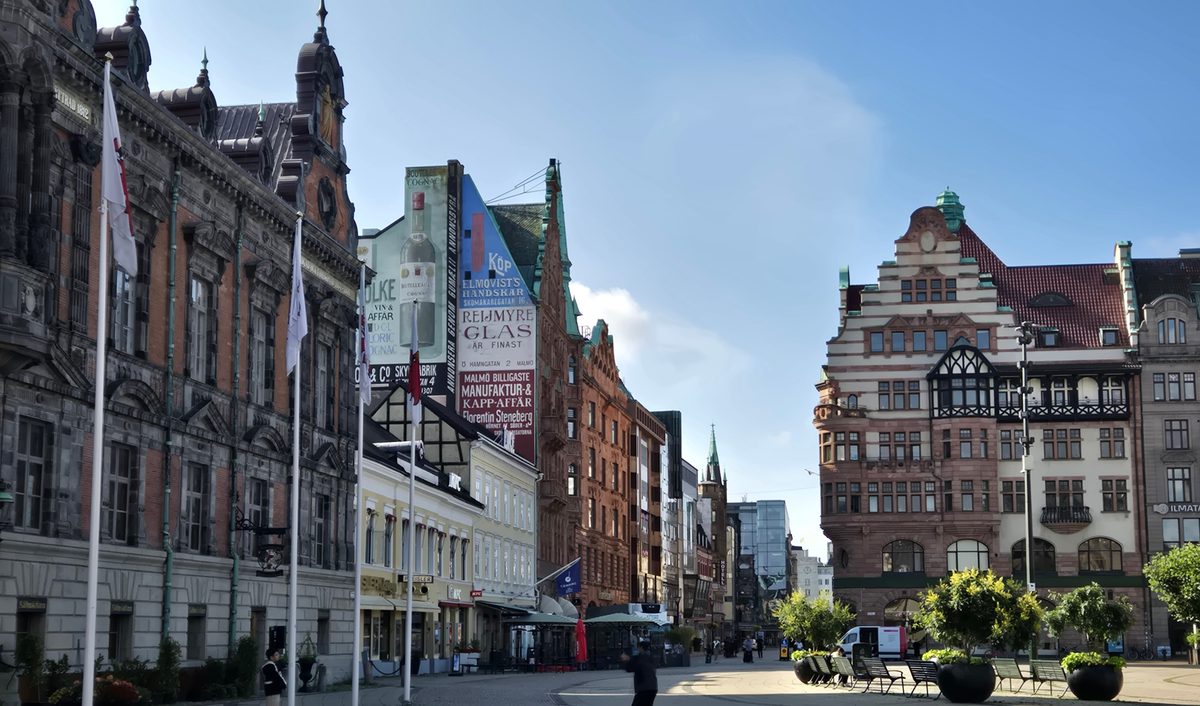
I visit Sankt Petri kyrka—Saint Peter’s Church, the oldest building in Malmö. It’s Gothic style but a distinctly Northern European varietal; here, bricks are the preferred building material in the 1300s, and brick lends itself less easily to peaked arches and minute sculptural detail. It has a more earthly feel as a consequence—less showy, more austere. It feels practical where other Gothic buildings of this time feel spectacular.
It won’t be open on the day that I visit so I can’t go inside. I’m left standing on the sidewalk gazing up at it as local residents begin their regular workdays. I don’t know if it’s an odd time for a tourist to be out or if the church just doesn’t gather many tourists, but the Swedes seem to notice me—I’m more out of place than normal when gawking at the Gothic.
For a nation with such a large historical footprint—a footprint traced by a millennium’s trade patterns—that I’m here in the early part of a workday doesn’t feel wrong. This would have been the center of civic life for most of the city’s history, and this has been a major seat of trade and economic guilds. A shopping cart has been abandoned on the lawn of Sankt Petri kyrka. It is the only misplaced thing I see on the entire Scandinavian trip, and I can’t help but smirk at it. A modern instrument of trade has found its way to the center of this historical trading community. Maybe not so out-of-place after all.
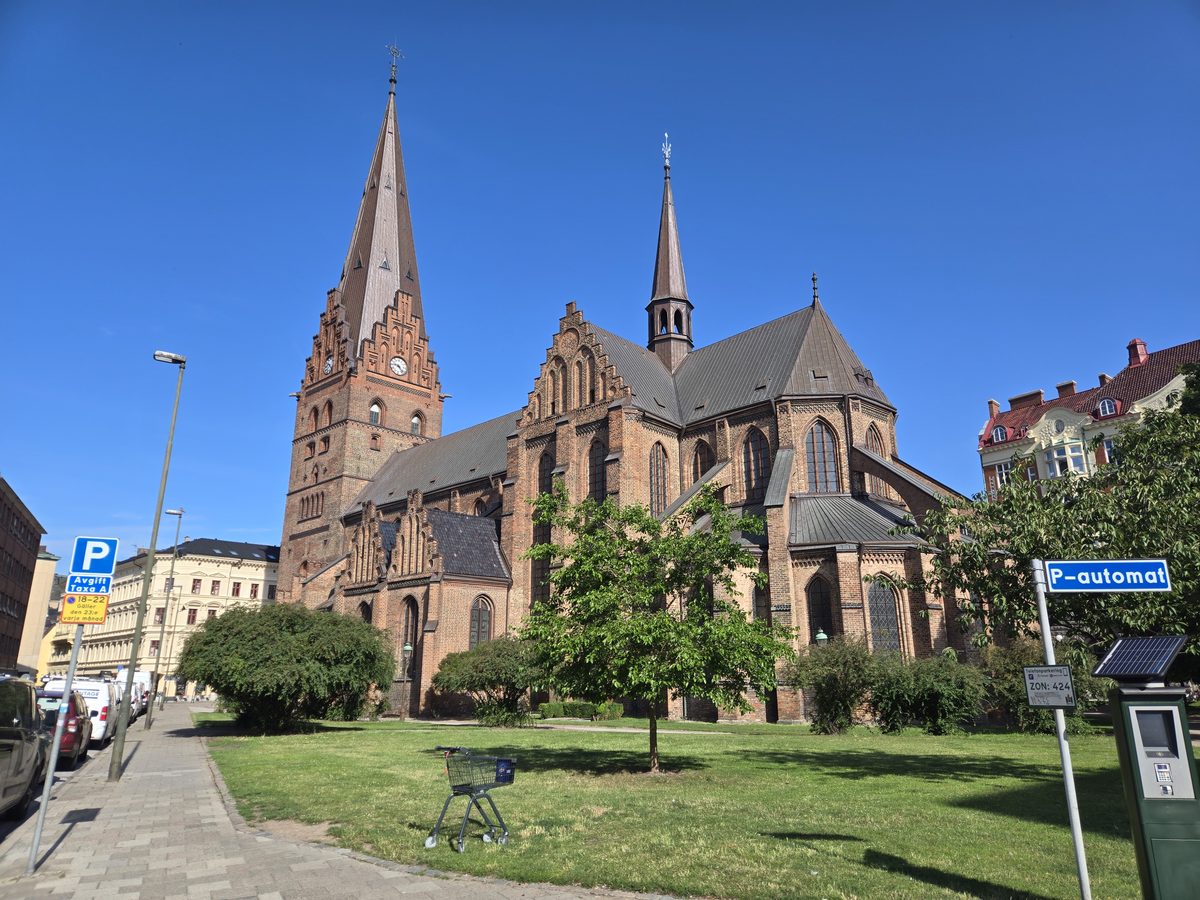
Sankt Petri kyrka. Saint Peter’s Church. And a shopping cart.
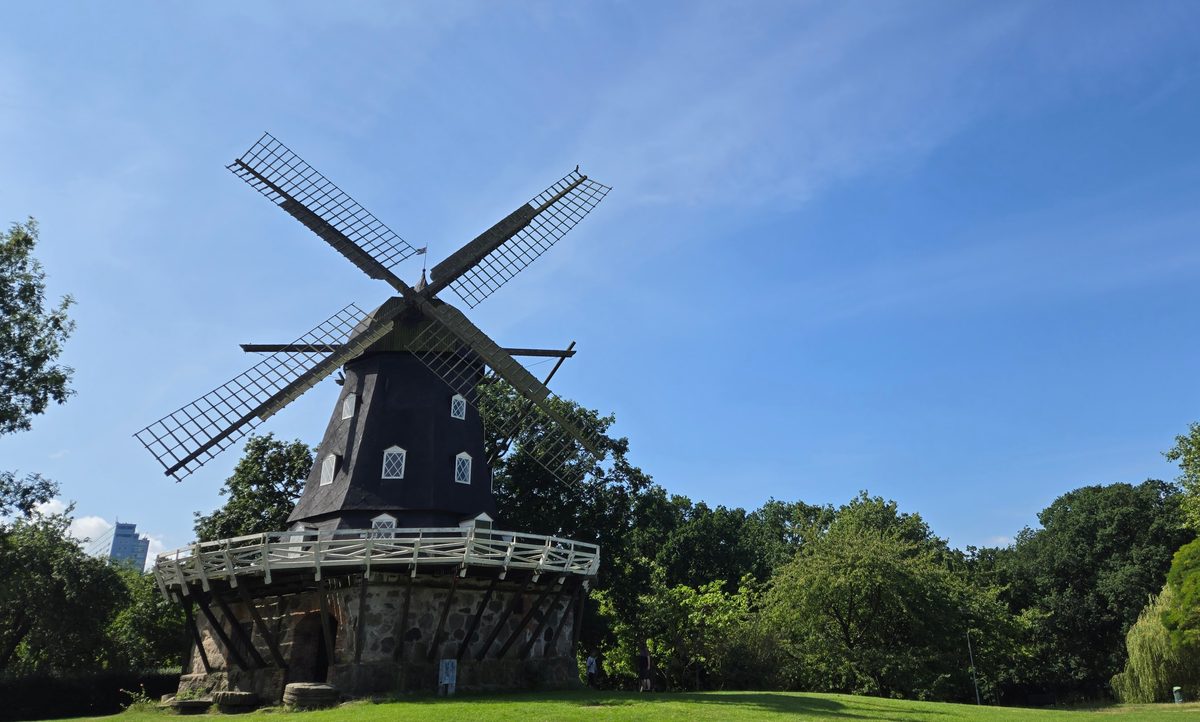
Later in the day I visit Malmö Castle. Castle, like château, can imply a gorgeous mansion or it can suggest a fortified outpost. Malmö Castle belongs to the latter group. It is not a handsome building, but it does have a water moat. Much like modern concepts of Vikings, our modern concept of “moat” has lost fidelity with what moats really were. Typically, they were pits. They were often filled with trees and brush to make traversing difficult, and I’ve read examples of wild animals like bears being kept in moats. But here, in this land established by river traders, surrounded by water, there’s a moat that looks like the ones from the Disney movies. Frankly, it’s much less dissuasive than a pit full of bears—I cross with no worries.
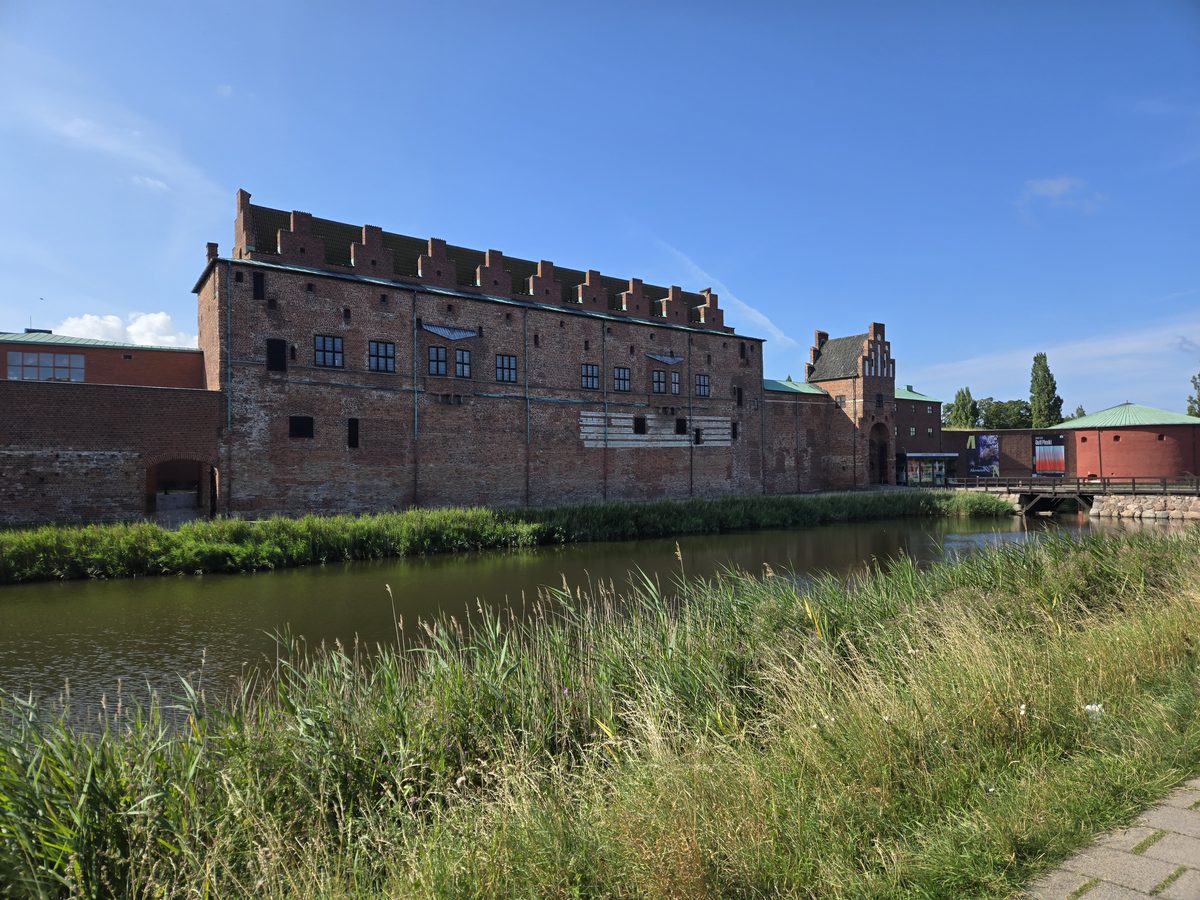
Malmö Castle. Much less dissuasive than a pit full of bears.
The castley part of the castle is fine. More on the operational side of matters than grandiosity, it has familiar hallmarks like tapestries, portraits, and recreations of kingly bedrooms and feasting halls for the modern tourist. Even the portraits of Kings from ages past look slightly bored with it. It’s a complex that feels more administrative than gaudy, and that’s fitting.
But the whole thing is a museum now, and much of the castle has “regular museum” flair. It seems like it’s being updated, but only periodically and only in some sections. There is an archeological and anthropological section that’s very new and has actual Viking artifacts and actual Vikings. It rates highly in my mental map of museum coolness.
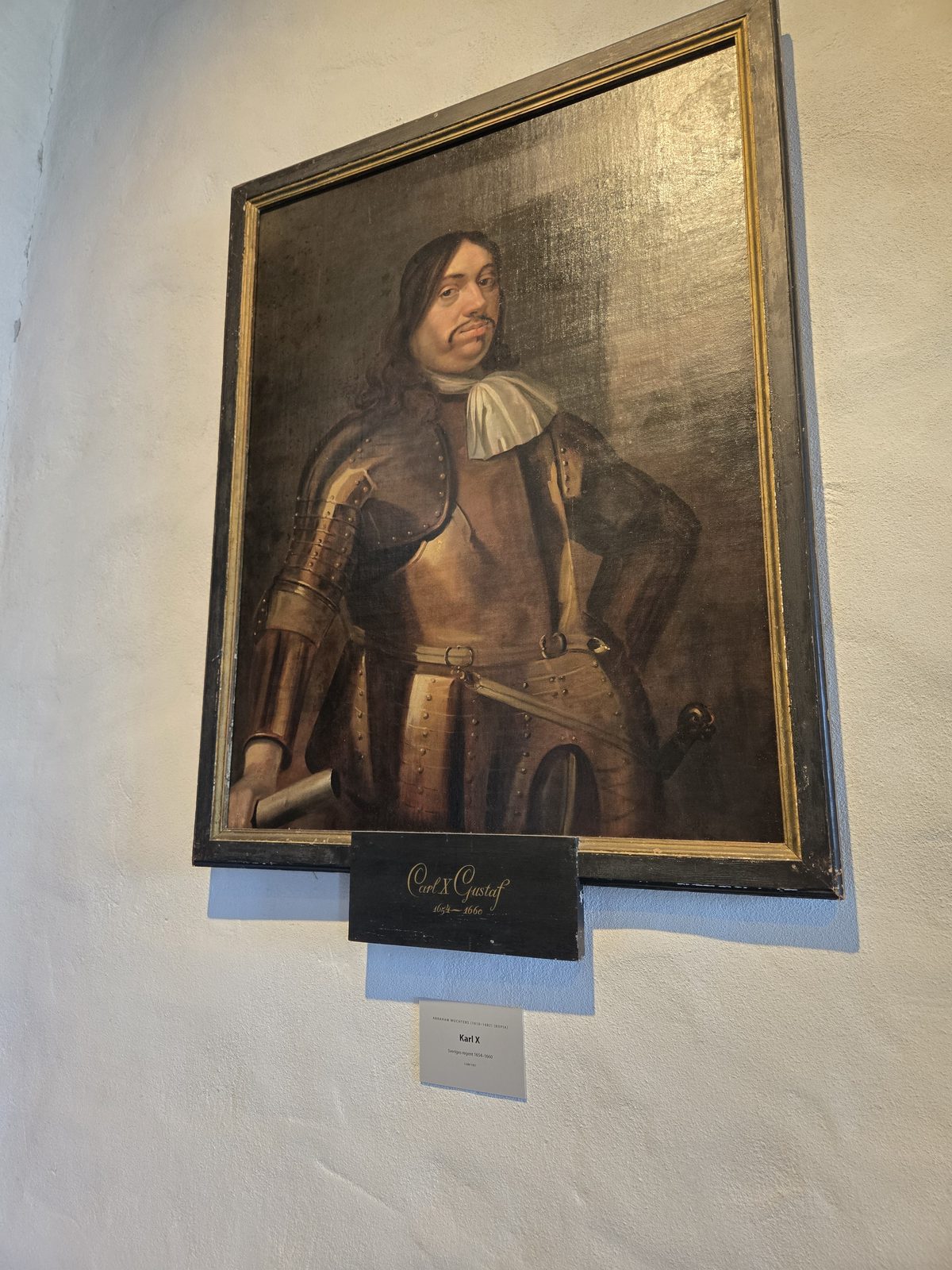
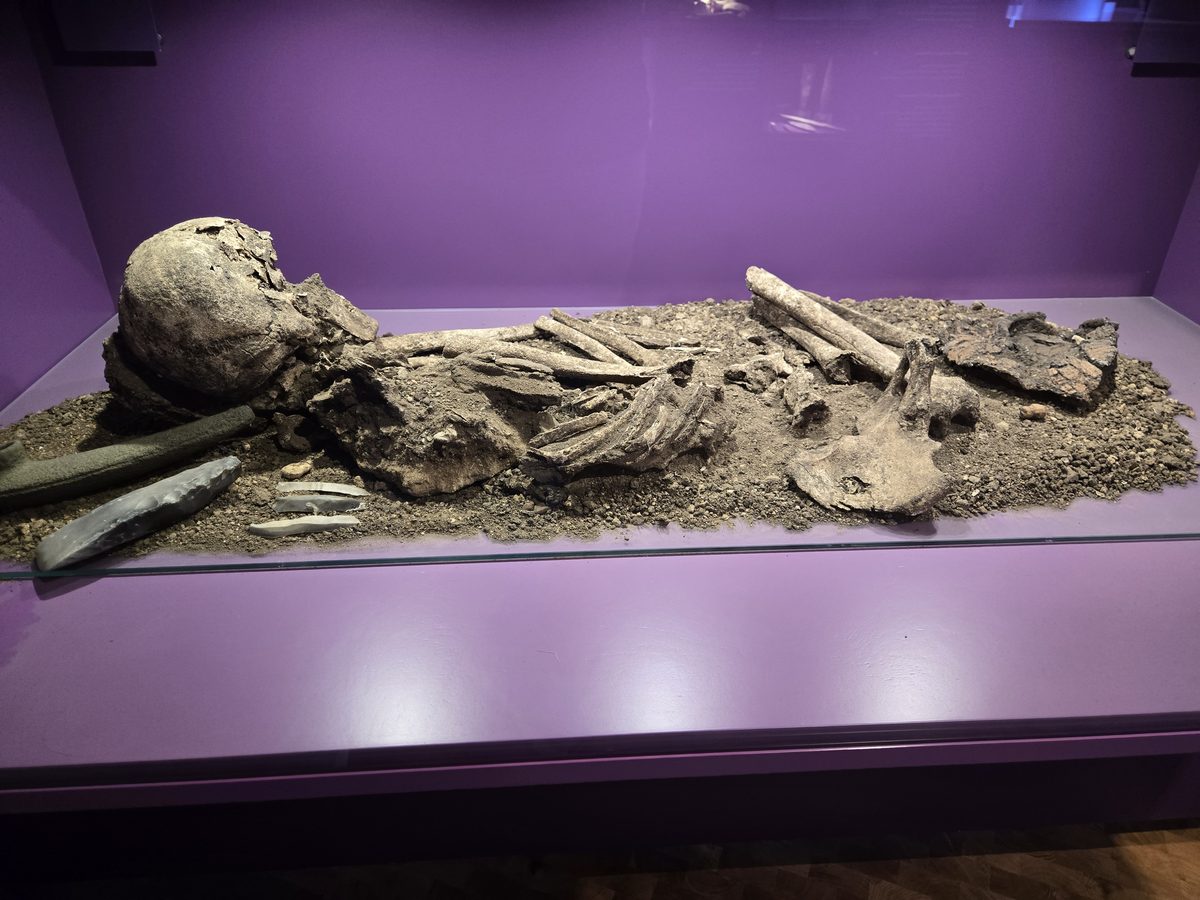
A bored king and a Viking. Now housemates.
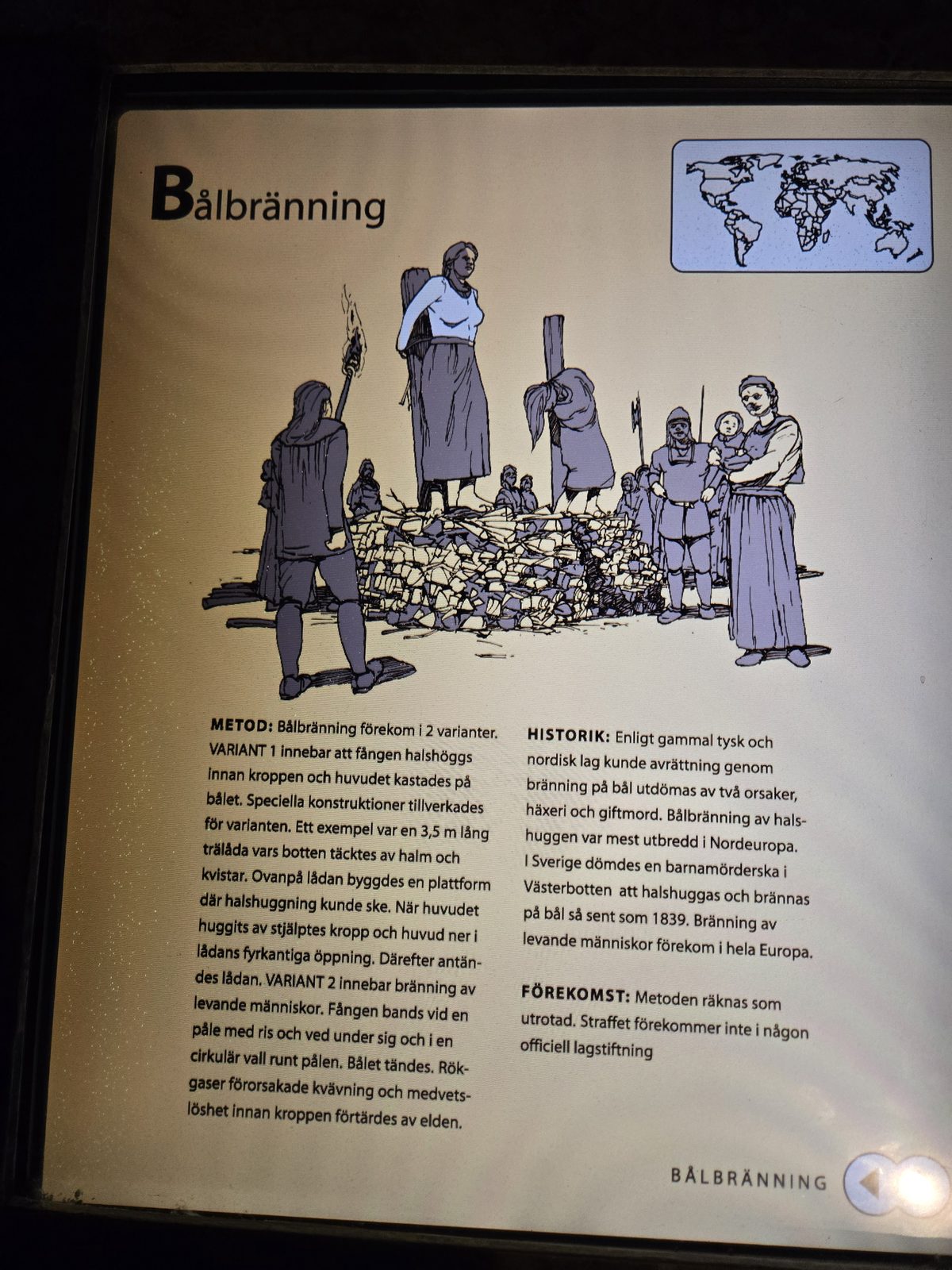
Other parts have not been updated and retain a feel that reminds me of childhood. In fact, the older parts of the museum are directed at children, and tell gruesome tales of witch trials, plague doctors, and the guillotine. An audio track plays on loop in the background. A woman whispers something in Swedish and a chicken clucks and then suddenly, WOOSH-CLANG! The sound of the guillotine. There’s even a blood spattering sound. About every 17 seconds a new head—chicken or human, who knows?—splatters its blood audibly around the space. Bring your kids!
Another, newer part of the museum is a modern art installation, and much of the art is pleasing to the eye. The thematic elements are natural—aurora borealis, forests, mountains.
Two full chambers are dedicated to the works of a local artist. It’s more post-modern—a mixed media installation. Creepy music and the artist’s whisperings play on loop, some of the installation is video or projection, and the entire exhibit is themed around a specific traditional Swedish hat. Like most living humans, post-modern is often a hard sell for me, as far as artistic movements go, but this is weird as hell, and I like it.
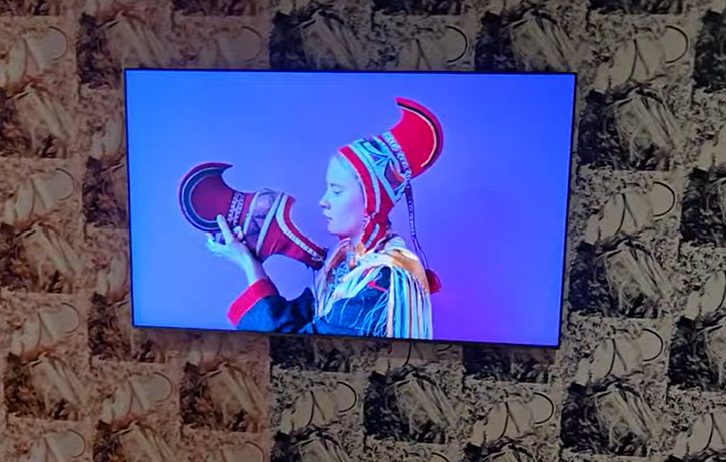
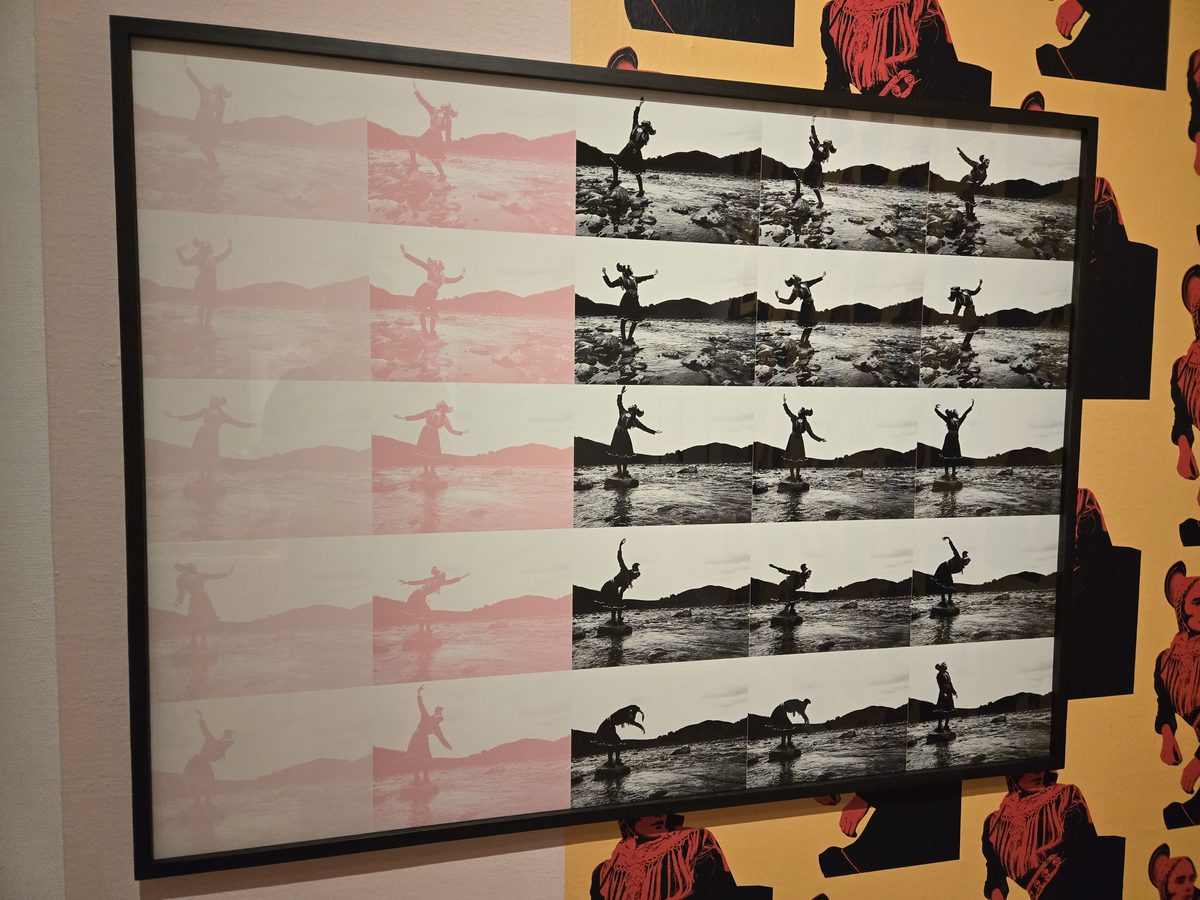
But I have another feeling about it, too, and it’s that historical connection I keep trying to gin up. I couldn’t find it in Nyhavn, I couldn’t find it at Sankt Petri kyrka with its abandoned shopping cart, and I couldn’t feel it in the more castley bits of the castle. But this weird assery—of all the things and all the places I’ve gone on this trip—this is the first place that’s dredged up that feeling of deep historical connection.
And it’s because most art is produced during a society’s economic good times. Not all—of course not all. But art that pushes boundaries, multi-faceted mixed media art installations—societies struggling with famine and war don’t have time for such luxuries. This type of weird-ass art only arises when a society has sustained economic strength.
I learn nothing about the hat that is the centerpiece of this exhibit, nor about its cultural ties, and I don’t feel like I need to. Somehow, this ridiculous, post-modern museum exhibit feels like an appropriate culminating achievement for a society with such long credentials in building economically strong communities. Who needs the Euro when you’ve got this dumb hat?
Pizza and Vikings
I meet a good friend and fellow professor for lunch. He and his family are making their first trip to Europe and flew into Bergen, Norway, then traveled by ferry and train around to Oslo. He’s staggered by the beauty of the country, and thoroughly impressed with its cleanliness and the ease of public transportation there. His only complaint is that he’s a peanut butter guy, and here in the land of Nutella, that is a hole that is not easily plugged.
I get to enjoy some of that European newness with him; we have pizza for lunch and it’s his first time receiving a pizza that is not pre-cut. It’s a situation I’m acquainted with. In many parts of Europe—most, even—there is less eating-with-the-hands than we Americans are used to. Why get your hands all covered in food, and why spread your nasty hand germs to what you eat? The pizza arrives uncut because, obviously, you’re going to eat it with a fork and knife, so asking the staff to cut it for you is like being the toddler whose Mommy slices the hot dog into bite size chunks.
Today we cut our pizzas into standard slices and eat like Americans—with our hands. And I’m happy to do so, because that’s how pizza was meant to be eaten. Sorry, Europe.
I assume the Vikings would also have been hand-eaters when it comes to pizza, but that isn’t a detail that made it into the Sagas. Food and fjords do fundamentally inform how Viking culture took shape in Norway, though. The fjords that cut and carve their way up the coast are famously beautiful, but they do not lend themselves well to agriculture and irrigation, and by the 800s the Norwegians have taken to the sea in search of more arable pastures.
These sea-faring Vikings form colonies on the islands they find in the North Sea and North Atlantic, and it’s from those Norse roots that modern Atlantic societies have blossomed.
I suspect most people think of Norway when we think “Vikings,” but these Vikings were more assimilators than conquerors, and it’s a fascinating mix of influences. Back home on the Fjords, no unified leadership structure ever emerges. Geographic separation lends itself more to localized tribal chieftains than to consolidated rule, but they are highly cooperative with each other, and the communities they form look more like commonwealths than fiefdoms.
The Norse Vikings settle throughout the British Isles, among other places, and a central trading node emerges on one particularly arable island there. The Vikings call it Dyflin and it becomes the key node linking trade among the other British Isles. Here as elsewhere, the Norse Vikings are quick to assimilate—they intermarry with the Gallic tribes, and language and customs quickly meld. In the Gallic languages, the community is called An Linne Dhubh or Duibhlinn. Eventually, as those languages conjoin, the name becomes Dublin. Even today, Dublin remains a major, centralized trading node connecting the British Isles and the North Atlantic.
The society founded by the Norse Vikings on Iceland is particularly representative, though. The tribes that founded this community create the Althing—a national assembly for settling disputes and refining laws. It’s new and novel, and this peculiar commitment to the shared pursuit of understanding gives rise to a society that values debate, learning, and sharing ideas. It becomes a template for governance as a cooperative act rather than an authoritarian one, and it lays the foundation for modern systems of parliament, the very word itself implying a society that talks it out, rather just conquering.
The legalism and importance of memory—laws were more recitational than permanently affixed in writing—has an interesting side effect: the community on Iceland develops a unique appreciation for preserving knowledge and memory. Iceland becomes a storehouse for Norse legend; those memories are preserved in Saga and song and, eventually, written down. These Icelandic Sagas, and their lessons of honor and duty and conquest, will become the basis for much modern understanding of “Vikings,” but other aspects are there, too, such as how the acts of a society can ripple throughout generations, and even environmentalism makes its way into the story. Operating on the northern edge of Earth’s habitable zones, these Vikings learn hard lessons, such as the ramifications of deforestation on Iceland, and balancing delicate ecosystems on Greenland to support agriculture. Some communities thrive and others fail, and on Iceland, much of this knowledge is gathered and preserved. Despite what television may tell us, these were forward-thinking, forward-looking, society-building Vikings. And who knows, maybe they did eat their pizza with a fork and knife.
After my friend and I have eaten our pizza, and wiped our greasy fingers, we go track down the waiter so we can be on our way. And as we come out of the restaurant, someone says, “Erik!”
That’s amusing, there’s another Erik here. Makes sense, this is the birthplace of my namesake and here it’s even spelled properl—
“Erik Taylor!”
What the hell? I’m in a foreign country, who knows me here!?
I turn around and I don’t see a familiar face. I must look baffled, because an Italian man raises his hand at me. And again, I must look baffled, because he says, “It’s me,” and tells me his name.
I try not to look it, but I’m baffled. I don’t recognize the name, and I don’t recognize the face. Despite my effort, the bafflement must still be creeping through because he’s kind enough to remind me that we were in grad school together. I would check with my grad school friends later, and they would confirm that he was indeed in one of our graduate classes, and they remind me that he once made us a lasagna.
I don’t remember him or his lasagna, but I give him my greasy, post-lunch American hand, and we make awkward small talk for a few moments. It’s a bit of an embarrassing encounter, and clearly the importance of memory has not transferred from my Viking ancestors to this modern American, despite my Viking namesake.
The Danelaw
For all that we think Norway when we hear “Viking,” and for all that Norse and Swedish Vikings did to seed the modern world, even combined they are outdone by the Danish Vikings. Situated on the sea and still attached to Mainland Europe, Vikings from Denmark would reshape the course of culture and history in the Western World. Danish Vikings had easy access to lands we would recognize as Germany, the Netherlands, Belgium, France, and perhaps most notably, England.
It begins with raids and then evolves into more organized conquest, even militaristic conquest. The assaults of Danish armies on Anglo-Saxon England were pivotal in reshaping political and military affairs there, and the Danelaw—a region conquered and ruled by the Danes in the 9th through 11th centuries—stretched across most of the modern country. London, Cambridge, Leicester, Nottingham, York, and many other modern English cities were held under Danish law during this time, and in 1016, Cnut the Great, a Dane, is crowned King of England.
As a response to Danish influence and military tactics, the Anglo-Saxons become more militaristic, as well; they copy the Danish playbook and become better organized, engage in more statecraft, and deliberately enlarge their economies to better finance all of it. Eventually they become equal in capability to the Danish armies and start winning back England, but the prolonged effort paved the way for another group to join the game and seize control of the board. The Normans arrive and, in 1066, defeat the tired and weakened army of Harold Godwinson at the Battle of Hastings and a Norman, William the Conqueror, is crowned King of England.
And who was William the Conqueror? The son of a Viking conqueror, Hrólfr.
Our legends of Viking raids come mostly from these Danish Vikings, but they are equally influential in affairs of statecraft and in bringing together different groups under a consolidated system of government. Cnut the Great and the Danelaw is part of that influence, as is Harald Bluetooth, who unified the different tribes of his region and Christianized them, and who is the namesake for the connective service we all know and use today. The familiar Bluetooth symbol is runic—the runes for Harald’s name, themselves unified. You can spot the runic ‘B’ within it the next time you connect your ear buds.
The historical echoes of the Danelaw and the Anglo-Saxon response to it reverberate throughout the centuries and into the present day. The focus on statecraft, militaristic organization, and building a strong economy to financially support defense and expansion did not stop with the diminishment of the Danelaw, nor did it end with the arrival of the Normans. Those principles would remain fundamental to the Anglo-Saxons and their descendants, and although a few centuries of conflict and turmoil would delay the inevitable, eventually the people descended from the Anglo-Saxons in the Danelaw would begin executing the Danish Viking playbook themselves—take to the sea in militaristic conquest, plant a state and grow a colony, and unify the whole system through coordination of law and trade. The British Empire grows from the seeds planted by the Danes; the systems of law, language, and governance that Danish Vikings installed in the Danelaw are part of the foundation of the common law system, and they have been spread and sown across the whole globe.
Not bad for a country that kinda resembles a middle finger.
But for all that history, for all that it touches my life and my language, I don’t feel that under-the-skin connection to it during my time in Copenhagen. It’s a nice place, it’s a cool town, it’s a major economic hub, and I’ll be happy to return again. But it’s almost too nice, too orderly.
And maybe that’s it. Maybe it is, in fact, too orderly and too nice.
Still Conquerors
When I arrive at Parken Stadium, I’m told to wait outside by some picnic tables that seem to belong to a restaurant next door. I do as I’m told—I go sit at one of the tables and try not to make eye contact with the host at the restaurant. The football club have back-to-back away fixtures while I’m in town, so a tour of the ground is all I can do, but I certainly wouldn’t have missed out on that. I expect it to be a big draw among the professors in town for the conference—I’m not the only one who likes to enjoy the local sports when I travel (I got invited twice to play Padel which is like, what, Pickleball? I don’t even know), so I booked my tour far in advance to secure my spot.
On the appointed hour, a man steps forth from Stadium and makes an address of a few paragraphs in Danish. After his few paragraphs, he says, “and does anybody need the tour in English.”
One hand goes up.
I guess all the other professors are playing Padel.
It turns out there is also an English family among the tour guests, so it’s not just me that forces the tour guide to use his English skills, but it’s very clear that we don’t get the same tour. At each tour stop he has several paragraphs to share, and there are well-rehearsed moments with a pause for laughter as a joke lands.
There are no jokes in the English-language version. We get sentences where the Danes get paragraphs, but that’s okay. I know where I am, and I know this club. I can almost be my own tour guide here. This one is especially fun for me, and for a few reasons.
One is childish. On this Scandinavian excursion I visit two clubs for which I have a juvenile affection. I visited Malmö Fotbollförening while I was in Sweden, and now I’m visiting FC København. MFF and FCK. Malmö effing Football, and for FCK… well, I don’t get the jokes on the Danish tour, but I come up with a few of my own.
The other reason is that this is one of those truly special clubs, FCK. The Danes are a very strong footballing nation. As in the Viking age and—well, always, really—Denmark punches above its weight class. The Danish national football team, who also call this stadium home, are a potent lot, and the names that grace the back of those Danish kits are found in the Starting Elevens of many of Europe’s elite clubs. The Danish football league itself is not one that attracts many international eyes, but a few Danish clubs are real splash-makers in the continental competitions, the UEFA competitions.
FC København is chief among the splash-makers, and they have a way of turning up at just the right moment to disrupt the plans of Europe’s upper footballing classes. In their first ever appearance in the Champions League in 2006, they beat Sir Alex Ferguson’s Manchester United here, at this very ground. Cristiano Ronaldo and Wayne Rooney were starters in that match for United, as were Michael Carrick and Darren Fletcher. United would win the Premier League that season, but they were completely neutralized on this pitch and under these lights.
The year prior to my visit, they again beat Manchester United here, and they reached the round of 16 in the Champions League—the only Danish side ever to do so.
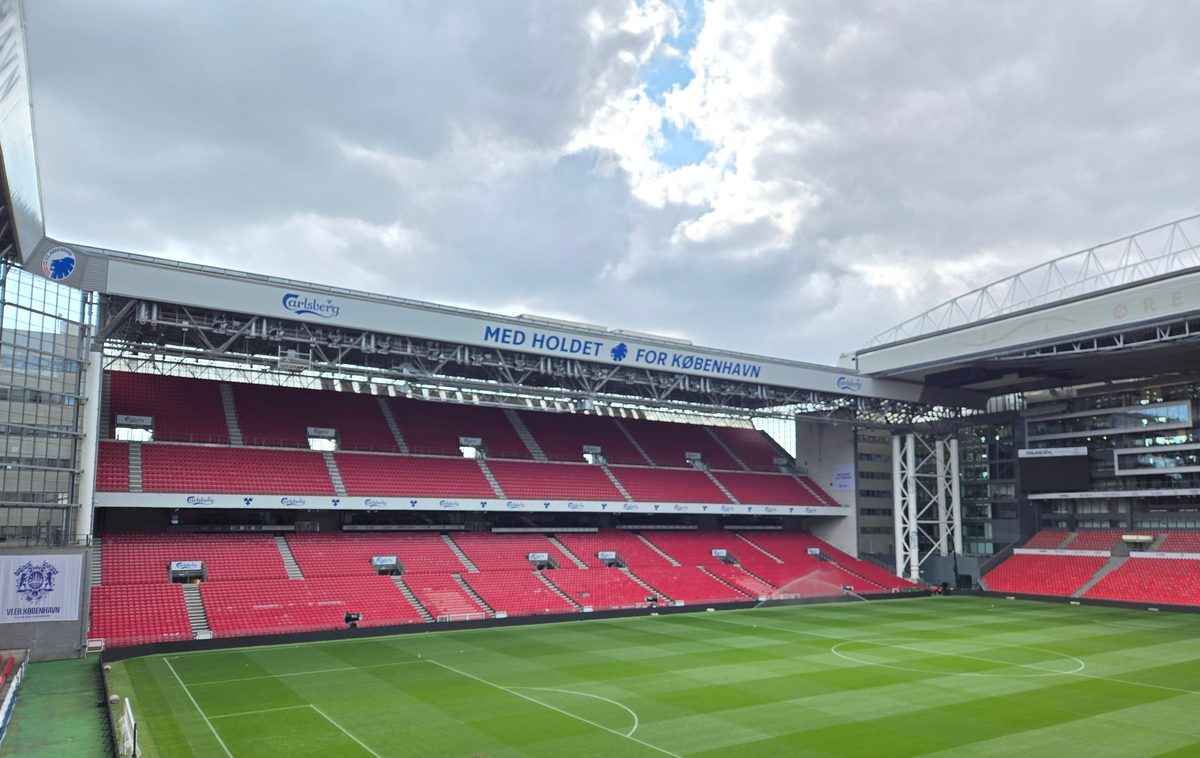
Parken. Where orderly Danes let loose.
They are a boutique pick for a football fan, and their tendency to outpunch is a big reason why. These are excellent reasons for a football nerd to have affection for a club, but there is one more reason and it’s the most important of all—atmosphere. FCK supporters bring intense atmosphere to their matches. Flags and chants, songs and fireworks, they are one of the clubs worth watching when they play on European nights.
I am disappointed I can’t attend a match, but it’s still nice to be in the space and to see the familiar sights and angles of the stadium. I’m not getting the full tour experience, but there are Danish families on the tour and it’s obviously exciting for the kids. Some of the adults seem to share stories of their favorite moments with the tour guide, they chat and smile and point toward the pitch. The English family and I are not really a part of it—we’re an addendum—but I enjoy being here just the same, and I enjoy how much the others are enjoying it.
I buy some merch after the tour. I’m slightly disappointed they don’t have a t-shirt or something with “FCK” on it, but wearing it would have been an insider joke for an audience of one, so I buy a regular t-shirt with the lion head crest and the club’s proper name, FC København. And after I leave the ground, I sit for a little while in a public square and enjoy the sunshine and read more about those 1876 foundations of the club before I go down to the tidy and neat subway station, laid out the exact same as all other subway stations.
And it’s a funny thing to me. For all that I’ve enjoyed and appreciated Copenhagen, and I have, almost all of it has felt a little sterile. I felt most comfortable in Nyhavn and in other areas that were swamped with tourists.
But then there’s Parken Stadium, where one of the world’s most orderly cities lets loose for their home club. It’s the tourists that bring the chaos to Nyhavn, but it’s these very same orderly Danes that bring the chaos to the football ground. And they bring enough chaos to lay low some of the big names of the sport, like Sir Alex Ferguson and Cristiano Ronaldo.
I guess even the Danes have to let the chaos out somewhere. I’m satisfied with their choice.
But there is also the conundrum. Few groups have contributed more to societal stability than the Danes and their fellow Scandinavian people. Despite their reputation, the Vikings’ lasting contributions to society are some of the very foundations that stabilize it—their legacy is almost antithetical to their popular image.
It’s a tale of creative destruction because, with the Vikings, it does usually start out with raids. But then they built—they built systems of governance, of law, of trade, even of ecological protection, and of cultural preservation. They laid some of the key, foundational drivers of modern life in Western Europe. And the Scandinavian states and their cities are masterclasses of societal order. So much so that I found it a tad awkward. And I tend toward order! In a way, it’s the most fundamental thing I do—I strive to understand how the world has come to order itself as we find it today. It’s my defense mechanism for navigating this chaotic world.
But the world needs chaos, too. Creative destruction is not just the way of the Vikings, it’s the way of nature, of physics, of academic research, and of super novae and black holes. Chaos and order are partners on the grand stage, and here in Copenhagen they’ve been retired to corners that feel a little too far apart.
But I appreciate the fact that Copenhagen—tidy, orderly Copenhagen, out here on a middle finger jutting into the North Sea—I appreciate that they’ve funneled their chaos into that most important vehicle: their football club. And that their football club consistently outshines their own spotlight and lays low some of Europe’s giants under the lights of Parken Stadium… I guess we never stop being what we truly are.
They may not take to the seas and the rivers in longboats anymore, but don’t be fooled—these orderly Danes are still conquerors.