 Away
Away The Val de Loire has much to recommend it but is perhaps best known for wine and châteaux. As a non-drinker, only one choice appeals so I booked a 10-hour tour of three châteaux for what would be a very rainy Spring Saturday. I’m excited for it, but also nervous—it’s a small group guided tour, which means I’ll spend 10 hours with a tour guide and a mélange of strangers driving hither and thither across the valley, and that triggers a bit of social anxiety. I’ve brought my computer and headphones in case the best thing for me to do is work while we’re in the van.
When I arrive at the designated meeting place I see a familiar face. That alone is shocking; I’ve met literally nine people in this country but, lo, here is Annabel, a charming and compact woman who is nearer to the hair-whitening stage than the hair-graying stage. She led me and my college students on a guided tour of Tours a couple of weeks prior. Then as now, no part of her suggests slowing down despite the obvious aging. She’s bundled in clothes and in tour guide tools—pole with handkerchief, notebook, iPad, backpack. A sherpa of knowledge.
She remembers me! I’m delighted but I shouldn’t be surprised, I haven’t seen any other hordes of American college students drowning out the silence in Tours. She asks me if the students have gone home and I say, “why, can’t you tell by how quiet it is?” She clearly gets the joke but the French do not laugh heartily with colleagues and strangers; mirth is reserved for friends and family, but I see that she’s in on the joke.
We’re chatting in that pleasant but awkward way when the tour guide I am waiting for arrives. She greets Annabel—it makes sense they would know each other—and she asks if I’m Andrew. “Andrew,” I say. “Non non, that’s my brother.” It’s meant to be friendly and mildly amusing but it lands like a punchline. Annabel actually laughs this time. I’m not sure how that landed so well but it helps me feel less anxious about the day. When the actual Andrew shows up it turns out he’s pretty alright, too. A consultant in a firm that does ethics advisory, he’s in France for the OECD conference; we talk shop while the tour guide drives.
We have two others joining from the next town over. I’m nervous for that, too. I’ve already established an identity in this group—charming, funny, up on the current issues in corporate ethics. Adding new people to the mix threatens the balance. What if they don’t buy my charming, funny, enlightened identity? What if they’re funnier, charminger, enlighteneder than me? I can always get my computer out, I tell myself.
They’re warm and friendly people, though. Paul and Anna from Alabama. He’s retired career military, she works in marketing, and in under two minutes they have proclaimed themselves the two most liberal people in all of Alabama. For a French citizen and an ethics consultant, that line seems to defuse something. For me, a political misfit in my own country and abroad, the most conservative people from Oregon would have been no better or worse—that political views are a top-level identity for someone is a red flag. Better that their identities be tied up in more important things, like being charming, funny, and enlightened.
The Ladies’ Castle
The images of Château de Chenonceau are what inspired my day. It’s like a Minecraft concept brought to life—who builds a castle over a river? It’s beautiful. It screams, “come take bad selfies here.” But how is this a good idea for a castle?
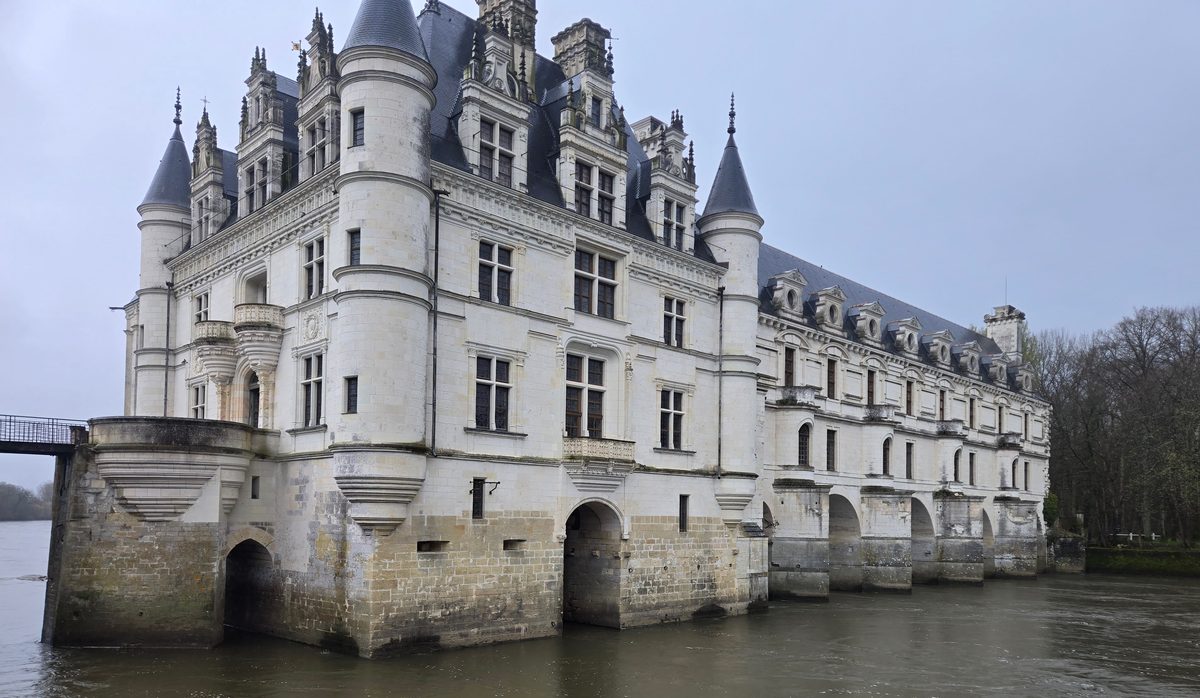
Château de Chenonceau. Who builds a castle over a river? Someone who can, apparently.
It’s cold and rainy, my nose is running and my pockets are stuffed with tissues, but approaching the château in the gray rain adds a bit of magic to the experience. The château emerges at the end of a carefully-maintained boulevard, its most striking architectural features faced this way. In the French style, there are beautiful gardens and that’s the first stop of the tour. I don’t actually care. The gardens don’t do it for me, even if I appreciate the symmetry.
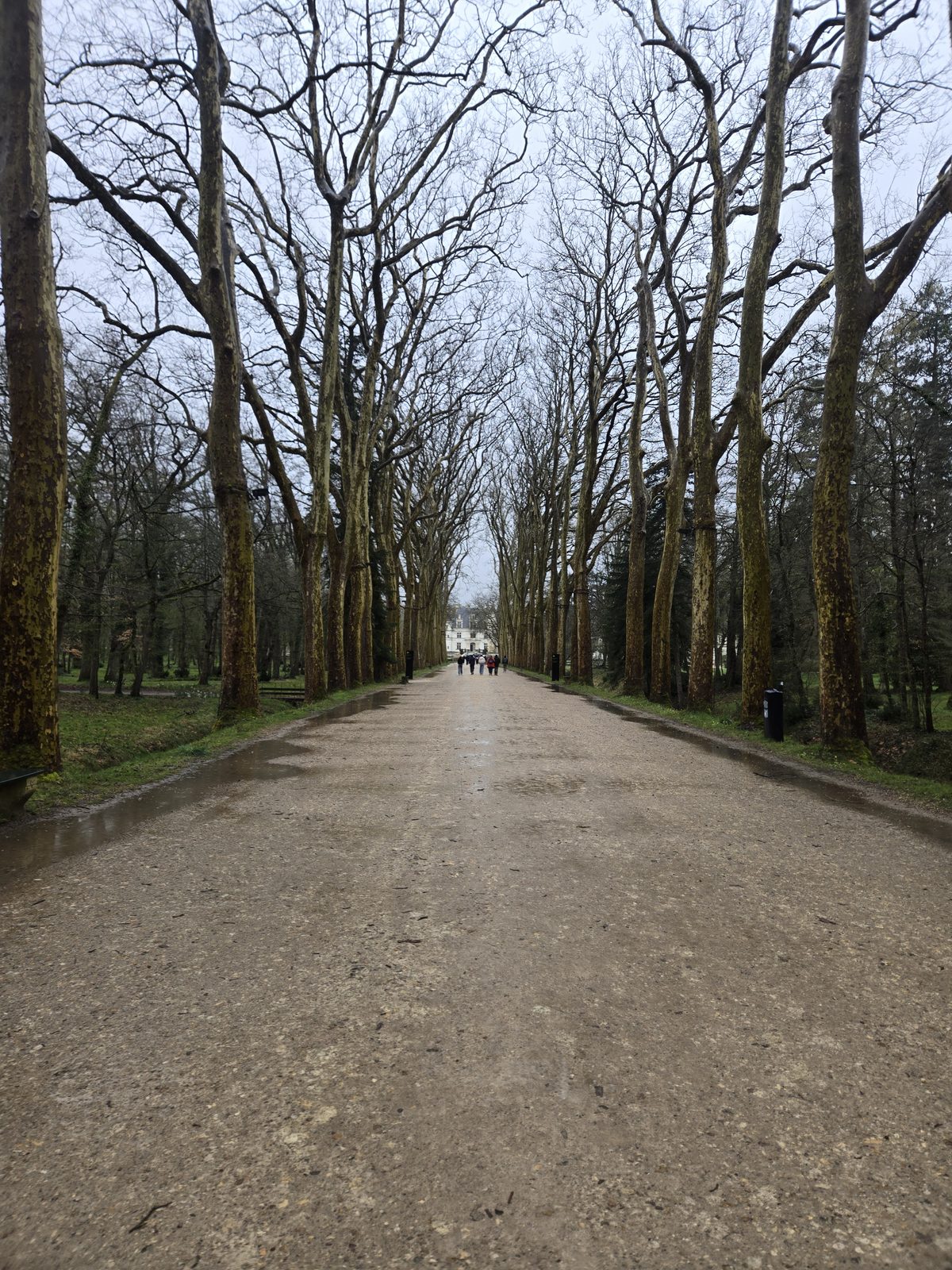
The tree-lined boulevard to Château de Chenonceau.
The tour guide takes us through the more interesting rooms within. The private chapel, the foyer, the various entertaining rooms. It’s less big than it seems. It isn’t small, but the main living areas are not those that have stretched across the river; the most substantial part of the castle has grown atop the riverbank.
There’s lots that’s interesting here. Tapestries are the strong hand and I find it easy to linger in front of them. Some of them are twice as old as my home nation and they tell familiar stories in elaborate detail. The time and energy that craftsmen would have devoted to each one strikes me as much as the finished product itself.
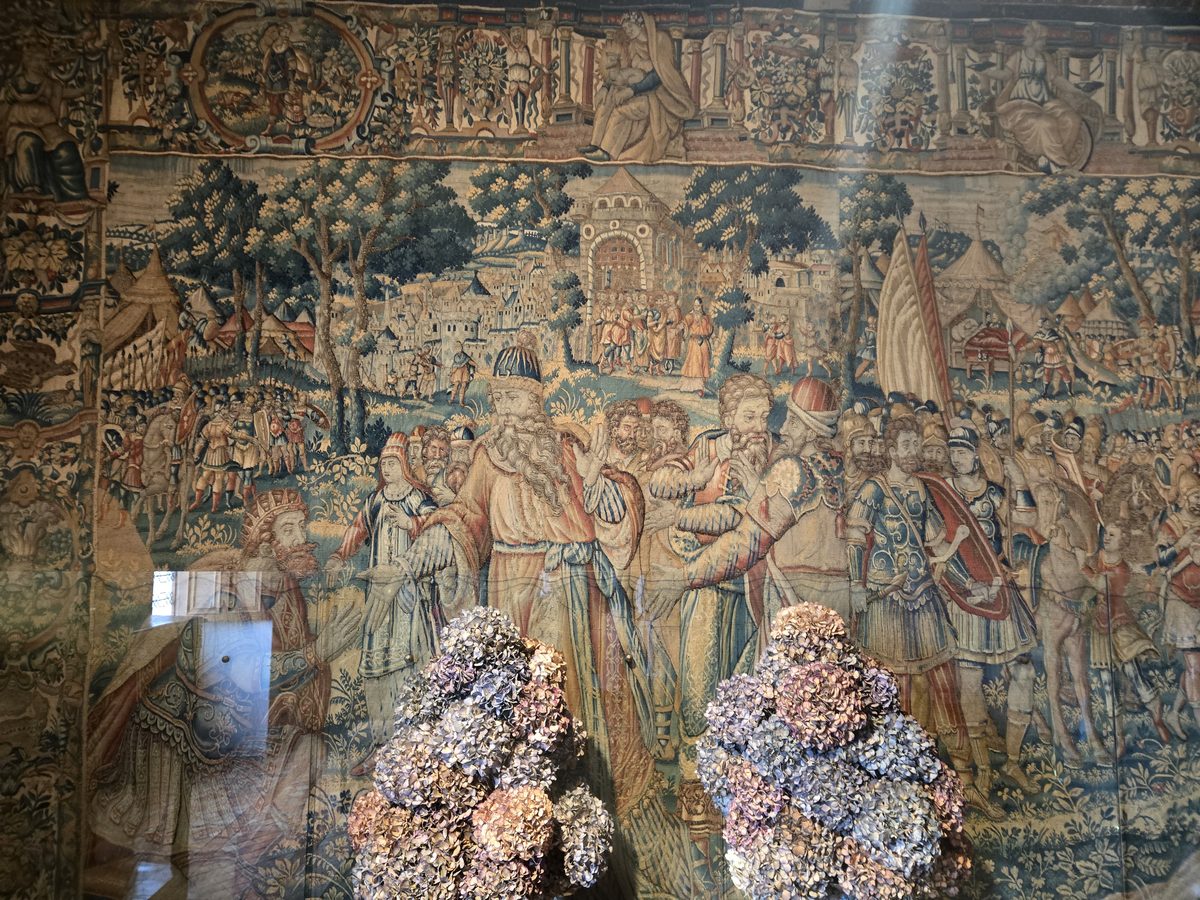
Twice as old as the United States and still holding every thread of the story.
Other things are interesting here, too. The Jesus Christ Chest, a particular window where the stones have been worn from years of perching, a mourning room. The mourning room arrests my attention. Castles can be dark places but this room has been made deliberately so. The windows are curtained, the walls are dark, there’s a literal altar to the bereaved husband in the corner. The widow spent the rest of her years mostly mourning her lost husband in this room, I’m told.
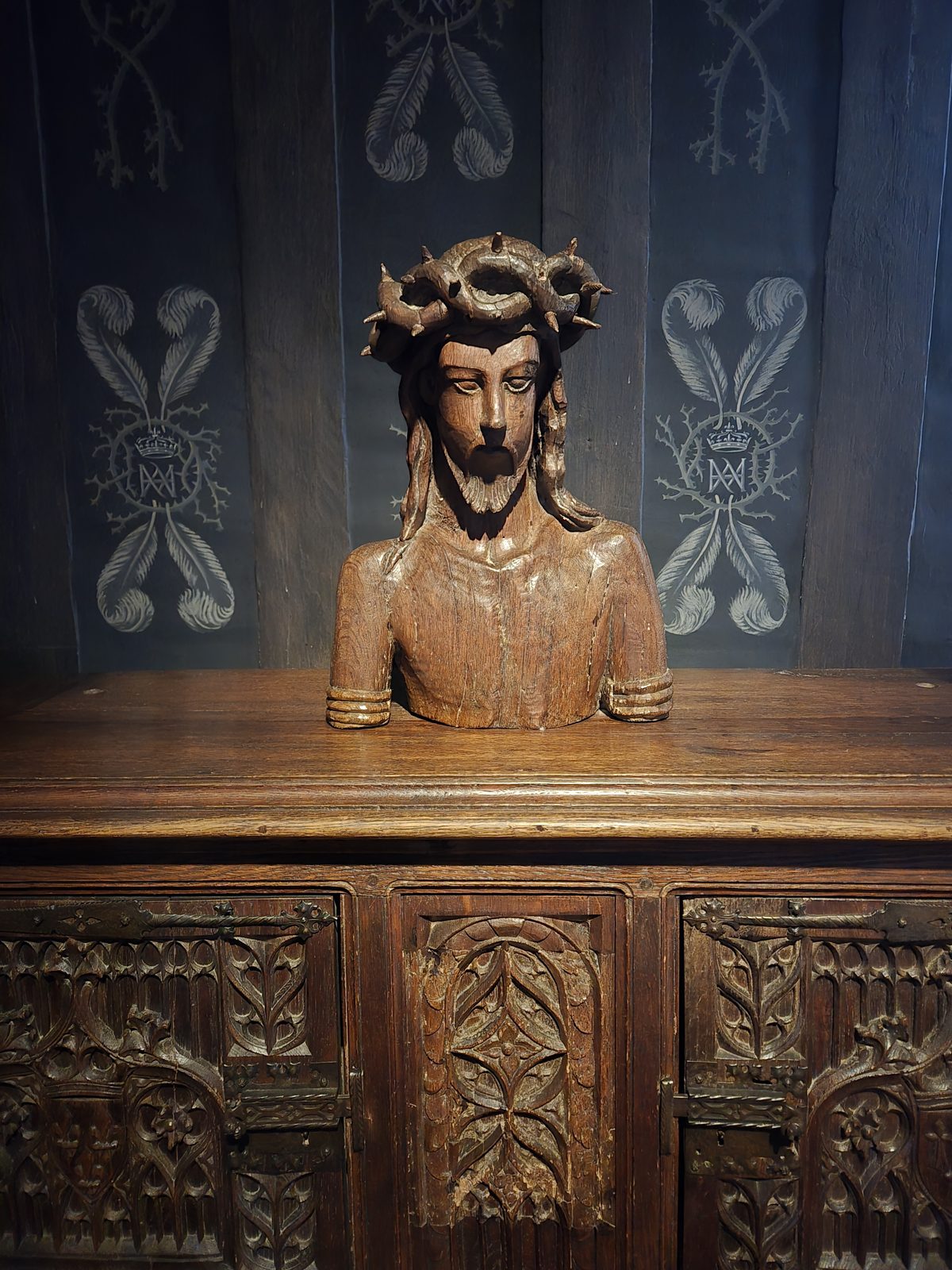
The Jesus Christ Chest. Even He seems unsure of why He’s on this chest.
Pffffft, I don’t buy it. These poor women were married off as assets, treated as property. Here’s one whose husband died and she managed to remain in the castle the rest of her life; she never had to remarry, to become another man’s property, ever again. This room, to me, has a feeling of release. I more readily believe that she adopted the identity of bereaved widow in order to purchase her freedom. There’s no evidence for this, and I keep my theory to myself, but that’s what I feel in this room. I share a knowing wink with a woman who died four hundred years ago.
Women controlling their own fate is a theme of this place. It’s unique in that way. The Chenonceau we see today was a passion project of Henry II’s mistress, Diane de Poitiers, who received the original château as a gift and commissioned its Minecraft-esque extension across the river. By all accounts she loved the château as much as the king loved her, his favorite mistress.
But Henry had a wife who also favored Chenonceau and when King Henry II died in 1559, Catherine de’ Medici used her influence to have Diane de Poitiers removed from Chenonceau and take control of the château herself. Never cross a Medici. Catherine herself is an inherited property—she had originally been married off to Henry’s older brother, and when he died, both she and the title of “heir” passed to Henry. A political marriage, Henry lavished much more power, influence, and affection on Diane de Poitiers and even wore her colors rather than his wife’s at the jousting tournament where he would receive a fatal wound. One would think Diane should not have been surprised that Catherine’s first act as queen regent was to seize Chenonceau and send Diane to the land of Nod.
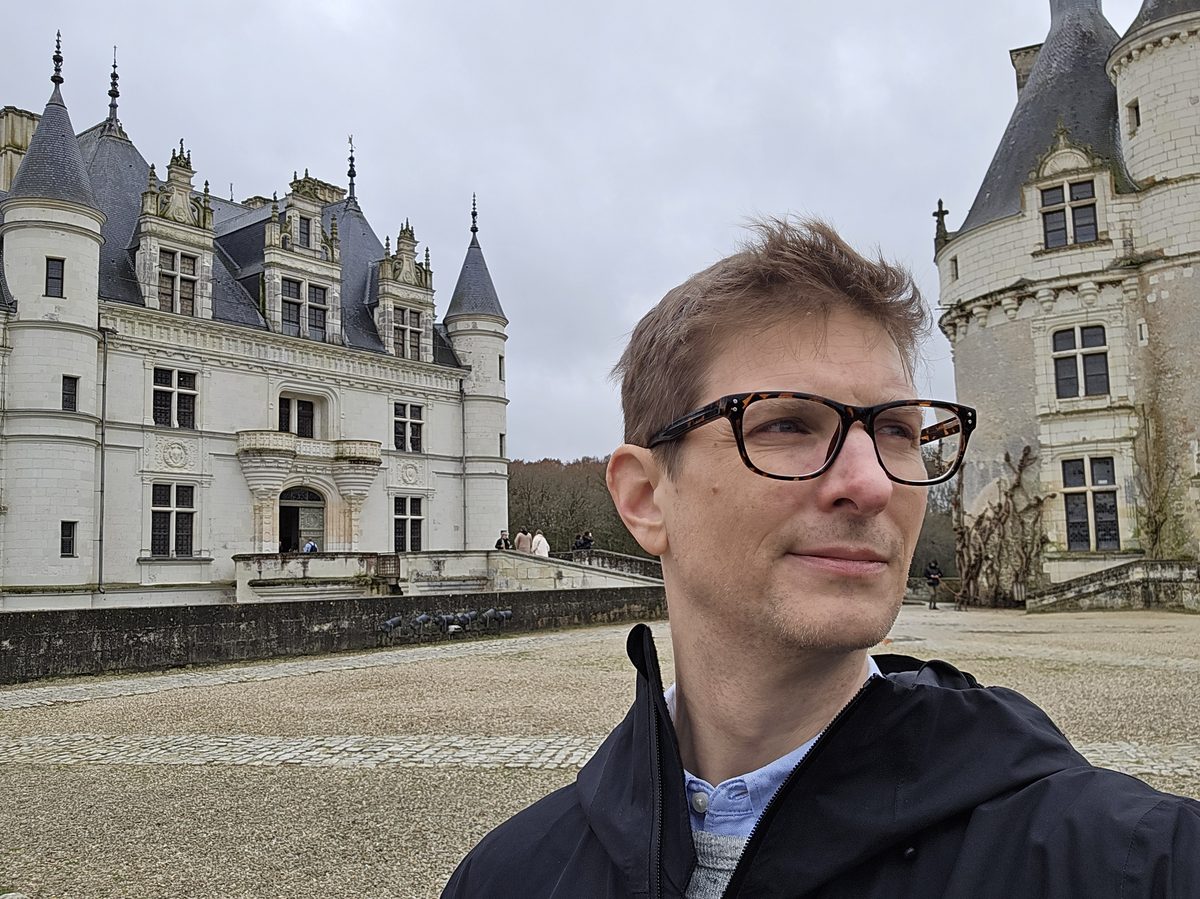
So many bad selfies.
I get a little carried away reflecting on the history of Chenonceau and its unusual role as an asset for those who were themselves seen as assets. It reflects that complexity and I enjoy being in the space, trying to understand what it must have felt like to be Diane de Poitiers, to be Catherine de’ Medici, to lock oneself into a mourning role for half a lifetime in order to purchase a sliver of freedom. I’m late returning to the group, everyone’s already waiting. Worse yet, I can’t tell which of the 25 white vans in the lot is the right one, and the tour guide has to come out and flag me down, social anxiety growing again.
Lesser Castles
Friendly banter unfolds in the van and suddenly the backpack with work gear feels heavy as it leans against my legs. The inevitable “what do you do?” question arises from my liberal Alabama friends and I give my one sentence answer.
“Whooaaaaa!”
The ego side of me loves this. Yes, it says, I’m not just charming and funny but also smart and impressive. The better half of me is mortified; it sounds much more impressive than it is. The differences between one person and another are always slighter than we think, and any person’s success or accomplishments are as much attributable to their environment as to any personal quality. I wasn’t trying to be smart and impressive today, I’m wearing my funny and charming hat. The backpack with work gear seems to shift its weight against my legs. We chat about my work and I try to back away from it: “it’s really not about smarts, it just takes a lot of hard work.” Dangit, that didn’t come off right either.
They are very likeable, though, Paul and Anna. Near my parents’ age and parents of grown children themselves, there’s a touch of parental proudness in their eyes: they smile softly at me as though I’ve done something that they should be proud of. This time, I accept. They are warm and themselves quite charming, and on yet another cold and rainy day I welcome the warmth.
For lunch the tour guide drives us to Château de Villesavin, a privately-owned château of which only a small segment is open to the public. We get the insider’s treatment, though—a privilege reserved only for this particular tour company. I assume every tour company in the region has a similar special deal. But none other than the countess herself greets us; she’s prepared lunch for us with her own hands, though she doesn’t join us for the meal.
Meals are one of the fundamental differences between France and America and one of the parts of my American identity that I struggle to shake. That I eat lunch at my desk sometimes strikes my colleagues at the University of Tours as odd, and when I go to restaurants for dinner I genuinely struggle to eat slowly enough so that I don’t leave in under an hour and insult the staff.
Wine and charcuterie are the first course at lunch, and again I am the unwilling center of attention. A non-drinking vegetarian is a little odd in the US but borderline incomprehensible in France.
The cheeses look utterly disgusting. Three of them are delicious and one tastes like it looks. One is a goat cheese that, for some reason, part of the preparation involves rolling it around in charcoal ash. You eat the whole thing, they say, so I do. It’s an act of faith; for most of my life food that’s rolled around in ash would not be something to eat. But I’m weird enough to not drink the wine or eat the meat, so I eat the dirty goat cheese and find that, gosh, that really is a complex palette of flavor. For all that I can’t shake being American, that the food here is remarkable—that it is complex and warrants taking time to unpack—can’t be denied. Cheese is an item at home but here it’s a category, like science-fiction or chemistry—it’s a placeholder for a tremendous amount of depth and variety.
I enjoy the rest of the meal as slowly as I can. The Countess has prepared a vegetarian quiche for me and I’m quite pleased with it. I take a small bite, chew it as slowly as possible, take a sip of water, nibble on some bread. Bite, chew, sip, nibble. I try to be slow but I’m still the first one finished. No one notices, the wine is a distraction.
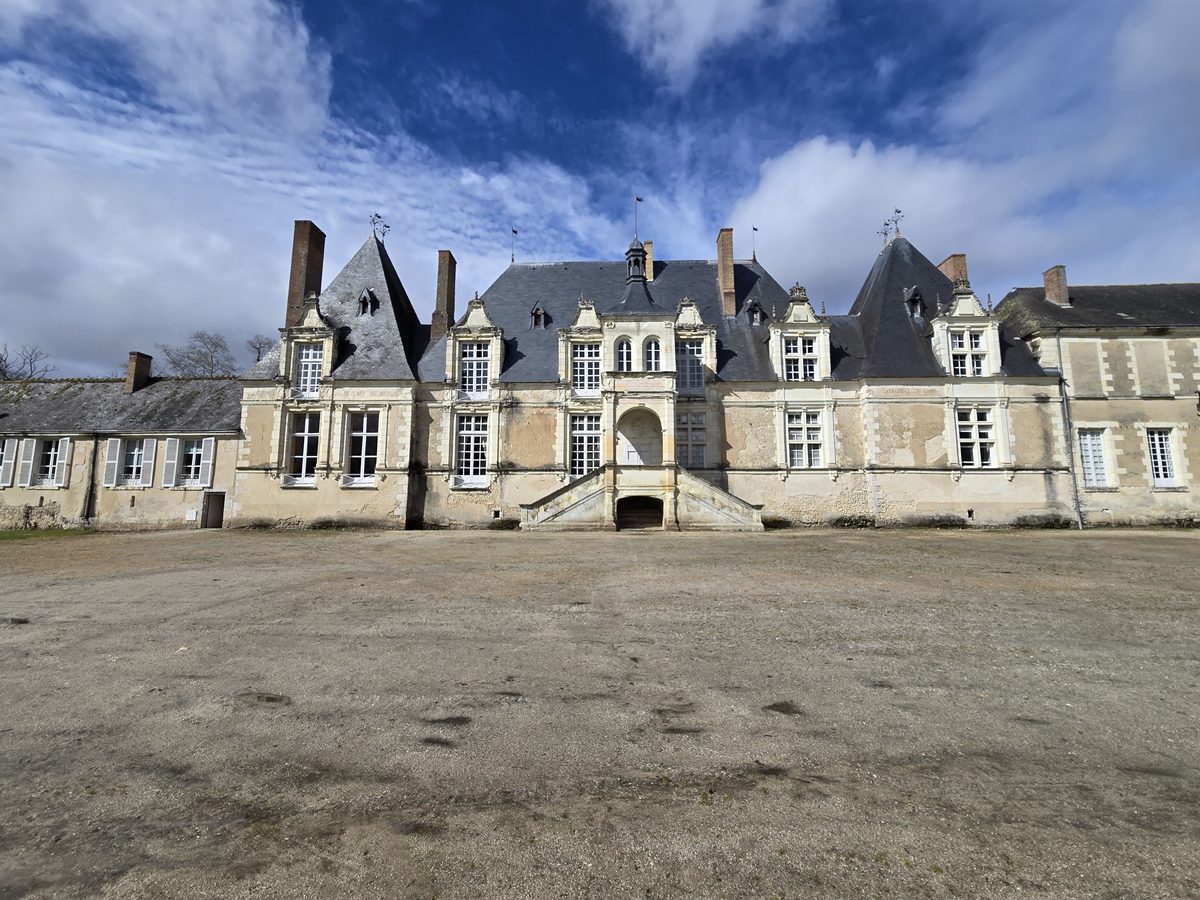
Château de Villesavin. Run down, partly inhabited, partly a working farm, partly a museum. My favorite of the day.
We’re given some time to explore the grounds on our own and even given permission to explore a part of the château that’s not open to the public, a special privilege just for this tour company. The countess gave us the instructions but I’ve forgotten them, and after a trip to the bathroom, Andrew and the Alabamans have already begun their wandering. I gird myself and go interrupt the tour guide’s break to ask for those directions again. Through that passage, third door, go down the hall and take the first left, second door on the right, go down the pipe and skip directly to Level 8 to fight Bowser… I figure it will make sense once I go through that passage and find the third door but I’m lost almost immediately.
Rather than risk traipsing through part of the castle that I’m not supposed to be in—and damaging that precious relationship between Countess and this particular tour company—I decide to play it safe and just explore the grounds. It has stopped raining and for 13 minutes it is a beautiful muddy day. As with lunch, more time is allotted here than I need so I’m trying deliberately to be slow. Ah, so that’s how the gutters connect between sections. Oh, that is an interesting arch above this window.
In the back of the château is a pigeonnier. It’s a large cylindrical structure with lots of little pigeon passageways up and down its sides, and there’s a small opening at the bottom that’s big enough for a hunched human.
I hunch and let myself in. It’s like the outside but concave instead of convex. I look up and try to imagine what it would have been like hundreds of years ago to be the pigeon caretaker. Messy work, I’m sure, but there would have been many worse jobs. Caring for birds doesn’t seem like the worst fate for someone born into a life of peasantry and servitude.
Suddenly Andrew hunches his way into the space. He’s clearly not understood the directions either, his leather loafers will die this day. We both pretend that we’re here on purpose, that we’re both deliberately exploring the backside of this château in the mud. That’s good, our mutual plight has spared us both embarrassment.
I walk around to the front of the château and take some photos before the rain resumes. Compared to other sights of the day, Villesavin is observably less impressive. After this stop we are going to Chambord, and this château was the home of the architect of that one. The tour guide tells us that he siphoned off money, resources, and workers from the king’s project at Chambord to build this. Bold move, Cotton, but it seems to have paid off. It may be a lesser feat as compared to other châteaux in this region but it will be my favorite. It’s run down, partly closed off, partly inhabited, partly a working farm, and partly a museum. The combination of combinations endears it to me, and I’m glad I’ve placed my trust in this particular tour company.
The museum and working side had closed for lunch but have re-opened by the time I trek back to the front of the château, so I wipe my feet, pass under the Musée sign, and enter the strangest space of the day.
It’s a museum of regional wedding artifacts mostly from the eighteen hundreds and it is staggering. I am instantly absorbed and will forever regret not taking more photos or just filming the whole experience. The musée has two main parts; one is a series of mannequins displaying scenes from a traditional wedding. By God, the mannequins are fantastically creepy. There are scenes of the bride being fussed over by matrons and younger sisters, of the groom receiving fatherly advice, of the packing of the wedding chest, of the ceremony. The purpose is to observe the elaborate lacework and handmade garments, I think, but the mannequins and their arrangements are so odd; they’re haunting. I absolutely love it and feel a pang of guilt; when I travel alone I try to leave the things my wife would enjoy for a future visit, but this she would have loved.
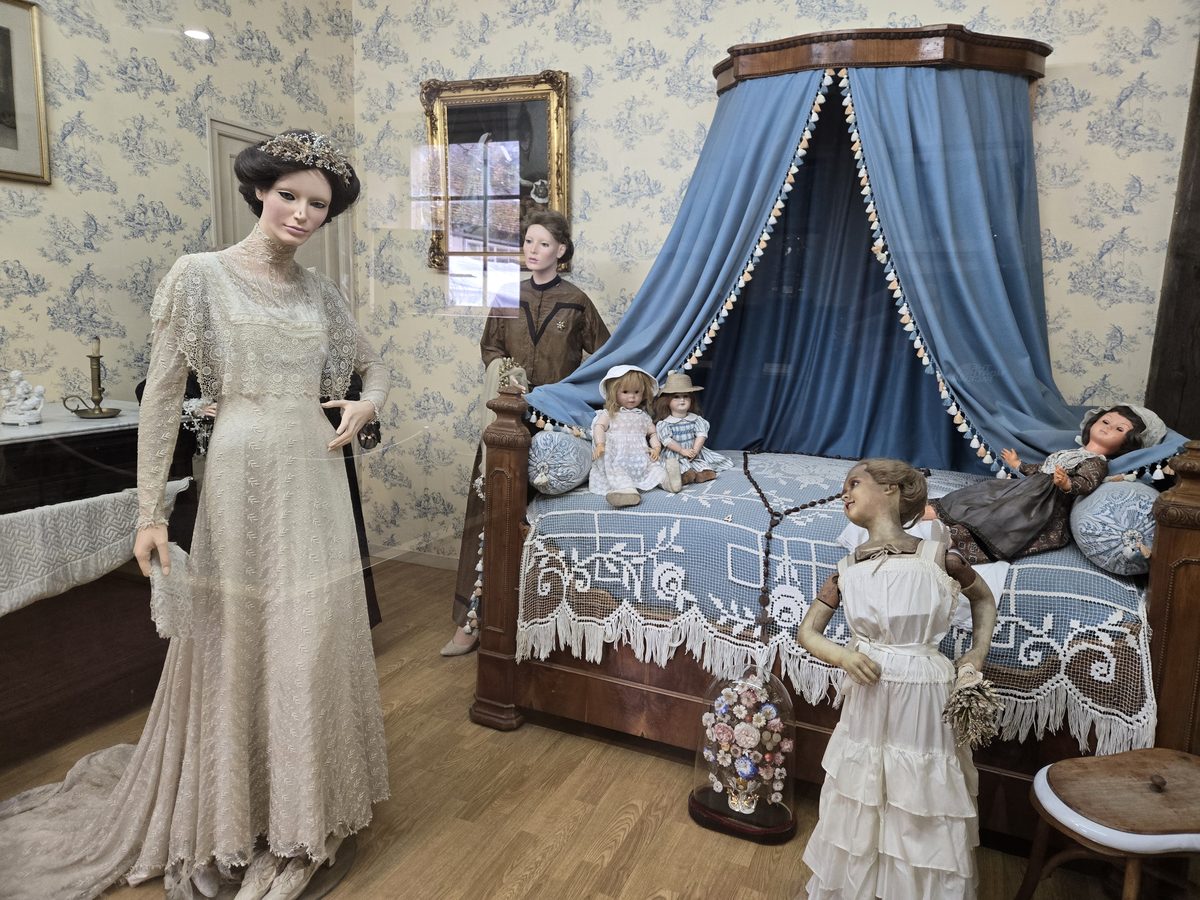
The mannequins are fantastically creepy.
The other main room of the musée contains scores of bridal headdresses. Symbols of status and transition, they were meant to communicate family wealth and community identity; apparently there is observable regional variety in the headdresses. Like the mannequins, I find this space fascinating in an unusual way. The headdresses are elaborate and gaudy and would have been momentary decorations before being consigned to dusty storage. It seems a fully pointless demonstration that is defunct as quickly as it is made.
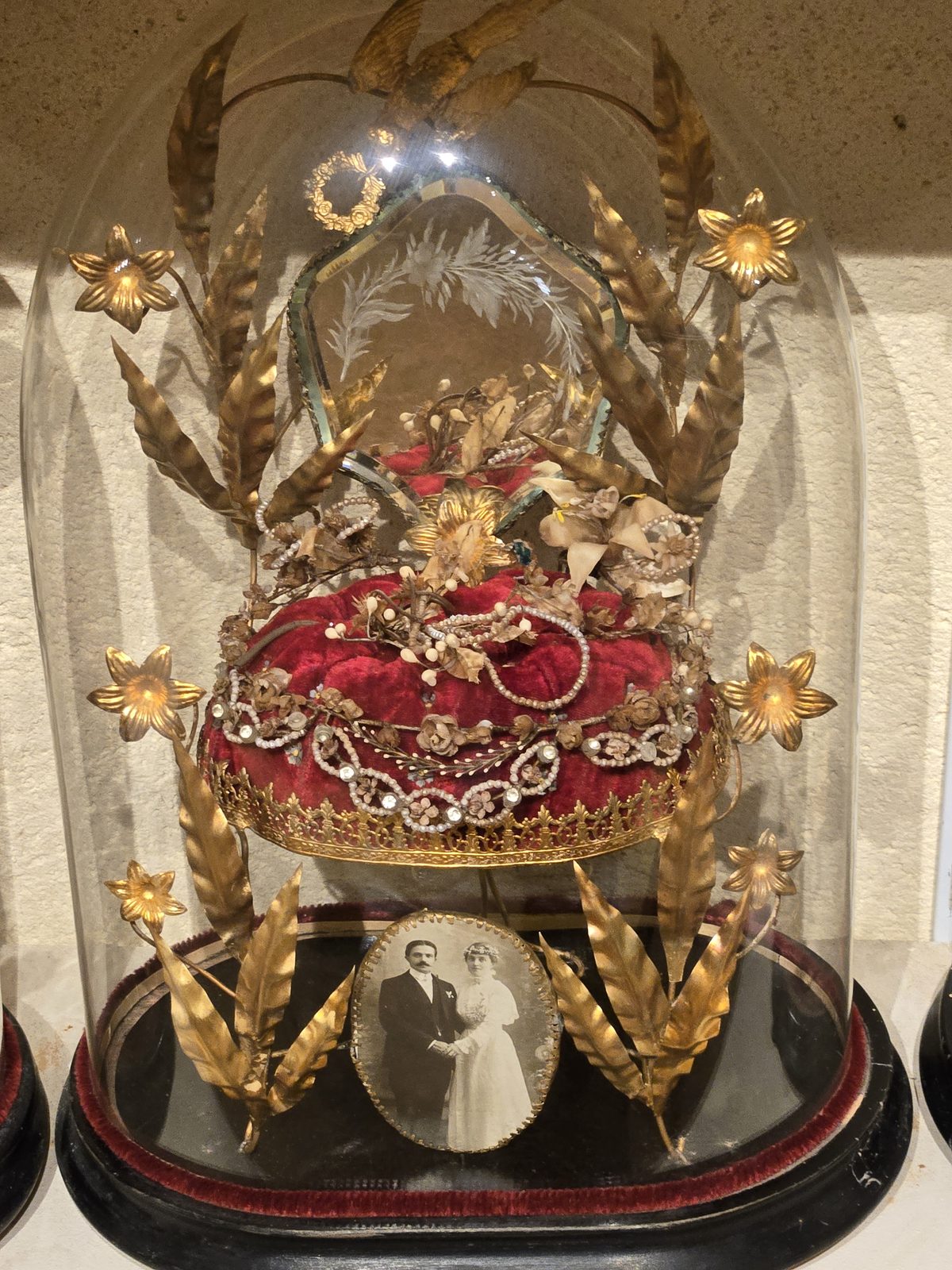
Gold flowers, pearls, and a photograph of a bride long since gone.
That it would have carried so much meaning, that some brides would not have had wealthy families to provide gold-ornamented headdresses, adds a touch of sadness and futility. What could they have done with their energies and resources if they weren’t so compelled to assert personal, familial, and regional identities at this transitional moment of life? That the people in the photos are dead and so are all who remembered them emphasizes the hopelessness of this assertion of identity. I feel bad for the brides because I can’t help but wonder if it was worth the effort, nor can I help answering that it was not.
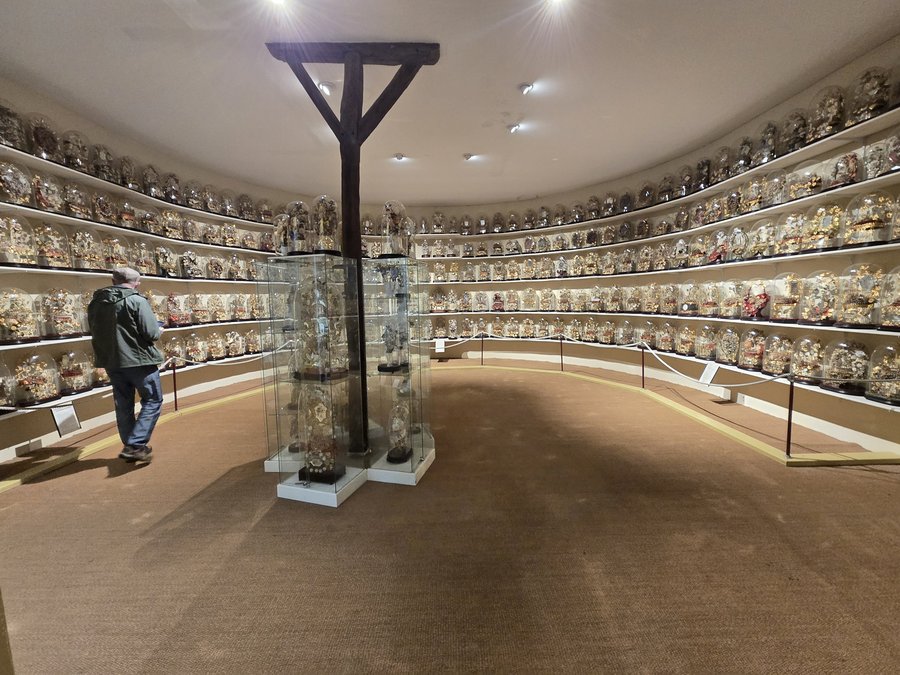
Elaborate, gaudy, momentary—and now behind glass, outlasting everyone who wore them.
I stand in the room and reflect on this, but the time to leave is approaching and I do not want to be late again, so I make my departure. I’m a punctual person, dammit, and I need to prove it.
Greater Castles
When the tour guide stops in front of Chambord so we can behold it, I have a singular and strong reaction: I can’t believe this ended in revolution!
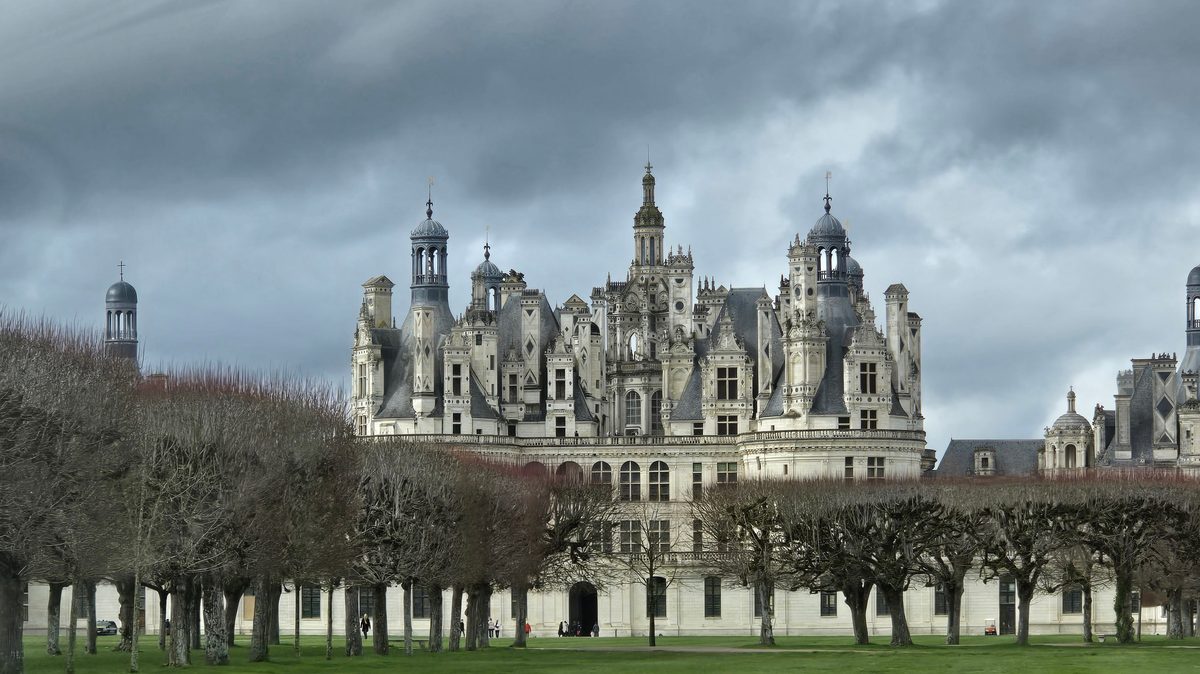
Château de Chambord. A hunting lodge. A hunting lodge!
The château is preposterous. It’s incomprehensible. It’s shockingly large and outrageously gaudy. It tests believability it’s so grandiose, but it’s also undeniable—it clearly exists, someone commissioned it and it was built. That anyone followed through with any step in that process challenges my American brain. Biltmore is a lovely large house, but we don’t have this. This one is intense. In a single view I see the guillotine coming. I see Marianne on the barricades and the whole revolution just on the horizon. This monstrosity of wealth and self-absorption demands them. This could only ever end in revolution.
Chambord by the numbers: 426 rooms. 282 chimneys. 365 fireplaces. A 32-kilometer enclosing wall surrounding 13,000 acres of hunting grounds. It was a direct forerunner to and inspiration for Versailles—and the only château in France that outdoes Chambord is Versailles itself.
The tour guide is slightly amused. I’m almost apoplectic. We would talk at length on the drive home, the tour guide and I, and she would confess that she studied history but fell out of love with it while in school. Only spending a year in the United States rekindled her love of history. In the US, our history is precious to us. It’s not that that’s untrue elsewhere, it’s just that we have so little of it and we cling to it so lustily. Something about that made her want to come home and be a tour guide in her native land, the Val de Loire. In this moment, I see the jaded side. She sees this castle once a week; it’s been here her entire life. Chambord and I are just meeting, though, and all those differences between the relationships of culture and history are evident in this moment. It challenges my comprehension of the world, and it bores her slightly.
No part of the feeling wears off for me. If anything, it only grows stronger the deeper into the château I dig.
Other than the size and scale, the most notable feature is a double spiral staircase within. Just that one feature, a staircase, is deeply rich in history. King Francis I commissioned this outrageous castle in the early 1500s and high among his requests for it was a solution to an important challenge: keeping the peace between his wife and his mistress.
I stand in the main entrance and observe the solution: a magnificent double spiral staircase so complex in its design and engineering one might think it was the work of a truly timeless master. Complex though it is, it provides a simple solution to the key problem. This moment in France, the 1500s, is one of the most extreme moments of conspicuous consumption. Status was conveyed in clothing and jewels and servants and ridiculous castles, and equally in making remarkable grand entrances at gaudy galas. A double spiral staircase with this open design allows both wife and mistress to descend the stairs simultaneously, not one before the other, not one above the other. Both wife and mistress can make their grand entrance at the exact same time, thus stopping any castle-stealing and banishing-to-Nod that might occur between the two.
That this was such an extreme problem is ludicrous. Was there not a country to govern, not a war to be fought, that the king devoted so much time and energy to balancing the power between his lovers? I skip the question of whether it’s worth it—having and balancing wife and mistress—and assume the arrangement is as much for the show of it as for the sex of it.
And that they went to such great lengths to solve this problem is also part of the tale. The feeling that this double helix staircase is the work of a true master is confirmed: Leonardo Da Vinci was here. One of his last works was this elaborate mechanism of balancing wife/mistress power. It’s an interesting story; by this period Da Vinci is old and, despite his lasting contributions to society, he was not only unwealthy but hotly pursued by creditors in his Northern Italian home. When he received a letter from the French King’s bursar promising him a château of his own for the rest of his life if he would come to France and solve this unsolvable problem of wife/mistress party entrances—I picture Da Vinci receiving the letter, grabbing his things, and being on the road to France in under thirty minutes.
It turns out my image is not far off accurate. Da Vinci did indeed make a hasty departure and with him he brought only three of his works—physically small works that were not hard to carry on this border-crossing move. One of those works is the Mona Lisa, and it’s in Da Vinci’s château in Amboise when the artist passes. This is why and how the Mona Lisa is in France at the Louvre today.
I stand in the foyer in my collector’s edition sneakers and J. Crew catalogue outfit and judge those shallow, showy French noblemen for placing so much value on the wrong things.
Hollow Rooms
Chambord only grows more ridiculous the deeper into its depths I go. Rooms have themes. Red with portraits of great men. Green with scenes from the hunt. Both are appropriate—this is a hunting lodge for a man who perceived himself as great. Yes, a hunting lodge. This whole ridiculous monstrosity that invites revolution was the king’s hunting lodge, and King Francis I would spend fewer days at Chambord in his entire lifetime than I spend in Europe this year. That it exists is the first injury; that he hardly used it is damning.
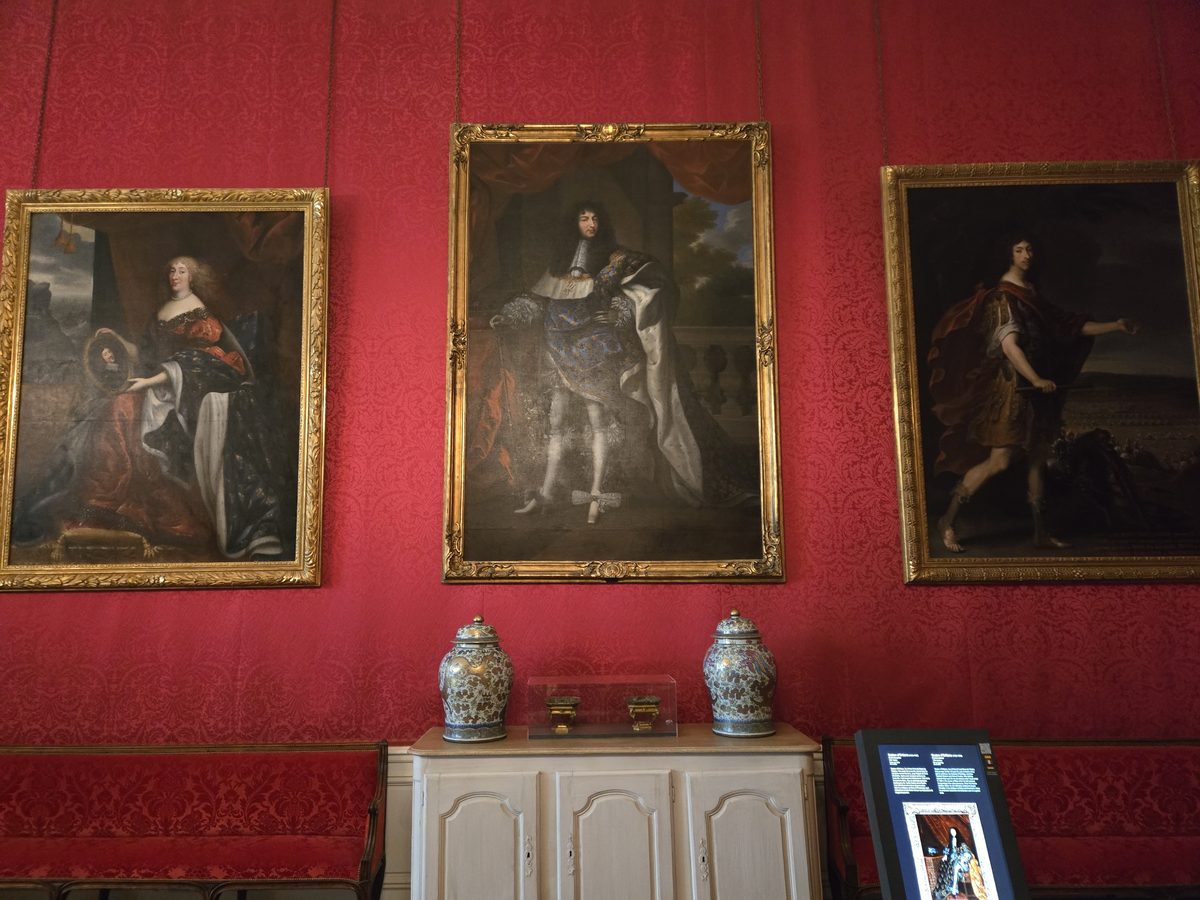
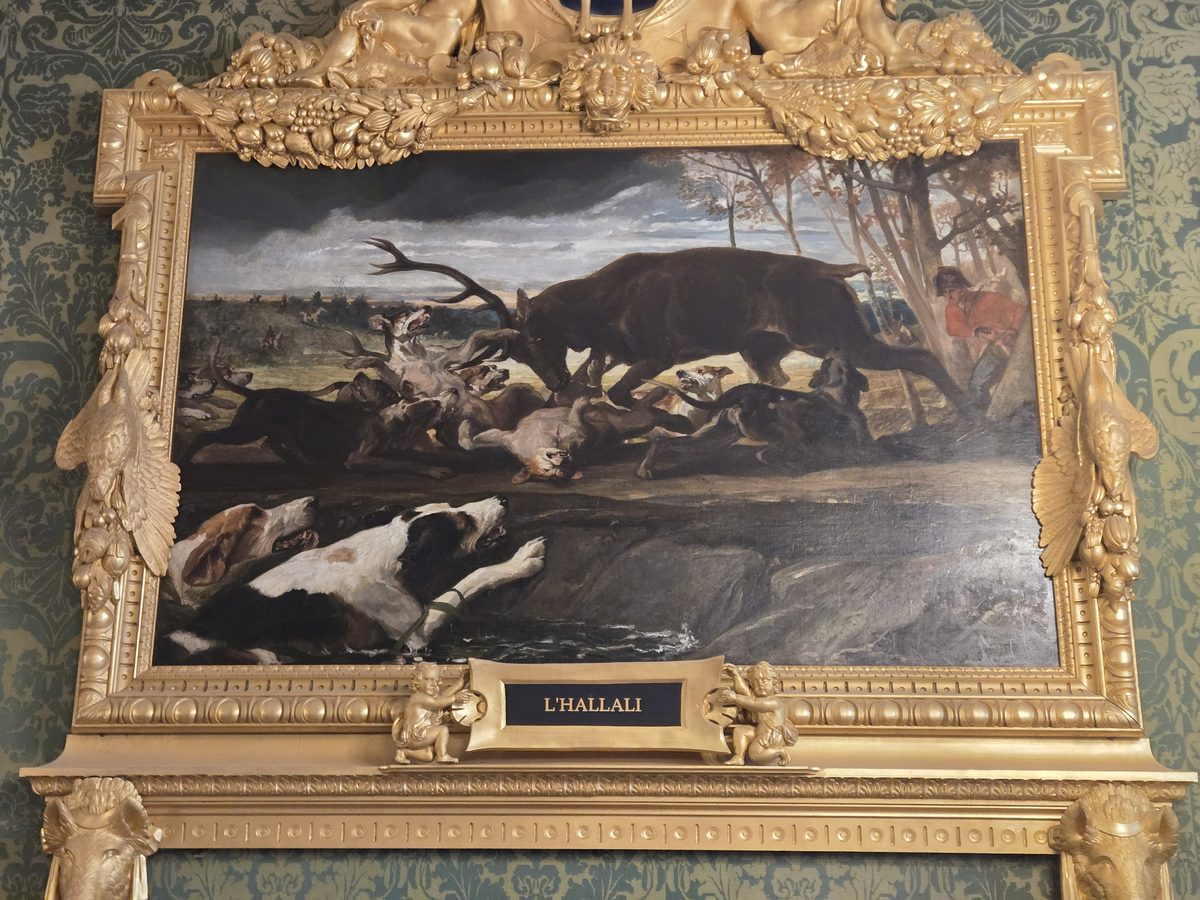
Left: Great men on red walls. Or pictures of women holding pictures of great men. Right: The hunt, immortalized in paint.
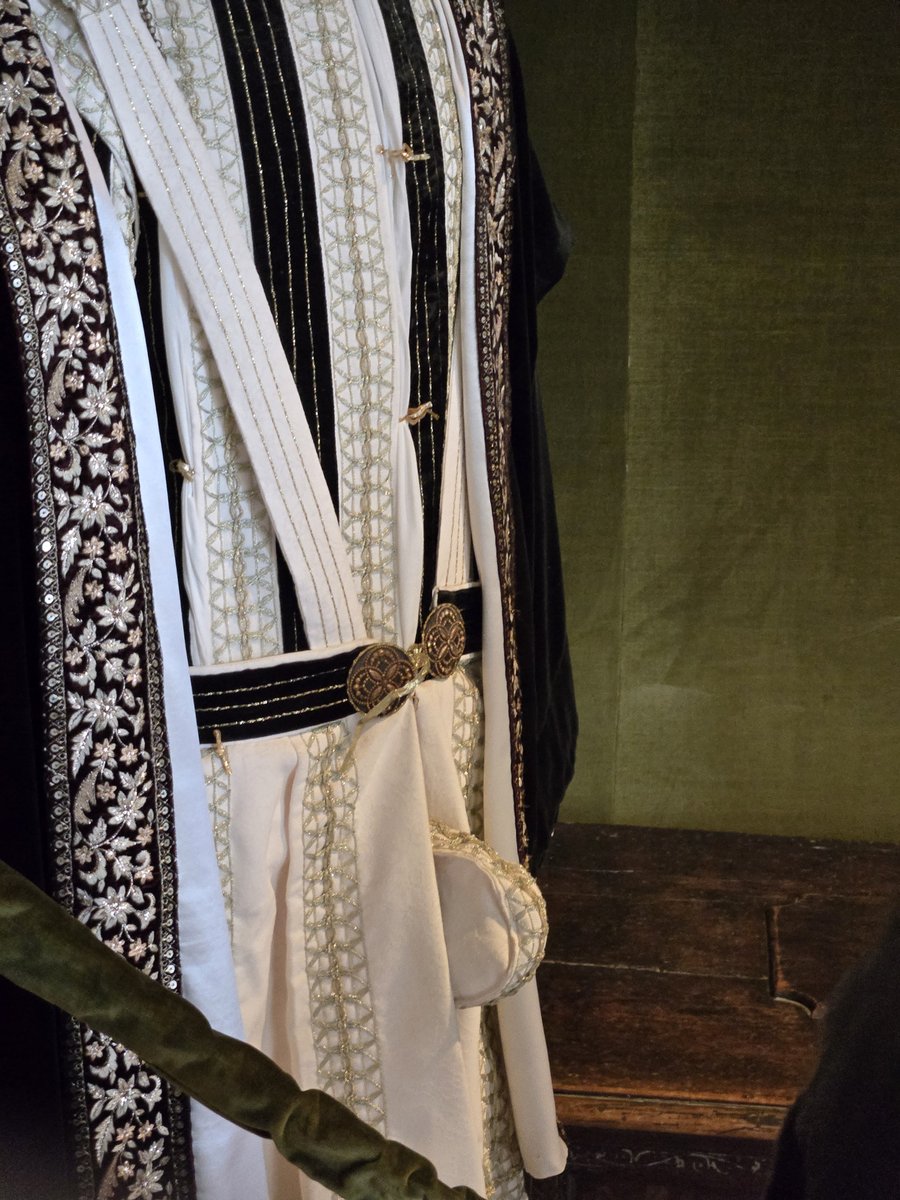
A courtier’s wardrobe, complete with codpiece. The size of one’s codpiece reflected one’s rank at court. The king’s would have been even bigger.
Atop the castle, the chimneys reach heavenward and the only thing that outstretches even them is the King’s private chapel. Not even his servants were allowed to go and clean the space, and even today the visitor is not allowed. It invites curiosity in much the way Chambord itself invites revolution. What would he do up there in his private ziggurat? I imagine him kneeling and praying for a minute, asking for blessings for the hunt, more money and castles, and peace between wife and mistress. Then surely he just rolled over and took a nap, right?
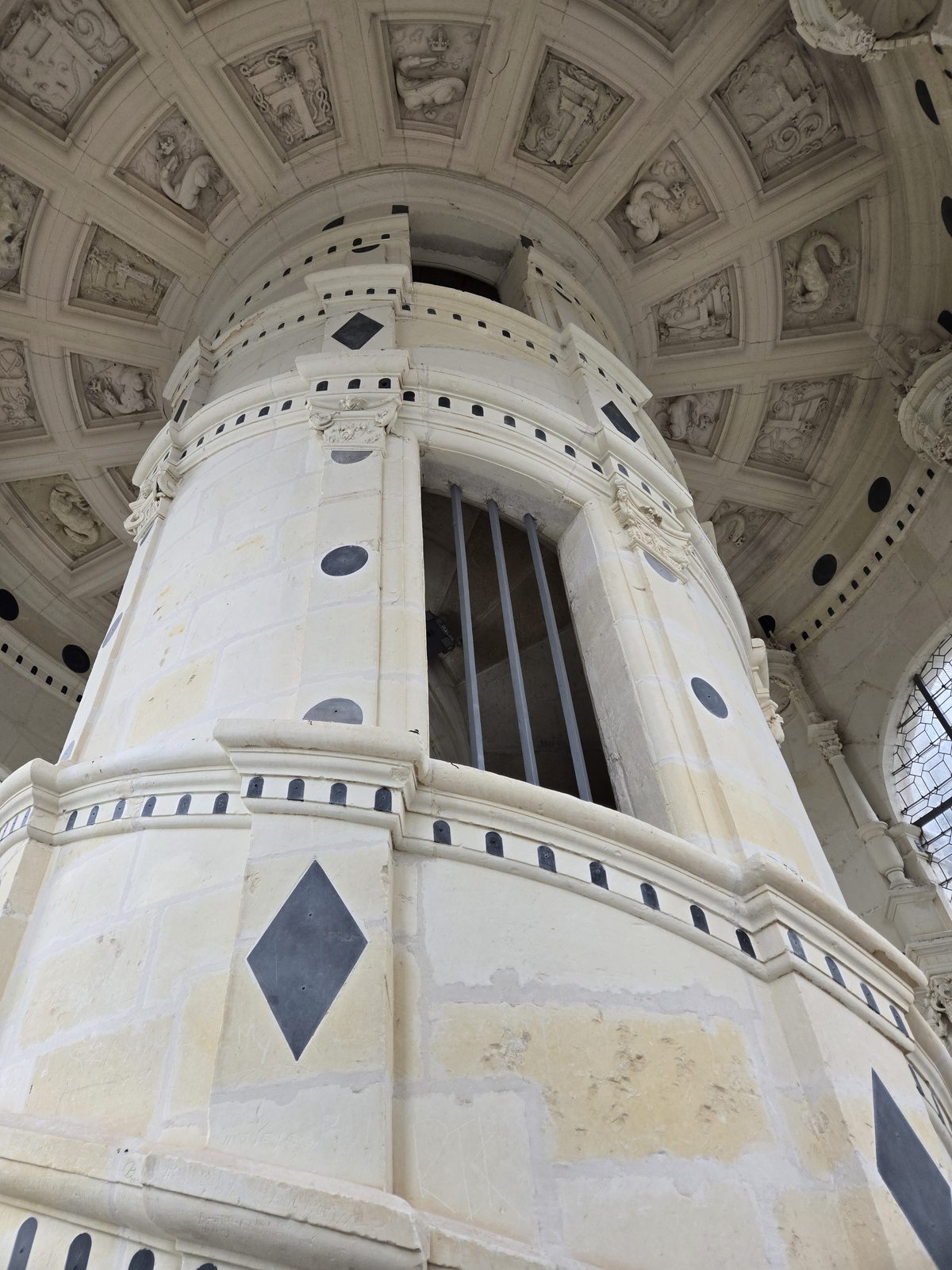
The ceiling. Even looking up, one can’t escape the showing-off.
It’s this image that I reflect on later after I’ve bought half the gift store and another needless espresso and sit with my shopping bags, indulging my own thoughts and ideas. Surely, I think, someone so obsessed with material things couldn’t have any actual, meaningful spiritual inclinations. The wind gusts and I adjust my hair to make sure it’s just so, sip my espresso, and snag a biscuit from one of my shopping bags.
Every aspect of Chambord is designed to impress, but most of it is actually empty. The rooms that are themed and decorated are for us, the modern tourists. Part of it is used for government offices; the French military has a major administrative department here. These former royal châteaux are the property of the French government now, and they do actually use them for government purposes, in addition to tourism. That might right the balance a little bit, but in its actual time Chambord was a hollow, empty symbol. When the king would come here, infrequently, they would pack up the art and furniture from the palace at the Louvre and bring it all with them; the châteaux weren’t furnished in absentia. The tour guide explains that an advance party would chase away the squatters and clean the place up.
This makes sense to me. In a way, it’s the only thing that makes sense to me here.
As the king’s hunting ground, naturally there’s a wall—the great enclosing wall of Chambord. It’s 20 miles in perimeter and contains 13,000 acres of what was supposed to be the king’s protected hunting ground. Keep the game in, keep the peasantry out—walls never do the job. That an advance party was needed clearly signals that they understood the wall was for show. I mean, it’s all for show, but somehow that great enclosing wall is the capstone. The king wants a hunting lodge; okay, I get that. That they would build this huge wall and enclose this huge space, knowing that it would neither keep peasants out nor game in—it pushes it over the top for me.
It’s a scar on this land. Tearing down Chambord would be as fruitless as building it in the first place, but, as we drive away, I feel strongly that it’s a blight, that it’s an insult to nature and to man. I genuinely can’t believe that they didn’t build it, step back and look at it, and say, “hmmm. Are we inviting a revolution with this?”
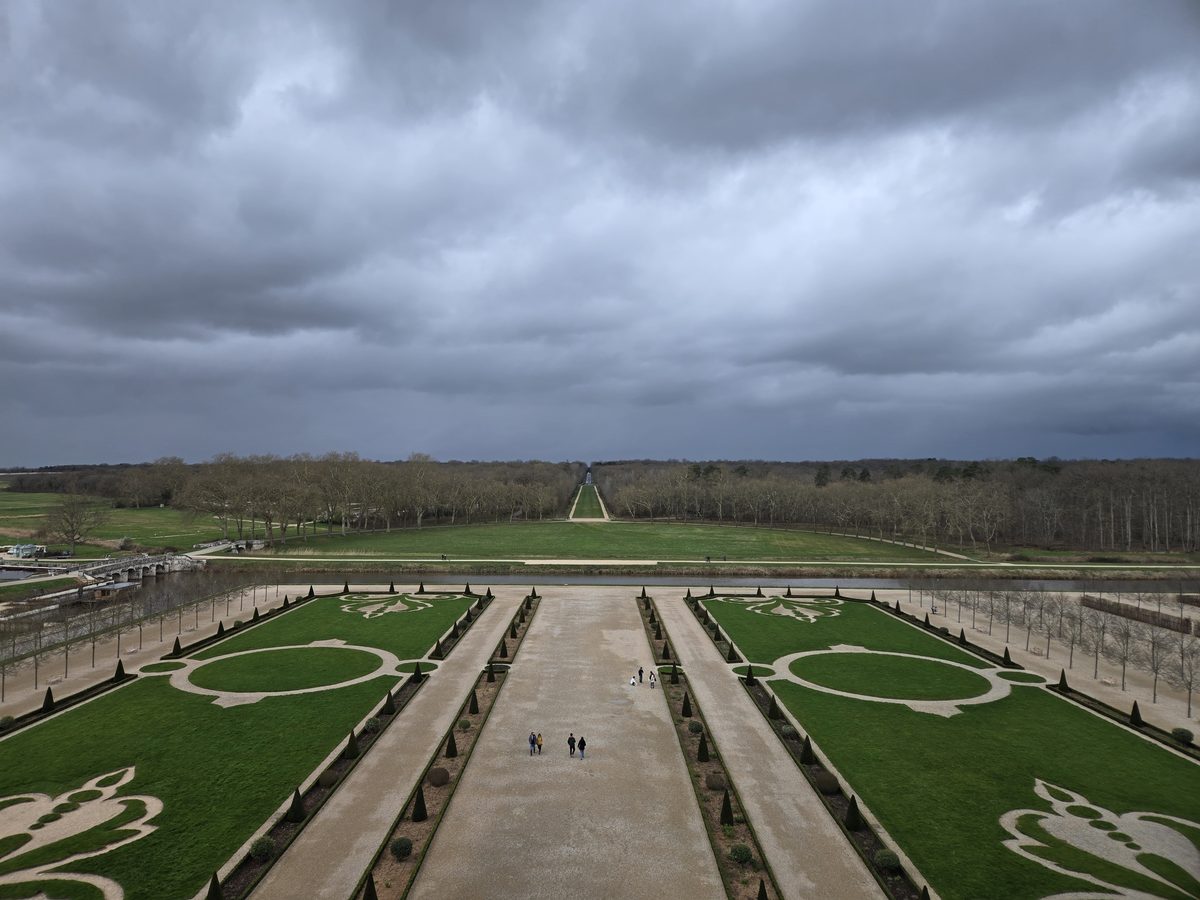
The view from the top. Squint and you can see the enclosing wall.
Everyone is tired. Everyone else, that is. For me, this has been a great day. It has been extremely busy and we will have burned eleven hours instead of ten when I finally say goodbye to the tour guide, but that fuels me; I would keep going if I could. Here in the van, driving through the gate of the enclosing wall, Chambord still looming in the rearview mirror, the other patrons have gravitated to the back of the van and I’ve been thrust into the passenger seat. In the far back, Andrew is asleep in impressively little time. I don’t think he ever came all the way back from lunch wine. The remaining four of us chat lightly but no one wants to keep talking about how they can’t believe this ended in revolution.
I learn more about Paul and Anna. It turns out they’ve just started dating. They went to a silent auction on their first date, put in the low bid on a getaway trip to Paris and Amboise, and won the auction. So their second date was a trip to Amboise and Paris. It is a thoroughly charming tale and I try to imagine if I could ever do such a thing. That is a major step into the unknown for a second date. I tell myself I could. If life followed a different path, if I was at their life stage and I was the second-most liberal person in Alabama and met a nice single lady who happened to be the number one most liberal person in Alabama—sure, I would take that plunge. I tell myself this but my heart is of a more analytical bent than a romantic one. I kid myself for today, though.
We say goodbye to Paul and Anna well before the time in the van is done. Andrew snoozes in the back, other châteaux pass by as the rain runs down the windows. I sit up front and talk with the tour guide. It’s a good conversation, she opens up a lot. She’s got into musicals lately. Ah, I have a “musical appreciator” hat that I slip on. She knows the big ones: Phantom, Wicked, Cats, all the Disney musicals. She hates Les Mis. This is hilarious to me but who says that she has to like a French story just because she’s French? For a moment I try to convince her that it is, in fact, the best musical, but I let it drop before long. She wants some older musicals to try but that way lies Rogers & Hammerstein. I urge caution. Jesus Christ Superstar, I suggest, and explain how to track down the John Legend version. I’m pleased with my recommendation. It’s a genuinely good recommendation and it gels with my self-view as a guy who knows things, a tour guide of his own.
Evening has settled in Tours by the time we finally return. I sense that an actual slice of friendship has formed between the tour guide and me on this long return journey. Andrew has awoken at some point and seems to have noticed, too; when we’re back he makes a very quick exit. So quick is his exit that mine is plodding in comparison. I had taken my coat off, I have all this work gear… No one else had brought more than a coat or purse but I’m the sherpa now. I’m still re-assembling myself when the tour guide is ready to head home. “Are you good,” she asks. I give her the American thumbs up. It’s a thoroughly odd way for our single-serve friendship to come to an end. And that’s my fault. I’ve carried so much baggage that it’s broken the flow of the moment.
Nevertheless, the day has been a good one, and I leave in the fading light and slowing rain feeling foolish for having ever packed work for a day of tourism. My work bag spent the whole day either waiting on the van or being in the way. The pack feels heavier now than ever, but it will be as light as the rain again by Monday morning. For now it’s good that it’s heavy, I should be more mindful of its weight.
The van zips by while I wait at the crosswalk and there’s a final smile and wave shared before I head down the cobblestones to l’appartement. It really has been a good day. And I am certainly happy I chose this particular tour company.